Leading expert advice from Wingu Academy
Wingu Academy

Online Schooling in 2026: How Wingu Academy Is Shaping the Future of Education

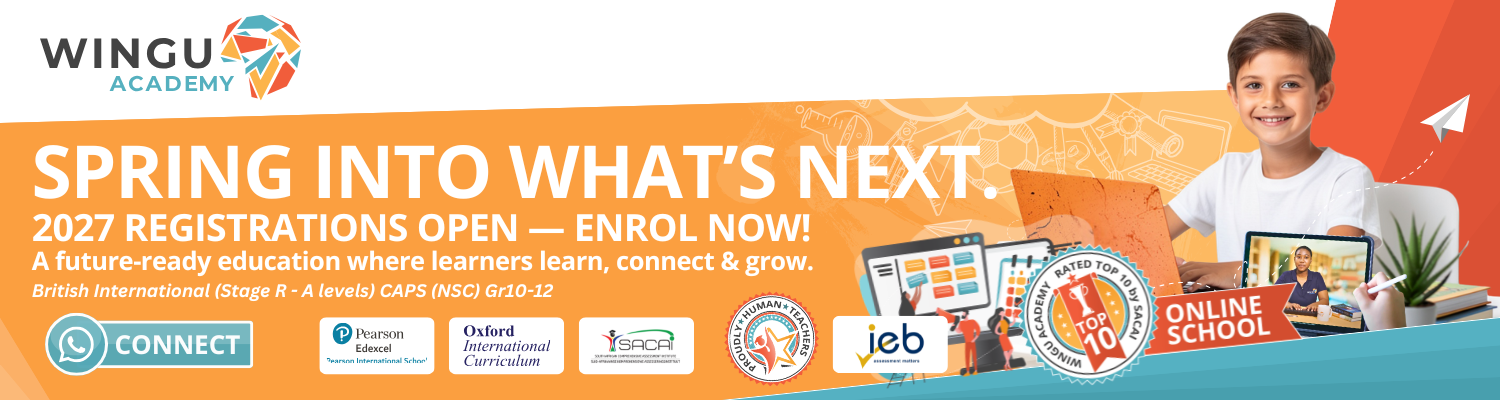
By 2026, online schooling is no longer viewed as a temporary solution or a response to crisis. It has matured into a mainstream, highly effective educational pathway — and at Wingu Academy Online School, this future is already a reality. What was once considered “alternative” has become a preferred choice for families seeking academic credibility, personalised learning, and a secure, future-focused environment. Wingu Academy stands at the forefront of this evolution, redefining what quality education looks like in a digital-first world. From Emergency Option to Established Choice Online education has undergone a fundamental shift. In 2026, families are no longer turning to online schools out of necessity alone, but out of confidence. At Wingu Academy, online learning is: For many South African families facing overcrowded classrooms, placement challenges, and rising school fees, Wingu Academy offers a stable, trusted alternative that delivers consistency without compromise. Technology That Enhances Learning — Not Replaces Teachers Innovation at Wingu Academy is purposeful. Rather than using technology for novelty, it is integrated to support real teaching and real learning. By 2026, online schools like Wingu Academy are embracing: Crucially, these tools enhance the work of qualified human teachers, not replace them. Live, teacher-led classes remain at the heart of the Wingu experience. Preparing Learners for a 21st-Century World Traditional schooling models often struggle to adapt to the skills demanded by today’s world. Online schools, when designed correctly, are uniquely positioned to bridge this gap. At Wingu Academy, learning goes beyond content delivery. Wingulians develop: These competencies are woven into daily learning, preparing learners not only for exams, but for life beyond school. Data-Driven, Learner-Centred Education Modern online education relies on intelligent use of data to support learners effectively. At Wingu Academy, integrated systems allow educators to track progress, identify support needs early, and adapt teaching accordingly. This unified approach: Data is used not to label learners, but to support them more precisely and personally. Accessibility, Inclusion and Flexibility One of the defining strengths of online schooling in 2026 is increased accessibility. Wingu Academy’s mobile-friendly platform, flexible structures, and recorded lesson access allow families from diverse backgrounds to participate meaningfully in quality education. Learning at Wingu Academy offers: This model creates space for learners to thrive academically and emotionally. A Strong Regulatory and Accreditation Framework As online education has grown, so too has regulation. In South Africa, frameworks such as the Virtual Schools Framework provide essential oversight, ensuring quality, credibility, and accountability. Wingu Academy operates within these structures, offering: Families can trust that learning at Wingu Academy leads to real outcomes, including recognised qualifications and future study opportunities. Meeting South Africa’s Education Challenges Head-On School placement shortages, rising fees, and limited access to quality education continue to affect families across South Africa. In response, online schools like Wingu Academy have stepped in with immediate, scalable solutions. Wingu Academy provides: This responsiveness has positioned Wingu Academy as a reliable educational partner, not just a school. Holistic Education for Modern Learners Education in 2026 is about more than academics. At Wingu Academy, holistic development is central to the learner experience. Through structured support, wellness initiatives, and strong teacher-learner relationships, Wingulians are nurtured as confident, capable individuals in a connected world. The Future Is Already Here Online schooling in 2026 represents a solidified, sophisticated, and essential part of the global education landscape. At Wingu Academy Online School, this future is not theoretical — it is lived every day. Innovative. Internationally recognised. Human-led. Future-focused. This is the Wingu Way.

Wingu Academy

Rethinking Education: A Smarter AlternativetoOvercrowdedClassrooms and Exorbitant School Fees

For many families, choosing the right school has become increasingly complex. Rising school fees, overcrowded classrooms, and inconsistent academic support leave parents questioning whether traditional schooling still offers the best return on investment for their child’s future. At the same time, families are seeking high-quality education that delivers strong results, individual attention, and long-term value — without unnecessary financial strain. This is where a carefully structured online school, such as Wingu Academy, offers a compelling alternative. The Challenge with Traditional Schooling Across many conventional schools, class sizes continue to grow while resources remain stretched. Teachers are expected to support large numbers of learners simultaneously, often limiting the level of individual attention each child receives. Questions families may ask themselves include: When rising costs do not consistently translate into improved outcomes, families are justified in rethinking their options. The Wingu Way: Online Learning Done Properly Wingu Academy was created to address these challenges directly — offering a structured, accredited online education model that prioritises quality, accountability, and learner support. Unlike passive or self-paced platforms, Wingu Academy operates exclusively through live, teacher-led classes. Learners engage daily with qualified human teachers, ensuring real interaction, guidance, and academic oversight. This approach allows for: Academic Credibility That Delivers Results At Wingu Academy, learning is not diluted. Learners complete real tests and exams, aligned with recognised academic standards. Progress is measured, feedback is structured, and expectations are clear. This academic discipline ensures: Flexibility Without Compromising Quality While live classes remain the foundation of learning at Wingu Academy, lesson recordings are available for revision and convenience. This provides flexibility for families without replacing real-time teaching. Learners benefit from: Importantly, flexibility never comes at the cost of structure or accountability. A Smarter Financial Choice for Families One of the most significant advantages of Wingu Academy is value. Families gain access to: All without the excessive overheads often associated with traditional schooling. The result is a premium education model that delivers strong outcomes at a more accessible cost. More Than an Online School — A Connected Community A common misconception about online education is isolation. At Wingu Academy, learners are part of an active school community. Through daily live interaction and collaborative learning, students build belonging and connection. Education succeeds when learners feel supported — academically and emotionally. Looking Ahead to 2026 As families plan ahead, many are choosing to move away from overcrowded classrooms and escalating fees, and towards smarter, future-focused education models. Wingu Academy offers a proven alternative: a school where quality teaching, real results, and affordability come together — without compromise. Considering a Change? If you are rethinking your child’s education for 2026 and beyond, Wingu Academy invites you to explore their learning models designed for today’s families and tomorrow’s success.

Wingu Academy

Teaching Online the Right Way: Why Wingu Academy Sets the International Standard for Online and Hybrid Education

The global shift towards online and hybrid education has reshaped how learning is delivered. What was once considered an alternative is now a preferred choice for families seeking flexibility, quality and academic credibility. However, effective online education requires far more than simply moving lessons onto a screen. It demands structure, trained teachers, thoughtful pedagogy and a school model designed specifically for live online learning. This is where Wingu Academy stands apart — as an internationally recognised online school that has refined live digital education into a proven, high-performing system. Beyond the Classroom: Teaching Online with Purpose At Wingu Academy, online learning is not an emergency solution or a temporary adjustment. It is a deliberate, expertly designed educational model supported by qualified teachers who are trained to teach live in a virtual environment. Drawing on international best practice, Wingu Academy ensures that learners experience: This approach supports both fully online learners and families choosing a hybrid schooling solution. Best Practice for Live Online Learning — The Wingu Way High-quality online education relies on intentional teaching strategies. At Wingu Academy, these principles are embedded into daily teaching practice. Prepared, Accessible Learning Materials Teachers ensure that lesson resources and links are shared in advance. This allows learners to arrive prepared, reduces disruptions and enables revision after lessons — a key advantage of digital learning. Small Group Engagement Live lessons incorporate breakout sessions where learners collaborate, discuss and problem-solve in smaller groups. Teachers actively move between groups, much like they would in a physical classroom, ensuring participation and support. Real-Time Feedback and Interaction Through polls, chat functions and guided questioning, teachers can assess understanding instantly and adapt instruction in real time. Learners are encouraged to participate actively, making lessons dynamic and responsive. Clear Structure and Instructions Complex tasks are carefully planned, explained both verbally and in writing, and often modelled through screen sharing. Teachers regularly check understanding before learners begin independent or group work. Established Online Classroom Norms Wingu Academy sets clear expectations for participation, questioning and communication. Whether learners are using chat, raising hands or speaking, structure ensures lessons remain focused and respectful. Building Community in a Digital Space A strong sense of belonging is essential for learner success. At Wingu Academy, community-building is not an afterthought — it is intentionally woven into the school day. Time is dedicated to connection, collaboration and relationship-building, ensuring that Wingulians feel supported, seen and part of a vibrant school community, even in an online setting. Flexibility with Accountability One of the defining strengths of Wingu Academy is its balanced approach to flexibility. While live attendance is prioritised, lessons are recorded to support: This ensures no learner is left behind — without compromising academic standards. Technology with Compassion and Realism Teaching online means entering learners’ home environments. Wingu Academy teachers are trained to approach this with empathy and professionalism, recognising the realities of family life while maintaining clear academic expectations. Teachers are also equipped to troubleshoot technical challenges efficiently and ensure learning continues smoothly. Designed for Online and Hybrid Schooling Wingu Academy’s model is ideally suited to families seeking: With a strong academic framework and internationally recognised standards, Wingu Academy offers learners continuity, credibility and confidence — wherever they are in the world. Leading with Optimism and Expertise Online education is most effective when teachers lead with confidence, adaptability and optimism. At Wingu Academy, educators model lifelong learning and collaboration, setting the tone for strong outcomes and resilient learners. Why Families Choose Wingu Academy Parents choose Wingu Academy because it offers: A Smarter Way Forward As education continues to evolve globally, Wingu Academy remains at the forefront — proving that online and hybrid schooling, when done properly, can deliver exceptional results without compromise. The Wingu Way is not just online learning. It is education reimagined.

Wingu Academy

A New Year of Innovation: Why 2026 Is the Moment to Choose a Trusted Online School

January is always a month of fresh starts, new routines, and decisions that shape a child’s academic year. Across South Africa, thousands of families—and many teachers—are considering online schooling as the safest, most future-focused option for 2026. But the latest media reports about fraudulent providers have made it clearer than ever that choosing the right online school matters. The New Year Brings New Responsibilities — and New Opportunities For parents and teachers who have not yet placed their children for 2026, Wingu Academy is encouraging families to reach out directly now. Early placement ensures: Starting early prevents the administrative challenges that affected many families last year across South Africa. Socialisation: What the Research Actually Shows As the year begins, many parents are re-evaluating what healthy social development looks like in a changing world. While misconceptions persist, global studies indicate that structured online socialisation often leads to better outcomes than traditional models. At Wingu, social wellbeing is intentionally engineered through: In 2026, Wingu will introduce true sociometry—a scientific, ethical method to map connections and detect any learner who may be at risk of social isolation. Very few South African schools, online or traditional, use sociometry in this way. Why January Is the Right Time to Move Online schooling is no longer a fallback; it’s a strategic choice. With rising concerns about safety, bullying (still above 60% in multiple national datasets), and rapid cultural and disciplinary shifts, many families and teachers are seeking stable, values-aligned alternatives. If you haven’t placed your child yet, contact Wingu Academy now to ensure a seamless start to the 2026 school year and secure a trusted, accredited academic pathway.

Wingu Academy

January Admissions 2026: How to Ensure Your Child Is Registered with a Legitimate Online School

The beginning of the academic year always brings a rush of administrative pressure, but the stakes in 2026 are higher than usual. After recent media coverage revealing online providers who failed to register learners for their official exams, parents and teachers are rightfully more cautious. Why Early Placement Matters More Than Ever Wingu Academy is reminding families—especially those who have not yet placed their children—to contact the school directly as soon as possible. January placement ensures: Understanding the Accreditation Landscape Umalusi’s emphasis on its “non-negotiables” has reshaped the 2026 environment. Wingu meets all nine, including: Wingu also exceeds requirements with: Parents and Teachers Are Encouraged to Reach Out Now If your child—or the child of a colleague or friend—doesn’t have a confirmed placement for 2026, January is the final moment to secure a dependable academic pathway. A quick call or message to Wingu Academy ensures the admissions team can walk you through the process smoothly and transparently. This year, more than any before, accuracy and governance matter. Don’t delay.

Wingu Academy

Starting the Year Strong: How Online Schools Are Redefining Academic Support in 2026

January sets the tone for the entire school year, and for many families, the priority is clear: choosing a school that offers meaningful academic support from Day 1. Data-Driven, Student-Centred Support The newest innovation in online education is the use of data analytics and early-warning academic systems. Wingu Academy has adopted the most globally recognised approach: Wingu’s internal quality cycles begin from January, not mid-year—ensuring learners accelerate quickly and confidently. A New Year, A New Standard in Social-Academic Balance Contrary to outdated assumptions, online schooling enhances the balance between wellbeing and achievement. Wingu uses structured social-academic models such as: In 2026, Wingu becomes one of the few schools nationally to integrate real sociometry—ensuring every student enters the year with support networks clearly mapped and actively nurtured. A Call to Parents and Teachers Still Finalising 2026 Plans If your child is not yet placed, January is the optimal moment. Wingu’s admissions team will walk you through: Start strong. Start early. Start with a school that delivers governance, transparency, and world-class student care.

Advice from the experts
Miki Maths Magic

Why do young children battle with Maths?

The Development of Maths Anxiety – Common Challenges that Children Face Studies show that at around age 8 children start losing their spontaneity and become more anxious about Maths. Why is this? Maths is Unforgiving! Maths measures us like no other subject and affects our self-esteem like no other subject.The perception is that if you are good at Maths, you are clever. A Maths answer is either perfect or not. An answer of 7 x 7 = 50 is very close but very wrong. None of us like being put on the spot and being wrong. Speed kills Many children equate speed to intelligence. Pressure to give answers quickly often builds anxiety in children that need a bit more time. Speed tests for basic facts are often counter-productive and serve to make the faster child quicker and the slower child even slower and more anxious. Children who work slowly end up doing fewer sums and get caught up in a downward spiral. Developing understanding takes time. When we emphasize speed only, we send the incorrect message that all problems should be solved quickly, which hurts children’s persistence on more complicated tasks. Emphasis on Rote learning and memory An over emphasis on rote learning impacts children that have a limited working memory and long-term memory. Many of our ideas around teaching Maths revolve around memorising Maths information. All of us differ in our ability to do that especially when what we must memorise has no meaning. Negative messages about Maths by Parents and Teachers Many of us send out messages of a fixed mindset. “I am just not good at Maths and will never be good at it. This is just the way I am!” One often hears parents say: “I was never good at Maths, so it’s not surprising my child isn’t good either.” A growth mindset says that we can all become better through practice. Ineffective Strategies Many children have an over-reliance on counting. This leads to problems in developing fluency for the four operations. Poor number sense and an inability to estimate leads to difficulty in understanding place value. This in turn has a negative effect on children’s ability to develop effective strategies to do calculations fluently. It is a common misconception that Maths is all about “rules” and procedures. Algorithms play a big role in Maths but a lot of it needs to be understood. Maths is about making sense of problems and understanding why particular strategies work. Maths becomes tricky if we don’t Understand what the Symbols mean Somewhere a young child is confronted with the fact that the number 7 on a clock can represent 7, sometimes 25 and at other times 35. When working with money, two 50 cent coins equal a R1 coin. When measuring length, we expect children to know that 100cm =1m. All of this is very confusing for a young child if they don’t have conceptual understanding of what the symbols represent. What can I as a parent do? Here are a few simple ideas for you to think about. Your Child first, Maths second Know that your child is a little human being not a little human calculator. We are human beings not human doings. Our ability to do Maths does not define who we are. Our ability to do Maths does not define our worth. Our ability to do Maths does not determine whether we will be financially successful one day. It is also true that Maths plays a big role in the school curriculum. Battling with Maths is not nice. Full Stop. Maths is a pathway to many careers. It feels nice to be able to solve a Maths problem. We firmly believe that all children can develop a good foundation in Maths. Be Authentic Know that you and your child are unique and that you both have your own unique gifts. Take a firm resolution to never compare your child with other children. All children develop differently and at their own pace. There is no rush. Regular opportunties for learning in an enabling environment gives your child the best chance. You as a Mom are unique with your own talents and parenting style. Take a firm resolution to never compare yourself with other Moms. You don’t have to be a great Mathematician in order to be a great Maths Mom. There is no Ceiling Know that your beliefs determine everything.Isn’t it amazing and scary that the beliefs that we infuse in our kids will be the beliefs that they will most probably carry with them for the rest of their lives. Children become what those around them believe them to be.The biggest gift that you can give your child is to help them develop a good feeling about themselves. Your child knows more than what you think. You know more than what you think. Your child is capable of much more than what you might believe. You are capable of much more than what you might believe. At the end of the day how you interact with your child is foundational. Read through these tips a few times and reflect on your belief systems around Maths. In our next article we will look at specific topics in the curriculum and give you some pointers of how to help your child. If you are interested in chatting further you are welcome to contact us at www.mikimaths.com

Educ8 SA

How Online Schools Like Educ8 SA Are Changing Education in South Africa

In recent years, the landscape of education in South Africa has experienced a significant transformation. Traditional classrooms, while effective, often come with limitations such as rigid schedules, high costs, and geographical constraints. This is where online schools like Educ8 SA are stepping in to revolutionise the way students learn, providing flexible, affordable, and high-quality education to learners of all ages. Breaking Down Barriers to Education One of the greatest advantages of online schools is their ability to remove the barriers that often hinder students from reaching their full potential. For families living in remote areas, accessing top-quality education can be challenging. Educ8 SA eliminates these geographic barriers, enabling students to attend classes, complete assignments, and engage with educators from the comfort of their homes. Moreover, online learning allows students to progress at their own pace. Whether your child excels in mathematics but struggles with reading, or you are an adult learner balancing work with education, Educ8 SA provides a personalised learning experience designed to suit your unique needs. Who Can Benefit from Online Learning at Educ8 SA? Educ8 SA serves a wide range of learners, making it a truly inclusive platform: Affordable Learning Paths for Every Budget A common concern among parents and adult learners is the cost of education. At Educ8 SA, we believe that high-quality education should not be a luxury. Our pricing structure offers something for everyone: These options ensure learners can pursue their educational goals without financial strain, opening doors to academic success and career opportunities. Flexibility and Personalised Learning Unlike traditional schools, Educ8 SA empowers learners to create schedules that suit their lifestyles. This flexibility is especially beneficial for adult learners juggling work, family, or other commitments. The online platform offers a mix of interactive lessons, live sessions, and self-paced modules, allowing students to take control of their education. For younger learners, this means learning at a pace that matches their abilities and interests. For older students and adults, it provides the freedom to study during evenings or weekends without compromising other responsibilities. Preparing Students for a Global Future Education is no longer confined to local standards. Students today need skills that will prepare them for a competitive, globalised world. Educ8 SA’s programs, such as the American High School Diploma and GED, provide internationally recognised certifications that give students the flexibility to pursue higher education or careers anywhere in the world. Moreover, by embracing digital literacy and technology-driven learning, students develop critical skills such as self-discipline, problem-solving, and time management—skills that are increasingly vital in the modern workforce. Supporting Every Student’s Journey At Educ8 SA, the student’s success is our priority. Our educators are highly trained and experienced in online teaching, ensuring that students receive the guidance and support they need to excel. Whether it’s assistance with assignments, exam preparation, or understanding complex topics, our team is dedicated to helping each learner reach their full potential. Additionally, the platform fosters a sense of community among learners. Despite being online, students can collaborate, share ideas, and participate in interactive discussions, creating a supportive environment that mirrors traditional classroom interactions. Why Choose Educ8 SA? Choosing the right educational platform is crucial for your child’s future or your own academic goals. Educ8 SA stands out because it combines: Education is the foundation for a brighter future. With Educ8 SA, learning becomes accessible, flexible, and tailored to your life—whether you are a young learner taking your first steps, an adult returning to complete your studies, or an international student seeking global opportunities. Start your journey today, and experience the difference online learning can make. Getting Started is Easy Starting your journey with Educ8 SA is simple. You can explore our programs and choose the path that suits your needs. For inquiries, enrolment, or personalised advice, reach out to us today:

Educ8 SA

Online Learning for Students With Special Needs

Every learner deserves access to quality education. Educ8 SA has designed online programs that accommodate students with special needs, providing an inclusive, flexible, and accessible learning environment. What Makes Educ8 SA Inclusive? The platform is computer-based and self-paced, allowing students to learn in ways that suit their individual abilities. Whether a learner requires extra time, simplified content, or interactive support tools, Educ8 SA ensures education is accessible and tailored to their needs. Key Features for Special Needs Students These features allow learners to focus on mastering concepts at their own pace, building confidence and independence. Programs Suitable for All Ages Benefits Beyond Academics Special needs students also gain valuable skills such as problem-solving, digital literacy, and independent learning. These abilities not only help academically but also empower learners for future career opportunities. Getting Started To provide your child with an accessible, inclusive online education: Educ8 SA ensures every learner has the opportunity to succeed, regardless of learning challenges. Contact Us Today!

Teneo Online School

Future-proofing your child in 2026: the skills South African schools can’t afford to ignore

The world your child will graduate into is changing faster than any generation before them. Artificial intelligence is reshaping how we work, information is everywhere (and not always reliable), and employers are increasingly hiring for skills that can’t be automated, like critical thinking, adaptability and communication. The question for parents isn’t just “Which school has the best reputation?” It’s: Will my child be ready for what comes next? South Africa is already moving in this direction. The Department of Basic Education has signalled digital transformation as a national priority through its Digital Education Strategy roadmap, recognising that technology-enabled learning is no longer optional in the long run. At the same time, global research continues to point to the same capability set. The World Economic Forum’s Future of Jobs research consistently ranks analytical thinking and resilience, flexibility and agility among the most essential skills employers want. So what does “future-proof education” actually look like for a South African family in 2026? 1) Digital fluency without losing foundational mastery Future-ready children need to be confident with digital tools, but not at the expense of reading, writing and numeracy. The smartest learning environments strengthen foundational skills while building modern fluency: researching responsibly, writing clearly, presenting ideas, and using technology to solve problems. 2) Faster feedback so gaps don’t become permanent In many traditional settings, a child can fall behind quietly for weeks before it shows up in a test result. Future-proof learning is feedback-rich: regular check-ins, visible progress tracking, and earlier intervention when engagement drops, or concepts aren’t sticking. That’s how confidence is protected, and how marks improve over time. 3) Adaptability as a daily habit The future belongs to learners who can adjust quickly: switch approaches, try again, collaborate, and stay calm under pressure. Schools that build routines around goal-setting, reflection and consistent effort help children develop the self-management skills they’ll need at university and in the workplace. 4) Credibility and quality assurance still matter Modern delivery doesn’t mean lower standards. In South Africa, NSC outcomes remain quality assured under Umalusi processes, and distance education has rapidly expanded, with SACAI noting the overwhelming majority of its candidates are now registered via distance education providers or online schools. The real differentiator is quality: qualified educators, strong systems, and reliable academic support. A practical parent checklist When evaluating any school, traditional or online, ask: Taryn Jankes, CMO of Teneo Online School, said: “Future-proofing isn’t about chasing the latest trend in education; it’s about making sure your child can think clearly, learn independently, and recover quickly when something is hard. In South Africa, parents also need schooling that’s credible and structured, but flexible enough to meet children where they are. If we can build strong habits, strong foundations, and real confidence, the results follow, and the child is ready for whatever the world throws at them.” At Teneo Online School, we believe future-proofing is about outcomes and capability: helping children build the skills to thrive in a world that won’t stand still, while still delivering credible academic results.

Wingu Academy

Teaching Online the Right Way: Why Wingu Academy Sets the International Standard for Online and Hybrid Education

The global shift towards online and hybrid education has reshaped how learning is delivered. What was once considered an alternative is now a preferred choice for families seeking flexibility, quality and academic credibility. However, effective online education requires far more than simply moving lessons onto a screen. It demands structure, trained teachers, thoughtful pedagogy and a school model designed specifically for live online learning. This is where Wingu Academy stands apart — as an internationally recognised online school that has refined live digital education into a proven, high-performing system. Beyond the Classroom: Teaching Online with Purpose At Wingu Academy, online learning is not an emergency solution or a temporary adjustment. It is a deliberate, expertly designed educational model supported by qualified teachers who are trained to teach live in a virtual environment. Drawing on international best practice, Wingu Academy ensures that learners experience: This approach supports both fully online learners and families choosing a hybrid schooling solution. Best Practice for Live Online Learning — The Wingu Way High-quality online education relies on intentional teaching strategies. At Wingu Academy, these principles are embedded into daily teaching practice. Prepared, Accessible Learning Materials Teachers ensure that lesson resources and links are shared in advance. This allows learners to arrive prepared, reduces disruptions and enables revision after lessons — a key advantage of digital learning. Small Group Engagement Live lessons incorporate breakout sessions where learners collaborate, discuss and problem-solve in smaller groups. Teachers actively move between groups, much like they would in a physical classroom, ensuring participation and support. Real-Time Feedback and Interaction Through polls, chat functions and guided questioning, teachers can assess understanding instantly and adapt instruction in real time. Learners are encouraged to participate actively, making lessons dynamic and responsive. Clear Structure and Instructions Complex tasks are carefully planned, explained both verbally and in writing, and often modelled through screen sharing. Teachers regularly check understanding before learners begin independent or group work. Established Online Classroom Norms Wingu Academy sets clear expectations for participation, questioning and communication. Whether learners are using chat, raising hands or speaking, structure ensures lessons remain focused and respectful. Building Community in a Digital Space A strong sense of belonging is essential for learner success. At Wingu Academy, community-building is not an afterthought — it is intentionally woven into the school day. Time is dedicated to connection, collaboration and relationship-building, ensuring that Wingulians feel supported, seen and part of a vibrant school community, even in an online setting. Flexibility with Accountability One of the defining strengths of Wingu Academy is its balanced approach to flexibility. While live attendance is prioritised, lessons are recorded to support: This ensures no learner is left behind — without compromising academic standards. Technology with Compassion and Realism Teaching online means entering learners’ home environments. Wingu Academy teachers are trained to approach this with empathy and professionalism, recognising the realities of family life while maintaining clear academic expectations. Teachers are also equipped to troubleshoot technical challenges efficiently and ensure learning continues smoothly. Designed for Online and Hybrid Schooling Wingu Academy’s model is ideally suited to families seeking: With a strong academic framework and internationally recognised standards, Wingu Academy offers learners continuity, credibility and confidence — wherever they are in the world. Leading with Optimism and Expertise Online education is most effective when teachers lead with confidence, adaptability and optimism. At Wingu Academy, educators model lifelong learning and collaboration, setting the tone for strong outcomes and resilient learners. Why Families Choose Wingu Academy Parents choose Wingu Academy because it offers: A Smarter Way Forward As education continues to evolve globally, Wingu Academy remains at the forefront — proving that online and hybrid schooling, when done properly, can deliver exceptional results without compromise. The Wingu Way is not just online learning. It is education reimagined.

Koa Academy

Beyond the Buzzwords:  How We’re Actually Using AI to Enhance Your Child’s Education

If you’ve opened a newspaper, scrolled through LinkedIn, or frankly, just existed in the last two years, you’ve heard about Artificial Intelligence (AI). It’s in the “boom” phase, and everywhere you look, someone is trying to bedazzle you with the newest, shiniest tech. At Koa Academy, we love innovation. It’s in our DNA. But we are also deeply protective of our learning environment. For us, the question isn’t “How quickly can we use AI?” – it’s “Does this actually help our students learn better?” As Jason Hutchison, our Deputy Principal, puts it: “We’re not trying to squeeze AI into our school just to say, ‘Hey, look at us, we’re so advanced.’ We have to make sure it really is improving what we’re doing, and not just acting as a pretty banner.” The AI You Don’t See (But Definitely Feel) When we think of AI, we usually picture a chatbot writing an essay. But at Koa, some of the most impactful AI is happening quietly in the background, making life better for our teachers, and by extension, your child.  “We tend to think of AI only as Large Language Models (LLMs) like ChatGPT or Gemini,” explains Jason. “But there is so much more to it than that – for example in the automation of systems.”  We’ve recently updated our backend workflows using AI automation. In the past, a teacher might have had to enter a test score in three or four different places. That’s tedious, and when humans are tired, errors happen. “Now, we’ve used backend lookups and AI to pull that information by typing it in just once,” Jason says. “We know that what we’re sending to students and parents is more accurate, and we’re significantly reducing staff workload.” Why does this matter to a parent? Because every minute a Pod Teacher spends fighting with a spreadsheet is a minute they aren’t spending connecting with your child. By letting AI handle the admin, we free up time for humans to do what they do best: mentor, guide, and care. Solving the “Two Sigma Problem” One of the philosophies driving our academic approach comes from our Principal, Mark Anderson. Mark frequently talks about educationalist Benjamin Bloom and the “Two Sigma Problem.” In simple terms, research shows that the “Holy Grail” of education is one-on-one tutoring. Students who learn with a personal tutor perform significantly better (about two standard deviations, or “two sigmas”) than those in a conventional classroom. The problem? In the real world, giving every single child a full-time human tutor just isn’t scalable or affordable. This is where AI changes the game. “What AI tools can do is give us the closest proximity to one-on-one learning that we can possibly achieve,” says Jason. “It becomes a research tool, a guide, and an ever-present, 24/7 tutor that students can ask questions of, working alongside the live teacher support they receive every day.” But we aren’t just throwing them into the deep end of the internet to chat with robots. We are curating the environment strictly. Meet NotebookLM: The “Walled Garden” There is a valid fear among parents that AI is a shortcut to cheating, or worse, a rabbit hole of misinformation. We get it. That is why Koa has chosen to embrace Google’s NotebookLM. Unlike an open Chatbot, where students  might ask a history question and get a hallucinated answer (or get distracted by something totally irrelevant), NotebookLM is what we call a “closed environment.” “We are creating content notebooks designed to work as a personal tutor, curated by our teachers,” Jason explains. “So, you’re able to ask questions, develop notes, and it creates audio overviews. But it is drawing only on information that our teachers have approved.” Themba, a key voice in our tech integration team, describes this as a “source-grounded” experience. “At Koa Academy, we embrace AI not as a replacement for human intellect, but as a powerful lever to amplify mastery-based learning,” says Themba. “By anchoring technology strictly to specific, reliable documents like textbooks and research papers, we minimize the risk of misinformation.” Imagine your child is studying for a Biology exam. They can use NotebookLM to quiz themselves, summarise difficult concepts, or even generate a podcast conversation about the topic to listen to. But because the source material was uploaded by Koa teachers, you know they aren’t getting lost in the “dark corners” of the internet. They are safe, and they are studying the right material. Future-Proofing Digital Citizens We know that we can’t hide our students from the world. AI is here to stay, and pretending it doesn’t exist won’t help them when they enter the workforce. Our job is to teach them to use it ethically. “We prioritize the ethical use of AI by teaching learners about the biases AI tools could have, data privacy, and the necessity of human-led verification,” Themba notes. “Our goal is to graduate adaptable digital citizens who balance high-level AI fluency with irreplaceable human skills like empathy and ethical reasoning.” We are setting clear boundaries. For example, using generic ChatGPT to write an essay? Not allowed. That’s bypassing the thinking process. But using the teacher-curated NotebookLM to help structure your study notes? That is encouraged. “We understand the parameters,” Jason reassures. “We understand how it can be used to enhance learning and also how it doesn’t lend itself towards being unethical. It’s actually very difficult to use NotebookLM to cheat in longer-form writing; it’s designed to help students understand, not to do the work for them.” A “Forever Conversation” So, where do we go from here? If there is one thing we want parents to take away, it’s that we are on this journey with you. “Parents need to understand that this is officially a forever conversation,” says Jason. “It’s not a ‘one and done.’ The question is rather: how can we continue to learn, grow, and harness the tools available to us to ensure that the best teaching and learning is taking place?” We don’t claim to

Wingu Academy

A New Year of Innovation: Why 2026 Is the Moment to Choose a Trusted Online School

January is always a month of fresh starts, new routines, and decisions that shape a child’s academic year. Across South Africa, thousands of families—and many teachers—are considering online schooling as the safest, most future-focused option for 2026. But the latest media reports about fraudulent providers have made it clearer than ever that choosing the right online school matters. The New Year Brings New Responsibilities — and New Opportunities For parents and teachers who have not yet placed their children for 2026, Wingu Academy is encouraging families to reach out directly now. Early placement ensures: Starting early prevents the administrative challenges that affected many families last year across South Africa. Socialisation: What the Research Actually Shows As the year begins, many parents are re-evaluating what healthy social development looks like in a changing world. While misconceptions persist, global studies indicate that structured online socialisation often leads to better outcomes than traditional models. At Wingu, social wellbeing is intentionally engineered through: In 2026, Wingu will introduce true sociometry—a scientific, ethical method to map connections and detect any learner who may be at risk of social isolation. Very few South African schools, online or traditional, use sociometry in this way. Why January Is the Right Time to Move Online schooling is no longer a fallback; it’s a strategic choice. With rising concerns about safety, bullying (still above 60% in multiple national datasets), and rapid cultural and disciplinary shifts, many families and teachers are seeking stable, values-aligned alternatives. If you haven’t placed your child yet, contact Wingu Academy now to ensure a seamless start to the 2026 school year and secure a trusted, accredited academic pathway.

Educ8 SA

Getting Your Kids Registered for 2026!

Registering your kids for online schooling through Educ8 SA in 2026 is a simple process. Here’s a clear, step-by-step guide to help you get started: Choosing the Right Curriculum Educ8 SA offers several curriculum options, including: Getting Started To register your child, simply visit the Educ8 SA website and follow these steps: That’s it! Once you’ve completed these steps, your child will be registered and ready to embark on their online schooling journey with Educ8 SA. Making Learning Fun with Educ8 SA Having fun while studying online can enhance the learning experience. Here are some ideas to help you get started: Gamify Your Learning Interactive Lessons: Engage with Educ8 SA’s interactive lessons, which include games, quizzes, and hands-on exercises. Virtual Rewards: Earn virtual rewards and badges for completing lessons and achieving milestones. Make it Interactive Videos and Animations: Watch Educ8 SA’s engaging videos and animations to make learning more interactive and enjoyable. Reward Yourself Set Goals and Rewards: Set specific goals for yourself and reward yourself upon achieving them. Take Breaks: Take regular breaks to relax and recharge. Celebrate Milestones: Celebrate your progress and milestones along the way with virtual celebrations from Educ8 SA. Stay Organised and Focused Create a Schedule: Develop a schedule that balances study time with breaks and leisure activities. By incorporating these ideas into your routine with Educ8 SA, you can make studying more enjoyable and effective. Contact Us Today! 084 685 2138   [email protected]   www.educ8sa.com  

Wingu Academy

January Admissions 2026: How to Ensure Your Child Is Registered with a Legitimate Online School

The beginning of the academic year always brings a rush of administrative pressure, but the stakes in 2026 are higher than usual. After recent media coverage revealing online providers who failed to register learners for their official exams, parents and teachers are rightfully more cautious. Why Early Placement Matters More Than Ever Wingu Academy is reminding families—especially those who have not yet placed their children—to contact the school directly as soon as possible. January placement ensures: Understanding the Accreditation Landscape Umalusi’s emphasis on its “non-negotiables” has reshaped the 2026 environment. Wingu meets all nine, including: Wingu also exceeds requirements with: Parents and Teachers Are Encouraged to Reach Out Now If your child—or the child of a colleague or friend—doesn’t have a confirmed placement for 2026, January is the final moment to secure a dependable academic pathway. A quick call or message to Wingu Academy ensures the admissions team can walk you through the process smoothly and transparently. This year, more than any before, accuracy and governance matter. Don’t delay.

Wingu Academy

Starting the Year Strong: How Online Schools Are Redefining Academic Support in 2026

January sets the tone for the entire school year, and for many families, the priority is clear: choosing a school that offers meaningful academic support from Day 1. Data-Driven, Student-Centred Support The newest innovation in online education is the use of data analytics and early-warning academic systems. Wingu Academy has adopted the most globally recognised approach: Wingu’s internal quality cycles begin from January, not mid-year—ensuring learners accelerate quickly and confidently. A New Year, A New Standard in Social-Academic Balance Contrary to outdated assumptions, online schooling enhances the balance between wellbeing and achievement. Wingu uses structured social-academic models such as: In 2026, Wingu becomes one of the few schools nationally to integrate real sociometry—ensuring every student enters the year with support networks clearly mapped and actively nurtured. A Call to Parents and Teachers Still Finalising 2026 Plans If your child is not yet placed, January is the optimal moment. Wingu’s admissions team will walk you through: Start strong. Start early. Start with a school that delivers governance, transparency, and world-class student care.

Impaq

Class of 2025: Impaq celebrates exceptional results, higher bachelor passes, and total of 558 distinctions 

 Impaq, a member of the Optimi Group and South Africa’s largest home and online school provider, congratulates its Class of 2025 on their National Senior Certificate results. Learners who completed their studies through Impaq’s distance and online learning models, have shown that alternative schooling pathways can meet family needs while preparing students for recognised academic outcomes.  Results show year-on-year gains in both bachelor passes and overall passes, alongside a rise in total distinctions.  Impaq Matric Results “To every matriculant, parent and teacher who put in the work this year – well done,” says Louise Schoonwinkel, MD of Optimi Schooling of which Impaq is a registered trademark. “These results show steady commitment, and the lift in bachelor and overall passes reflects that effort.”  Remarkably, the class of 2025 entered high school in the shadow of Covid-19. In 2020, while completing Grade 7 amid lockdowns and rotational timetables, their transition to Grade 8 was shaped by backlogs and hybrid learning in 2021. They advanced into the FET phase in 2023, sat SACAI’s compulsory common assessments in June 2025, and have now completed Grade 12—a full high-school journey navigated through disruption, consolidation, and steady progress.  Impaq Top 10 (NSC 2025) Impaq’s Top 10 matriculants set the pace for the Class of 2025, each completing seven subjects with averages between 81.14% and 92.29%.   Drawn from across South Africa, this group showcases standout strengths across languages, commerce and STEM – among them Mathematics (up to 96%), Business Studies (98%), Afrikaans FAL (95%), CAT (91%) and English HL (88%). Their performances underline what disciplined study, clear structure and steady teacher support can deliver in home and online schooling.  Congratulations to the following top students of Class of 2025: Overall, Impaq students achieved a total number of 558 distinctions cross 21 subjects. Chris Klopper, CEO at SACAI, explains, “The release of the results emanates from a comprehensive process of interaction with Umalusi, the quality assurer. The quality assurer’s process comprised the following to ensure that the quality of the results of the three examination bodies is on par with each other and that parents and candidates can be assured of the credibility and quality of the results, i.e.:   Home & Online Schooling Success Amidst Challenges The achievements of these learners come at a time when more families are exploring alternative education options. Homeschooling offers parents and students a way to overcome challenges such as school placement issues, language barriers, and overcrowded classrooms.  Impaq’s focus remains on equipping families with the resources and support they need to meet education requirements and deliver quality learning experiences in the home environment.  “Distance and online learning are no longer a “second-best” alternative for many families – it has become a practical and effective model that offers flexibility, accessibility, and, increasingly, proven academic success,” Klopper says.  “The quality of distance education providers that make use of the latest technology for teaching, continuous assessment and proctoring has improved with leaps and bounds over last few years. It is now clearly a viable alternative model for quality education. Based on the success of these institutions, SACAI has identified best practice principles that will form part of an advocacy programme to ensure that all institutions are drawn up to the highest common denominator,” Mr Klopper concluded. 

The Collective Genius Centre

When traditional school isn’t the right fit: a different way for your teen to thrive

Every child is intelligent — but not every child thrives in a traditional school system. For many parents, the signs are clear: a capable teen who feels overwhelmed, misunderstood, anxious, disengaged or labelled as “difficult,” “lazy” or “falling behind.” Often, the problem isn’t your child — it’s an environment that was never designed to accommodate different ways of thinking and learning. The Collective Genius Centre offers a powerful alternative for learners who need something more personalised, flexible and human-centred; a place where learners are supported, and where diversity is not just accepted but valued. A different kind of school The Collective Genius Centre is a boutique learning centre for Grade 8 to 12 learners, offering an internationally recognised Cambridge-aligned curriculum in a calm, structured setting. With small classes of just four to ten learners, students receive meaningful individual attention and are never lost in the crowd. This personalised approach allows tutors to adapt lessons to suit each learner’s strengths, challenges and pace, ensuring real understanding rather than rushed content coverage. A supportive environment for neurodivergent learners For learners with ADHD, dyslexia, autism spectrum differences, anxiety or sensory sensitivities, the right educational environment can be life-changing. At The Collective Genius Centre, tutors understand neurodiversity and actively accommodate different ways of learning. Teaching is flexible, patient and responsive, helping learners feel safe, capable and supported. This means: When learners feel understood, confidence grows, and learning follows naturally. Inclusive, calm and confidence-building Diversity is valued at The Collective Genius Centre, not only in background, but in thinking styles, personalities and strengths. The atmosphere is inclusive and respectful, allowing learners to show up as themselves without fear of judgement or comparison.  The centre is also able to support learners managing chronic conditions such as diabetes, as well as those with physical challenges, by offering flexibility, understanding and practical accommodations that allow learners to focus on learning without added stress. Parents are kept closely involved through regular progress feedback, creating a strong partnership between home and school. Because thriving matters If your child is capable but unhappy, bright but overwhelmed, or struggling to fit into a traditional system, it may be time to explore a different path. The Collective Genius Centre offers an alternative where learners are supported, understood and empowered to succeed, academically and personally. WhatsApp us for more information.

Educ8 SA

Back to School with Educ8 SA in 2026

New Year, New Skills: Tips for Online Students As we welcome the new year, we would like to wish all students a fantastic return to their studies. This year is destined to be one of the best yet! With the new school term underway, students are preparing for their return to online learning. While this has become the norm, adjusting can still be challenging for many. That’s why Educ8 SA, as a leading educational resource provider, is here to assist you in this transition and provide the resources that will help students make the most of their online learning experience. 1. Time Management is Key   One of the biggest challenges of online learning is effectively managing your time. Without the structure of a physical classroom, it’s easy to get distracted and fall behind on assignments. Therefore, it’s essential to create a schedule and stick to it. 2. Create a Designated Study Space Having a designated study space can significantly enhance your online learning experience. Find a quiet and comfortable area in your home where you can focus and minimise distractions. 3. Set Goals for Yourself Setting goals is crucial in any academic journey. In online learning, establishing realistic short-term and long-term goals is especially important. This practice will keep you motivated and organised. 4. Stay Connected with Peers and Teachers While online learning may feel isolating, it’s vital to stay connected with your friends. Join study groups, participate in online discussions, and reach out for support and guidance when needed. This not only enriches your learning experience but also helps you build relationships and stay motivated. In today’s fast-paced world, technology has become an integral part of our lives, continuously evolving and changing the way we live, work, and learn. As we look to the future, it’s clear that digital education will play a crucial role in shaping the minds of the next generation. With this in mind, Educ8 SA is proud to announce our innovative online educational platform, set to revolutionise education in 2026. We recognise the importance of providing quality education in a convenient, accessible manner. That’s why we have developed a state-of-the-art online educational platform that combines cutting-edge technology. Our online school is designed to meet the ever-changing needs of students, delivering a personalised learning experience that empowers them to reach their full potential. Unlike traditional schools, Educ8 SA offers a flexible learning schedule, allowing students to access their lessons anytime, from anywhere. This enables students to learn at their own pace without the constraints of a physical classroom. Our online platform features a user-friendly interface, making it easy for students of all ages to navigate and access learning materials. We also understand the importance of hands-on learning and practical knowledge. That’s why we have incorporated a variety of interactive learning tools into our curriculum. Fees: As we continue to evolve and adapt to the changing landscape of education in 2026, Educ8 SA remains committed to delivering a world-class learning experience for our students. With our unique features, flexible learning options, and expert educators, we are confident that we will continue to lead in the online educational space. In conclusion, at Educ8 SA, we believe that education should not be limited by time, place, or resources. Our online educational school is a testament to our commitment to providing accessible, high-quality education to students worldwide. Join us on this exciting journey as we strive to shape the future, one student at a time. Enrol your child at Educ8 SA and witness the difference for yourself. Contact Us Today! 084 685 2138 [email protected] www.educ8sa.com

Impaq

Nearly 23 000 pupils still unplaced as term begins — families weigh interim options and longer-term alternatives

With public schools due to open on 14 January 2026, placement pressure remains acute in several provinces. News24 reports that almost 23 000 pupils in Gauteng, Western Cape, Limpopo and Mpumalanga were still awaiting places this week as departments work through appeals, late applications and capacity constraints.  Against this backdrop, education providers say parents are asking two sets of questions at once: “How do we secure a place now?” and “What is our Plan B if we don’t?”  Here are some practical steps for those caught in placement bottlenecks — from documenting applications and tracking provincial deadlines to understanding recognised alternatives that keep learning on track.  “Most families still want their first-choice school, and departments are working to place learners,” says Louise Schoonwinkel, MD at Optimi Schooling of which Impaq is a registered trademark. “But when the clock runs down, parents also need a credible pathway that protects the academic record and daily routine. We encourage families to plan in parallel: continue engaging with your district on placement while you map a structured learning option at home should you need it.” Gauteng officials say the province has narrowed its own backlog to about 4 858 Grade 1 and 8 learners, with late applications open through 30 January 2026 and offers being released on a rolling basis. Departments in the Western Cape, Limpopo and Mpumalanga have also acknowledged outstanding lists and ongoing appeals as schools prepare for the first day.  Schoonwinkel emphasises that “alternative” does not mean “informal”: home education in Grades R–9 requires provincial registration, while learners in Grades 10–12 who opt for distance education complete the NSC through an assessment body accredited by Umalusi. Families also retain social and co-curricular opportunities through sport, arts and more, which many use to maintain a balanced routine during placement uncertainty.  “Parents’ primary concern is credibility — is this route legal and recognised? And the answer is a resounding yes,” Schoonwinkel adds. “If an alternative route is necessary — even temporarily — the weekly plan, assessment calendar and reporting must be clear from day one. That’s what helps learners settle quickly while placement issues are resolved.” For families still waiting this week, Schoonwinkel suggests a simple checklist: confirm the status of all applications and appeals, keep copies of offers or correspondence and explore a weekly learning timetable at home that aligns with the national curriculum. “The aim is not to replace the school you wanted; it’s to prevent lost learning time while the system catches up,” she says. As the term starts, provincial departments will keep issuing offers and finalising appeals — but for several thousand families, decisions must be made now.  “Every learner deserves a stable start,” Schoonwinkel concludes. “Whether that stability comes via a late placement or a structured alternative at home, the focus should be the same: consistent teaching, credible assessment and a calm daily rhythm until a permanent solution is in place.” For families who prefer a teacher-led model, Impaq’s Online School offers a timetable of live classes with qualified subject teachers, structured assessments and clear reporting. The daily routine is managed by the school, so parents don’t have to oversee each lesson while still staying informed. It can serve as an interim bridge during placement delays, or as a longer-term solution where the fit proves right for the learner. For more information please visit https://impaq.co.za/ 

Koa Academy

Alumni Spotlight: Kyra Bennie, Class of 2023 — Thriving After Koa: Prepared for University and Life

Kyra Bennie, Class of 2023, joined Koa in his final year after moving from a mainstream school. Unsure if online learning would suit him, he quickly adapted with Koa’s support, building the skills that continue to guide him in life. What is Kyra doing now? | Kyra is currently pursuing a Bachelor of Science at the University of Cape Town, tackling a demanding combination of subjects and performing very well. Alongside his studies, he continues to pursue his passion for surfing, while also preparing to apply for a switch to Engineering next year, confident in the foundation Koa gave him. How did Koa help Kyra thrive in a new learning setting? | Entering Koa in matric was initially daunting. He recalls wondering if he could adapt to a new way of learning and teaching online. However, with the support of Koa’s excellent teachers and user-friendly educational platforms, he quickly found his rhythm and excelled academically.  How has Koa prepared Kyra for life beyond school? | Kyra found that the self-studying aspects of Koa prepared him well for the intensity of his Bachelor of Science at UCT, while also teaching him how to prioritise his work effectively. He shares, “The problem-solving and motivational skills that Koa taught me have been implemented into my personal life, from international solo travel to etiquette in the workspace.” Time management was another key skill he developed. Using the Clockify app introduced at Koa, he learned to plan and prioritise his subjects efficiently – a tool he continues to use and speaks highly of in his university studies. Beyond academics, Koa’s flexible approach allowed Kyra to pursue his passion for surfing, ensuring he could train daily and compete at a high level, representing his province in the SA Junior Surfing Champs and SA Open Champs.  What did Koa instill? |Kyra looks back on his time at Koa as a chapter that equipped him with self-discipline, adaptability, and practical skills that continue to guide him both academically and personally. Reflecting on his journey, he says, “Whatever my reasons were for choosing Koa, it was the right choice, and I am forever grateful for the opportunities and skills they have provided.”  From adapting to a new learning environment to excelling at university, Kyra’s journey highlights the power of combining academic excellence with life-ready skills. Koa intentionally nurtures this balance, preparing students for success, instilling confidence, and equipping them to navigate whatever comes next – in school, university, and beyond. Discover Koa Academy here. 

Wingu Academy

Why Wingu Academy is the smart start to 2026 for families still deciding

Every January, South African families face the same dilemma:Is the school environment we’re choosing truly the right one for this year? In 2026, the question is more urgent than ever. The Changing Educational Landscape With student safety concerns rising, record bullying statistics, and shifting school cultures, many families and teachers are turning to online schooling as a way to provide stability, wellbeing, and quality academic structure. Online schooling today is not “school from home”—it is a globally aligned learning model that integrates: What Makes Wingu the Strongest Option for 2026 Wingu Academy begins the year with a level of quality ordinary schools rarely achieve: January Placement: Smooth, Safe, and Fully Verified Wingu encourages parents and teachers who have not yet placed their children to contact the school immediately. Direct admissions support ensures: No risk of the errors highlighted in recent media reports A New Year Deserves a New Standard Parents and teachers are choosing online schooling for: Choosing Wingu in January means entering 2026 with a plan—not uncertainty.

Wingu Academy

Why Parents Are Choosing Premium Online Schools in 2026: Safety, Governance, and Student Experience

The global shift toward online and hybrid schooling has accelerated dramatically in the last five years. Parents are no longer motivated only by technology or flexibility; many are seeking safer, more predictable, and academically transparent environments for their children. The Safety Imperative Across South Africa and internationally, school-based safety concerns continue to rise: For many families, online schooling offers: Wingu Academy’s learner base includes students who left unsafe environments as well as athletes, artists, and high-achieving students seeking flexible, structured alternatives. A Social Experience Built for the Modern Student Parents often express concern about socialisation—but the latest research shows online schools with intentional design outperform traditional models. Wingu learners benefit from: This creates measurable social health. Academic Credibility in an Expanding Sector With media reports highlighting fraudulent online providers, parents increasingly demand transparent academic systems. Wingu provides: This level of clarity is rare even among traditional schools. Governance That Meets (and Exceeds) National Standards Umalusi’s non-negotiables are welcomed by Wingu and already fully met. In most categories, Wingu goes beyond the requirements by: Leading South Africa in Educational Innovation Wingu’s management systems include: These practices reflect the school’s long-term strategy:To be the most academically rigorous, student-centred, and future-focused online school in South Africa.

Wingu Academy

Rethinking Socialisation in Online Schooling: The Innovation the Media Overlooked

For many years, a persistent misconception has clouded public understanding of online schooling: the belief that digital learning environments cannot support healthy social development. Yet the latest global research—and the lived experiences of thousands of families—tells a very different story. When Socialisation Is Designed, Not Assumed Traditional schooling environments rely heavily on incidental socialisation—learners happen to interact because they are placed in the same building. Online schools, by contrast, are forced to design social interaction intentionally, systematically, and measurably. Worldwide innovations now include: This data-informed approach actually enables stronger, healthier, and safer peer networks than many brick-and-mortar environments. Understanding the Real Social Risks in Schools Today Recent media statements have questioned the ability of online schools to develop sociometry. Ironically, the most current data shows that socialisation challenges are far more acute in physical schools: International reports mirror this; syntheses from Kenya show a bullying prevalence of 63–82% in Nairobi public secondary schools. In this national and global context, online schooling is increasingly becoming a protective factor for learners seeking stability, safety, and values alignment. How Wingu Academy Leads South Africa in Modern Socialisation Models At Wingu Academy, socialisation is engineered—not left to chance. Innovations include: In 2026, Wingu will pioneer one of the most advanced sociometric systems in the country. 2026 Social Innovation Roadmap This makes Wingu one of the very few South African schools using real sociometry as a pastoral and instructional tool—not just online schools. The Future of Social Learning Is Digital + Human The emerging research is clear: When digital schools intentionally design, monitor, and nurture social connection, learners thrive—and often socially outperform their traditionally schooled peers. Online schooling isn’t the threat.It’s one of the most promising innovations in learner wellbeing today.

Wingu Academy

Online Schooling, Accreditation, and Trust: What Parents Need to Know in 2026

As online education continues to expand globally, recent media reports have raised important questions about accreditation and exam registration. Some families were affected by providers who failed to register learners with recognised examining bodies—a deeply troubling development. This moment highlights a critical truth:Not all online schools are equal. The New Global Standard: Transparent Examination Pathways Internationally, leading online schools now follow strict documentation models that allow parents to verify every step of the qualification process.Wingu Academy has long complied with—and exceeded—these global expectations. How Wingu Academy Guarantees Examination Integrity Wingu learners write through: All Wingu matriculants have received their official Umalusi National Senior Certificates. For international streams, Matriculation Exemption Certificates are issued without difficulty. Wingu alumni are already succeeding at: …and more, studying everything from engineering and veterinary science to commerce and teaching. The Due Diligence Every Parent Should Do Top global digital schooling experts advise parents to check: Wingu has all of these—and is elevating them even further. Understanding Umalusi’s Non-Negotiables Umalusi has recently re-emphasised strict standards for online schooling. Wingu not only meets these, but in most cases surpasses them. Examples include: Wingu goes beyond compliance by implementing: Why ISO 21001 Matters In 2025–2026, the leading global trend in online education is the move toward ISO-aligned quality frameworks for schools. Wingu Academy is pursuing ISO 21001 accreditation, likely making it: This signals: Setting a New Benchmark for South Africa Wingu has also expressed interest in participating in Umalusi’s planned online-school mock accreditation pilot—intended for only three schools nationally. This is not just compliance. This is sector leadership.

Curro Online

Future-Ready Education Starts Now: Why Grades 7 and 8 at Curro Online Are a Smart Move for 2026

‘The future belongs to those who prepare for it today.’ Malcolm X’s words strike home for parents and guardians – here in South Africa and further afield – who want to give their children a meaningful advantage in a world where careers, technology and expectations are constantly shifting. Even though Grades 7 and 8 may feel early to worry about employability, these are the years where foundational skills and confidence take shape. With additional space now open for 2026 in Grades 7 and 8, Curro Online is making room for more families looking for credible, structured, future-ready schooling that delivers real value. At a time when households everywhere are watching their budgets carefully, our model is designed to give you measurable return on your educational investment. And with our saving of 50% on the enrolment fee for all new enrolments for 2026 from 28 November 2025 to 31 January 2026 (Grades 5 to 9 only), it’s an opportunity worth considering. (Ts and Cs apply.) Academic Quality You Can Trust Curro Online follows an enhanced CAPS curriculum grounded in rigorous teaching and supported by the IEB’s respected assessment approach. South African parents understand the strong reputation of these standards, while our international families appreciate their structure, reliability and global relevance. These foundations position learners for success in a world where critical skills shortages continue to grow across multiple countries. Among the most in-demand fields today are: These capabilities start forming long before Grade 12. They’re nurtured in environments that encourage critical thinking, creativity, communication and digital competence – core strengths at Curro Online. Turning Screen Time into a Strength Let’s be honest: today’s young teens spend hours on their phones. They scroll, watch, experiment and – more than ever – create! Instead of resisting this reality, Curro Online turns it into opportunity. Content creation is now a global industry, generating primary income for millions. The skills behind it (storytelling, editing, digital design, branding, strategic thinking) are relevant in marketing, business, entrepreneurship and entertainment worldwide. Because our school environment is technology-rich, learners naturally become strong digital citizens. They learn to navigate online platforms, communicate professionally, think critically and harness creativity responsibly. What often looks like ‘just screen time’ becomes a powerful collection of future-ready skills. Why Families Choose – and Stay With – Curro Online Parents who remain loyal to Curro Online do so because they see genuine growth: calmer children, more focused routines, stronger academics and noticeably improved confidence. For many, online learning removes classroom pressures and distractions, allowing children to thrive without compromising quality. We also understand that one of the biggest concerns – especially for Grades 7 and 8 parents – is social interaction. That’s why we’ve expanded our social ecosystem for both our South African and global learners. Our learners benefit from: These opportunities help children form authentic friendships proving that connection extends far beyond the screen. Curro Online: Key Facts Choosing Curro Online means: We’re a Smart Investment Curro Online blends academic excellence, digital mastery, emotional support and future-focused learning into an offering that prepares learners for the world they are stepping into – whether that future unfolds in South Africa or anywhere across the globe. Enrol Now for 2026! With space open in Grades 7 and 8 for 2026, now is the perfect moment to explore whether Curro Online is the right fit for your family. Join us for one of our upcoming information sessions to see firsthand why more families are choosing a future-ready path for their children. RSVP today. Curro Online: Information Sessions (2) – Fill out form

Educ8 SA

Educ8 SA: How the Education System Is Changing for the Better

Education is often described as the great equaliser — the tool that gives every child, regardless of background, a fair chance at a brighter future. Yet, for decades, traditional education systems have struggled to live up to that promise. Overcrowded classrooms, rigid curricula, under-resourced teachers, and outdated assessment methods have left millions of students behind, especially in developing regions where inequality is most pronounced. But the tide is turning. Around the world, education is evolving — and not just in form, but in philosophy. The future of learning is no longer about rote memorisation or standardised testing; it’s about nurturing creativity, adaptability, emotional intelligence, and real-world problem solving. The education system, once resistant to change, is now in the midst of one of its most exciting transformations in history. 1. Personalised Learning Is Replacing One-Size-Fits-All Every child learns differently. Some thrive through visual learning, others through hands-on experimentation, and still others through discussion or movement. For much of modern education, this individuality was ignored in favour of uniform instruction — but today’s technologies and pedagogical advances are changing that. Artificial intelligence, adaptive learning platforms, and project-based curriculums are allowing teachers to tailor learning experiences to each child’s strengths, pace, and passions. Instead of forcing students to fit into a rigid mould, education is now being shaped around them. In forward-thinking schools and home education platforms, personalised learning plans are helping students grasp complex topics at their own speed while encouraging deeper understanding. Learners who once struggled to keep up are now flourishing when given the chance to learn differently — and that change is redefining what success looks like. 2. The Rise of Hybrid and Home-Based Learning The COVID-19 pandemic accelerated the shift toward flexible learning like nothing before. When schools around the world closed, families and educators were forced to reimagine how learning could happen beyond classroom walls. What began as a crisis response soon revealed something profound — children can thrive outside traditional school systems when given structure, support, and freedom. Hybrid models, where students combine classroom time with home-based or online learning, are now seen as one of the most effective ways to balance academic rigor with emotional well-being. Home education, once considered unconventional, has grown exponentially — especially in countries like South Africa and Ghana, where parents are seeking safe, values-based, and quality alternatives for their children. Parents have discovered that learning at home or in smaller, flexible settings can create space for curiosity, family connection, and life skills — qualities that often get lost in the pressure of traditional schooling. Educational platforms like Educ8 SA, for example, are helping families navigate this shift by offering accredited programs, personalised tutor support, and community engagement that bridges the gap between home and formal education. 3. Digital Tools Are Creating Access and Opportunity Perhaps the most transformative change in education is how digital technology has democratised access. What was once a privilege of the few — quality learning materials, top-tier teachers, or global educational content — is now available to anyone with an internet connection. Online classrooms, open-source textbooks, and digital learning tools are empowering students from rural villages to global cities alike. Children in underserved communities can now watch world-class science demonstrations, join global discussions, and access university-level resources. For Africa in particular, this shift is revolutionary. Educational inequality — historically driven by limited infrastructure — is being challenged by mobile learning and affordable digital platforms. Governments, NGOs, and private innovators are collaborating to ensure connectivity and devices reach more learners, while educators are being trained to integrate technology meaningfully into lessons. The digital divide still exists, but the momentum toward inclusion is unmistakable. Technology, when used wisely, is not replacing teachers — it’s amplifying their reach and impact. 4. Emotional Intelligence and Soft Skills Take Center Stage The workforce of the future demands far more than academic knowledge. Employers are looking for problem solvers, collaborators, and creative thinkers — people who can communicate effectively, show empathy, and adapt to change. Modern education systems are finally reflecting this reality. Around the world, schools are placing greater emphasis on social-emotional learning (SEL), teaching children how to manage their emotions, build resilience, and work harmoniously with others. Lessons in empathy, community service, mindfulness, and teamwork are becoming core components of curricula. Educators are recognising that emotional well-being is not a “nice-to-have” — it’s essential to long-term success. A confident, emotionally aware learner is far more likely to thrive both academically and personally. 5. Skills for the Real World: From Coding to Creativity The global economy is changing fast, and education is catching up. No longer confined to textbooks, modern learning is increasingly focused on real-world application. Coding, entrepreneurship, environmental science, and design thinking are being introduced to students at younger ages. Children are encouraged to solve real community problems — to build apps, plant gardens, start mini-businesses, and engage in local sustainability projects. This shift from passive consumption to active creation helps learners see education not as something done to them, but as something for them. It instills purpose and agency, preparing them not only for jobs that exist today but for the ones that don’t yet exist. 6. Teachers as Mentors, Not Just Instructors In the traditional system, teachers were seen as the ultimate source of knowledge. But in today’s world — where information is available at the tap of a screen — the teacher’s role is evolving. Educators are now mentors, facilitators, and guides. Their mission is less about transferring facts and more about nurturing critical thinking, guiding curiosity, and building character. Many teachers are embracing this transformation wholeheartedly, using creative approaches to connect with their students and inspire a love for learning. Professional development programs and new education technologies are helping them adapt, ensuring they remain at the heart of the education revolution. 7. Inclusion, Equity, and Lifelong Learning Another encouraging change is the global movement toward inclusive education. Schools and learning institutions are becoming more aware of diverse learning needs — from neurodiversity to

Teneo Online School

School Bullying Searches Surge 1 343% in South Africa 

Research by Teneo School has found that online searches for “school bullying” in South Africa have surged by 1 343% over the past month, highlighting a growing public crisis around learner safety, school culture, and mental wellbeing. The data, sourced from Google search trends, indicates more than 23 000 searches in the last month alone, as parents and educators react to recent reports and viral videos showing violent incidents in schools. This digital signal reflects deepening anxiety among families about the psychological and physical risks children face in traditional classrooms. A national concern resurfacing Bullying has long been one of South Africa’s most entrenched education challenges. According to the HJW Attorneys, more than 3.2 million learners are bullied yearly in South Africa, whether physical, verbal, or online. But the sudden, month-on-month surge in search interest suggests that public attention has reached a tipping point. Education specialists point to systemic factors: overcrowded classrooms, limited counselling capacity, inconsistent disciplinary policies, and the rapid spread of violent incidents on social media. 21.7% of learners in a KwaZulu-Natal study reported absenteeism due to feeling unsafe, an impact that can persist for years. The digital dimension: when bullying doesn’t stop at the school gate The rise of social media has made bullying continuous, often following learners beyond the school grounds. South Africa reports the highest cyberbullying risk at 36% in one dataset of online risk exposure, driven by WhatsApp groups, online shaming, and exclusionary digital spaces that amplify schoolyard conflicts. This shift has prompted many parents to look for better schooling environments where monitoring, accountability, and pastoral care are structurally built in. Online schooling, once seen as a niche, has become a credible solution for families seeking both flexibility and psychological safety. How data-driven schooling changes the equation South Africa’s leading online school, Teneo School, says that digital environments, when properly designed, can actively prevent the conditions that allow bullying to thrive. The school’s proprietary Smart School System™️ continuously monitors learner participation, engagement, and peer interaction, allowing teachers to spot early warning signs such as sudden withdrawal, absenteeism, or disengagement from group work. Every learner’s digital footprint is visible to teachers and parents in real time through secure dashboards, helping identify behavioural changes before they escalate. Weekly alerts, feedback loops, and active communication between educators and parents create a level of visibility that traditional systems often struggle to match. In addition, Teneo Schools’s open-access policy, welcoming learners of all abilities, including those with ADHD, autism, dyslexia, anxiety, and sensory impairments, has made inclusion a built-in feature of its academic model rather than an add-on. Teachers are trained to recognise the emotional and behavioural patterns that often accompany bullying and victimisation, and to intervene early using both pastoral support and data-backed insight. From reaction to prevention Education experts argue that the real opportunity lies in shifting from reactive punishment to proactive prevention, and data is at the heart of that shift. Real-time engagement tracking and early-intervention alerts can identify learners at risk of both being bullied and exhibiting bullying behaviours, long before issues reach a crisis point. Lientjie Pelser, Head of Academic Phases at Teneo School, said, “The 1 300% rise in searches tells us that families are looking for solutions, not slogans. At Teneo School, we’ve seen how data can make care visible, giving teachers the insight to intervene early, while giving learners a sense of safety and belonging. Every child deserves to learn without fear, and technology, used responsibly, can help make that possible.”

Wingu Academy

How Online Schools Are Using Data, AI, and Modern Pedagogy to Build Better Learning Pathways

Rapid innovation in the global ed-tech sector is reshaping how students learn, collaborate, and prepare for future careers. The latest trends show a decisive shift toward personalised, data-driven learning. Wingu Academy’s model is closely aligned with these global innovations, placing it among the most future-focused online schools in Africa. AI-Enhanced Learning Pathways The modern online school uses AI not as a teacher replacement, but as a set of intelligent tools that support: Key Features: Wingu’s move toward enhanced sociometric analysis in 2026 positions it at the forefront of AI-informed pastoral and academic care. Evidence-Driven Pastoral Care Internationally, top online schools use data visualisation to monitor learner wellbeing. Wingu’s 2026 sociometry programme will integrate: Components: This approach is groundbreaking in a South African context. Quality Assurance through Multi-Layer Moderation Globally, the most reliable online schools mimic university-level quality systems. Wingu already implements: Measures: These are hallmarks of mature, high-quality academic governance. International Articulation and Global Benchmarking Online schools that lead in innovation always emphasise international comparability. Wingu’s pathways include: All mapped to USAf matriculation requirements. ISO 21001: The Global Standard for Educational Organisations While most schools—traditional or online—never approach international quality management standards, Wingu is undergoing ISO 21001 processes to ensure: This places Wingu in the league of international e-learning organisations with world-class governance. Student-Centric Learning for a Post-2025 World Beyond compliance, Wingu integrates: The future of schooling is flexible, data-rich, student-centred, and internationally aligned—exactly the direction Wingu is strategically advancing.

Impaq

A practical guide for parents on end-of-phase assessments at home

South Africa’s BELA Act requires end-of-phase assessments in Grades 3, 6 and 9. An “end-of-phase assessment” is a formal evaluation, set and marked by a qualified teacher or assessor under exam conditions, to confirm that a learner has mastered the required outcomes before progressing to the next phase. For families choosing home education, this is both a compliance step as well as an opportunity to confirm that their child’s learning is on track before moving into the next phase. The rule of thumb for parents is simple: treat these assessments with the same standards you would expect in any mainstream school: qualified people objective conditions, and clear academic records. The requirements for end-of-phase assessments ensures that homeschool learners can easily transfer back to a mainstream school should they wish to do so, or be ready to successfully complete Grade 10, by ensuring that learners are assessed in line with the standards expected in a traditional school environment,” says Louise Schoonwinkel, MD of Optimi Schooling of which Impaq is a registered trademark “We advise all families who partner with us to register with their province, use our credible assessments, and keep proper records; therefore, keeping a portfolio of evidence for a period of three years on all assessments completed by their learner. We guide our clients to follow the framework, to make sure their child’s progress through every grade is recognised and recorded, as that helps to transition smoothly to the next grade.” What the law expects What “good” looks like in home education Think of end-of-phase assessments as a package with four parts: design, conditions, marking, and moderation. Consistency beats cramming Although the legal requirement lands at the end of each phase, the best results come when families apply the same standards throughout the phase: Who signs off and what to file It is good practice for the competent assessor to sign off the learner’s marks at year-end. Most provincial report templates include a signature section for this purpose. Keep the following on record: “When families have these records, it demonstrates that they have taken all due diligence steps. There will be no questions as to their child’s progress, and will ensure there is a smooth transition to the next grade and the next phase. This will be more important when they choose, for example to re-enter mainstream schooling, or planning Grade 10 subject selections,” Schoonwinkel explains. “End-of-phase assessments should reassure both parents and learners: the work of the phase has been learned, demonstrated, and recorded fairly,” Schoonwinkel concludes. “Qualified people, objective conditions, and disciplined record-keeping – do those three things well to ensure your child moves to the next grade and the next phase.”

Koa Academy

What Are Parents Really Hoping For in Their Child’s Education?

Most parents want a school environment where their children feel safe, supported, and able to grow. But beneath the usual considerations, academic quality, subject choices, and exam readiness, there are deeper hopes at play. Parents want their children to develop socially and emotionally, discover their interests, and gain the confidence to navigate a future that looks very different from the world we grew up in. At Koa Academy, we believe these bigger aspirations shouldn’t be left to chance. They deserve to be intentionally built into the school experience. That’s why our approach to teaching, learning, and school structure is guided by core principles designed to help young people prepare for a meaningful and successful life. As South African families consider schooling options each year, it’s worth looking beyond the usual checkboxes and asking: Will this school support my child’s deeper development, not just their academics? Putting Soft Skills at the Centre More and more parents recognise that soft skills play a decisive role in their child’s long-term success. Creativity, communication, empathy, critical thinking, and problem-solving are the abilities that help young people thrive in school and far beyond it. Yes, content knowledge still matters, but it’s far easier to teach a new piece of information than it is to develop adaptability or sound judgement. The workplace reflects this reality. LinkedIn reports that soft skills are the top priority for over 80% of specialised roles on their platform. Strong academic performance and subject expertise remain vital, but they shouldn’t come at the expense of transferable, relevant skills that young people will use throughout their lives. These skills support not only a solid academic education but also everyday decision-making, relationships, and navigating a complex world. At Koa Academy, we ensure that opportunities to develop soft skills are woven into the learning journey. We aim to equip students with the tools they need to thrive in a wide range of environments, both now and in the future. Strong Foundations Start With Understanding Education today should be about more than memorising facts and writing test after test. A modern approach focuses on the core ideas and ways of thinking that sit beneath different subjects and topics. Take a History essay, for example. It’s not only about recalling dates, people, and events. It’s also about learning how to think critically, evaluate information, and solve problems. When students understand the concepts behind what they’re doing, they can apply that understanding in new and meaningful ways. By focusing on the “why” of learning, not just the “what,” students start to see how their schoolwork connects to real life. This makes their education feel more relevant and, ultimately, more impactful. This foundation helps young people become more confident, independent thinkers – not just students who can memorise and repeat. Encouraging a Love of Learning One of the most valuable outcomes a school can nurture is a genuine love of learning. Lifelong learners don’t wait for someone to tell them what to study; they actively seek opportunities to grow, explore, and improve. This mindset not only sets students up for academic success but also helps them adapt to an ever-evolving world. Helping children develop this mindset requires partnership between home and school. It includes building strong routines, encouraging curiosity, setting small achievable goals, and surrounding young people with peers and adults who spark interest. Importantly, it involves helping students see mistakes as part of the process: feedback, not failure. At Koa, we intentionally cultivate this mindset so that learning becomes a habit, not just a requirement. Learning That Fits the Individual Children learn at different paces and in different ways, yet many mainstream schools still rely on teacher-paced learning, where the entire class moves through content at the same speed. This “teach to the middle” model limits both accelerated students and those who need more time. Mastery-based learning turns this model on its head. Instead of marching through content to keep up with the teacher’s pace, students progress only once they’ve fully grasped each concept. Those who understand quickly can move ahead; those who need more time can pause, revisit, and deepen their understanding without falling behind. In this model, the teacher becomes a facilitator who supports each student’s unique learning journey. Over time, mastery-based learning helps reduce learning gaps – especially in the senior grades where they matter most. Choosing a School That Aligns With Your Values When parents think about choosing a school, it’s worth digging deeper than academics and facilities. What values do you hold when it comes to raising your child? What kind of young adult do you hope they will become? A great school should reflect and support those values. It should help students become adaptable, curious, compassionate, and resilient – traits that matter just as much as test scores in an ever-changing world. Parents often default to what they experienced growing up, or what’s considered the “norm.” But schooling today doesn’t have to look like schooling from twenty or thirty years ago. Rethinking education with your family’s values in mind can make all the difference. Finding a school that aligns with those values, one that sees your child as an individual with potential and purpose, is one of the best investments you can make in their future. Discover Koa Academy here. 

Educ8 SA

My child has unique learning needs and how can Educ8 SA assist

Are you a parent of a child with unique learning needs? Look no further than Educ8 SA to provide the specialised education your child deserves. Our team of highly trained professionals understands that every child has a different learning style and requires individualised attention. With our comprehensive range of programs and resources, we are committed to empowering your child to reach their full potential. Understanding unique learning needs When it comes to education, one size does not fit all. Children with unique learning needs face specific challenges that require tailored support. Understanding these needs is essential to provide the right educational environment for these children. Unique learning needs can encompass a wide range of conditions, including dyslexia, ADHD, autism spectrum disorder, and more. Each child’s learning challenges are unique, and it’s crucial to approach their education with sensitivity and expertise. At Educ8 SA, we believe that every child, regardless of their learning challenges, is capable of achieving academic success. Our team is dedicated to understanding the individual needs of each child and providing the necessary support to help them thrive. Challenges faced by children with unique learning needs  Children with unique learning needs often face various challenges that can affect their educational journey. For example, a child with dyslexia may struggle with reading comprehension and writing skills, while a child with ADHD may have difficulty with focus and organisation. These challenges can make it challenging for these children to keep up with traditional teaching methods and may result in a loss of confidence and motivation. Educ8 SA recognises these challenges and works closely with each child to overcome them. We understand that it is essential to address the underlying difficulties these children face to provide them with the tools they need to succeed. The importance of tailored education for children with unique learning needs One of the most crucial aspects of supporting children with unique learning needs is providing them with a tailored education. Each child requires a customised approach that considers their strengths, weaknesses, and individual learning style. By tailoring education to their specific needs, we can create an environment where they can thrive and reach their full potential. At Educ8 SA, we take pride in our personalised approach to education. Our team of professionals takes the time to assess each child’s strengths and weaknesses, allowing us to develop a customised learning plan. By addressing their unique needs, we can help children overcome challenges, build confidence, and develop essential academic and life skills. The benefits of Educ8 SA’s specialised programs Educ8 SA offers a range of specialised programs designed to meet the unique learning needs of each child. Our programs are carefully crafted to address specific challenges and provide a supportive environment for growth and development. Here are some of the benefits of our specialised programs: Research-based strategies: We stay up-to-date with the latest research in education and learning disabilities, incorporating evidence-based strategies into our programs. By using proven methods, we can maximise the effectiveness of our teaching and support. Innovative teaching methods: We believe in embracing innovation to enhance the learning experience. Our teachers utilise technology and interactive resources to engage students and make learning more enjoyable and effective. Holistic approach: At Educ8 SA, we understand that education goes beyond academics. Our programs focus on developing essential life skills such as communication, problem-solving, and self-confidence. We aim to empower children with the skills they need to succeed in all aspects of life. Success stories from students at Educ8 SA The impact of Educ8 SA’s specialised programs can be seen through the success stories of our students. Many children who have struggled in traditional educational settings have thrived under our tailored approach. Here are a few inspiring stories: A student with dyslexia, joined Educ8 SA when she was struggling to keep up with her classmates. With personalised support and specialised reading programs, she not only improved her reading skills but also gained confidence and a love for learning. Another student with ADHD, found it challenging to focus in a traditional classroom environment. At Educ8 SA, he received individualised attention and learned techniques to manage his attention difficulties. This enabled him to excel academically and develop better organisational skills. These success stories are a testament to the effectiveness of our specialised programs in helping children overcome their learning challenges and achieve their full potential. How Educ8 SA supports parents and caregivers  At Educ8 SA, we understand that parents and caregivers play a crucial role in their child’s educational journey. We believe in fostering a collaborative partnership between educators and families to ensure the best possible outcomes. Here’s how we support parents and caregivers: Regular communication: We maintain open lines of communication with parents and caregivers, providing regular updates on their child’s progress and addressing any concerns or questions they may have. Parent zoom sessions and support: We offer parent zoom sessions and support for parents and caregivers to provide them with valuable resources and a supportive community. These sessions cover various topics related to education, learning disabilities, and parenting strategies. Parent education sessions: We provide parents with the knowledge and tools they need to support their child’s learning at home. These sessions offer practical tips and strategies that can be implemented in everyday life to reinforce the skills learned in the classroom. Additional resources and support for children with unique learning needs In addition to our specialised programs, Educ8 SA offers a range of additional resources and support for children with unique learning needs. These resources are designed to complement our programs and provide further assistance in overcoming challenges. Some of these resources include: Assistive technology: We utilise various assistive technologies to support children with specific learning needs. These technologies can help improve reading, writing, organisation, and overall learning outcomes. Learning materials and resources: We provide children with access to a wide range of learning materials and resources tailored to their individual needs. These resources support their learning journey and help reinforce concepts taught in the classroom. Individualised support

School of Rock Parktown North

Music all year round: Why School of Rock Parktown North Is the Gift That Keeps Giving

At School of Rock Parktown North, we don’t just teach kids how to play instruments, we help them build confidence, creativity, community, and lifelong skills. As the year winds down and festive energy sets in, many of you are probably looking for enriching activities that give you and the kids more than just a hobby. Here’s why the School of Rock experience is a perfect fit for the season! Beyond Notes: The Many Benefits of Music Education Music isn’t just fun; it’s transformative. Learning an instrument or singing can improve language development, memory, concentration, and even academic performance. Why School of Rock Parktown North Does It Differently At School of Rock Parktown North, we believe that learning music should be fun, social, and purposeful. Our model combines individual lessons with band rehearsals and live-performance opportunities, giving kids a real chance to experience what it’s like to be in a rock band. Holiday Workshops for Kids: December & January This festive season, our Holiday Workshops give children a fun, structured way to explore music while school is out. Open to both new and current students during December and January, these workshops offer: Whether a child is picking up an instrument for the first time or expanding existing skills, our workshops provide inspiration, fun, and confidence through music. Please pop us an email at [email protected] or Whatsapp us on 074 322 2000 for more info and to book a slot!  Corporate Year-End Workshops & Team- building events School of Rock Parktown North also offers corporate and adult-focused workshops that are perfect for companies looking for a creative way to celebrate the end of the year. These sessions are designed to be fun, team-oriented, and stress-relieving: These workshops offer a unique, memorable way to close out the year; combining music, collaboration, and a little bit of festive cheer. Reach out at [email protected] or Whatsapp us on 074 322 2000 for more details.  A Great Time to Start (or Re-Start) With the new year around the corner, there’s no better time to explore what music can offer. Whether you or your child has never touched an instrument, are looking to deepen skills, or want a creative team-building experience, School of Rock Parktown North is ready to welcome you all with open arms. Let music be more than a gift this holiday!

Educ8 SA

Managing Academic Pressure with Educ8 SA

As the year winds down, it’s essential for kids to stay focused, but not at the cost of their well-being. With only two months left, academic pressure can be overwhelming, leading to stress, anxiety, and burnout. Recognising the signs of excessive stress and implementing effective coping strategies can help students navigate this challenging period. Signs of Excessive Stress Coping Strategies Tips for Managing Academic Pressure The Educ8 SA Solution At Educ8 SA, we understand that every child is unique and has individual needs. Our personalised learning approach helps students thrive in a supportive environment. With our comprehensive range of programs and resources, we’re committed to empowering your child to reach their full potential. Benefits of Learning with Educ8 SA Supporting Your Child’s Success Why Choose Educ8 SA? At Educ8 SA, we believe that quality education should be accessible to everyone. Our innovative online school is designed to break down barriers and provide a wide range of learning opportunities. Who We Serve Educ8 SA caters to a diverse range of learners, including: Pricing: Take the Next Step Don’t let academic pressure overwhelm your child. Join Educ8 SA today and discover a supportive learning environment that fosters growth, confidence, and success. Contact us: Website: www.educ8sa.com Email: [email protected] Phone: 084 685 2138

Wingu Academy

Teaching with Purpose — The Wingu Way

When education systems commoditise teaching—measuring by hours, seats, or content delivered—something essential gets lost: the human, moral, and relational dimension. Wingu Academy insists on a different path. We believe education’s purpose is not just to impart knowledge, but to guide character, build ethical capacity, and enable agency. Research into online learning environments highlights the centrality of teacher presence—not just as lecturer, but as mentor, facilitator, and moral guide. Studies on interactive online teaching found that teacher-student engagement, peer interaction, and teacher feedback predict deeper learning, motivation, and satisfaction. Live classes are a core expression of presence. They allow qualified teachers to respond dynamically—adapting explanations, noticing when students are confused, and using verbal/non-verbal cues to ensure understanding. That trust and connection fosters a learning environment where students feel safe to struggle, ask questions, and take risks. But teaching with purpose also means designing learning experiences for lasting impact. That includes real tests and exams to map progress, but also recordings so that students can reflect. It means qualified teachers who continuously invest in their own growth, share insights, and guide students not just through syllabi, but through cognitive challenges and ethical choices. Research from universities and studies during the COVID-19 transition show that blended methods—live instruction supplemented with recorded materials and formative assessments—yield strong learning outcomes, especially for students who may struggle with pace, access, or traditional models. In the Wingu community, this manifests in classrooms where students are seen and heard, assessments are fair and transparent, and growth is acknowledged. Teachers lead with integrity. Learners grow with confidence. And education becomes more than instruction—it becomes a partnership in purpose.

Wingu Academy

Purpose in Progress — The Power of Intentional Education

In an age when education platforms proliferate, and content is everywhere, the difference lies in why and how we teach. At Wingu Academy, we believe education with purpose transforms lives. Intentional education doesn’t just move students through content—it shapes their thinking, builds agency, and grows capability. Recent empirical research supports the power of live online teaching. A study with pre-service mathematics teachers in China over 51 class hours found that students taught via live classes improved significantly from pre-test to post-test in areas including problem solving and mathematical methodology. This suggests that live, interactive sessions aren’t simply convenient—they’re academically effective. Purposeful education must combine human interaction, accountability, and flexibility. Wingu’s model does just that. Live classes with qualified human teachers help ensure that each learner experiences supportive feedback, immediate clarification of doubts, and dynamic interaction—something research shows increases engagement and retention. For example, a study on “Assessing the Effectiveness of Using Live Interactions and Feedback to Increase Engagement in Online Learning” found that live components and feedback mechanisms strongly correlate with higher learner performance and persistence. But not everyone can always attend live classes. That’s why Wingu complements live instruction with class recordings. Recordings allow learners to revisit complex topics, review explanations, and catch up when schedules clash. Research during the COVID-19 shift showed that many students appreciated the flexibility that recordings brought—being able to pause, rewind, and absorb at their own pace. Accountability matters as well. Real tests and exams—designed and marked by qualified educators—create solid milestones. They measure not just rote memorisation, but comprehension and application. In South Africa, for example, a study of Grade 9 mathematics found that the quality of school-based assessment strongly predicted achievement. When assessments are well designed, clear, and consistent, they contribute significantly to learning outcomes. Qualified teachers add another crucial dimension. Beyond delivering content, they interpret learner signals—facial expression, tone, confusion—and adjust accordingly. They model academic rigour, ethical behaviour, and curiosity. Research on the “Human Element in Teaching” emphasises that emotional cues, teacher empathy, and relational trust improve student motivation, self-efficacy, and social skills. Putting intent into every aspect of education—from lesson planning, teacher-learner interaction, assessment, to flexibility—culminates in progress that’s not superficial. Progress is deeper when learners understand why they learn, feel guided by a capable human, and see their growing competence. At Wingu, our commitment is to deliver education that’s intentional in every detail: live classes that spark engagement, qualified teachers who know both content and context, meaningful assessments, and recordings that support review and reflection. Purpose is our path; progress is our promise.

Sidebar Image

Sidebar Image

Scroll to Top