
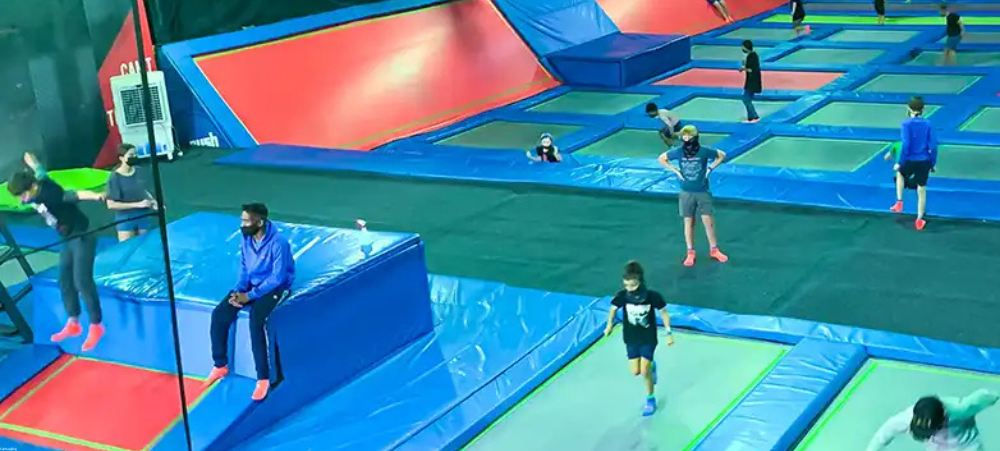
Trampoline therapy for autism is one of the most effective and accessible sensory interventions available to South African families — and at Rush, it happens naturally, joyfully, every single session.
For a child on the autism spectrum, the world can feel like a constant stream of overwhelming signals: the glare of mall lighting, the unpredictable sounds of a public playground, the sensory chaos of a busy robot intersection. But inside a Rush trampoline park, something measurably different occurs. The rhythmic, predictable bounce of a trampoline mat is not just fun — for many neurodivergent children, it is a form of neurological liberation.
Our latest article explains exactly why, and how to make the most of the April 2026 school holidays for your child’s sensory wellbeing.
The Science of the Bounce: Proprioception and Vestibular Regulation
Trampolining directly stimulates the two sensory systems that children with autism most commonly struggle to regulate: the proprioceptive system, which maps body position, and the vestibular system, which governs balance — making it one of the most neurologically targeted forms of sensory-friendly indoor play available.
To understand why a trampoline works so well, we need to look at the hidden sensesthat underpin daily functioning for children with Autism Spectrum Disorder (ASD).


The Proprioceptive System: Your Child’s Internal Map
The proprioceptive system relies on receptors in joints and muscles to tell the brain where the body is in space — without the eyes needing to check. For children who feel chronically clumsy, bump into furniture, or struggle with personal space, this system is under-regulated. The deep-pressure impact of landing repeatedly on a trampoline provides intense, grounding proprioceptive feedback.
In practical terms: children who enter our parks feeling frazzled and dysregulated frequently leave visibly calmer, because their nervous system has finally received the high-intensity input it was craving.
The Vestibular System: Balance, Focus, and Calm
Located in the inner ear, the vestibular system controls balance, spatial orientation, and the ability to filter out irrelevant sensory information. The repetitive up-and-down motion of jumping organises these signals in a way few other activities can match. A 2025 study published in the Multidisciplinary Science Journal found that even short-term trampoline interventions significantly reduced anxiety — measured through heart rate variability — and improved motor proficiency in children with ASD.
These are the Rush trampoline park benefits that parents at our Claremont location see every week.
A Safe Space for Self-Expression and Stimming
At Rush, stimming is not just tolerated — it is the default mode of the activity, which is precisely why trampoline parks are one of the most genuinely neurodivergent-friendly activities in South Africa.
“Stimming” — self-stimulatory behaviour such as rocking, flapping, or spinning — is a natural and necessary self-regulation strategy for many neurodivergent individuals. In most public environments, these movements attract unwanted attention or correction. On a trampoline, however, repetitive jumping is the activity. There is no masking required.
This matters more than it might initially seem. Chronic masking – the suppression of natural autistic behaviours to conform to neurotypical expectations — is associated with significantly elevated rates of anxiety, burnout, and depression. An environment where a child can stim freely, within a safe padded space, is not a luxury. It is a mental health intervention.
The physical intensity of jumping also provides “heavy work”input- the kind of full-body exertion that lowers cortisol levels, reduces post-session meltdowns, and – as many parents report — supports better sleep and improved focus once the takkies are back on and it is time for homework or dinner.


Social Interaction Without the Social Pressure
A visit to Rush trampoline park offers something rare for autistic children: genuine peer connection without the exhausting demands of direct social performance.
One of the most overlooked aspects of autism is the sheer cognitive and emotional cost of conventional social interaction. The complex unspoken rules of team sports, the nuance of conversation, the unpredictability of group play — these can be genuinely exhausting for a neurologically different child. Trampoline parks offer a powerful alternative through what developmental psychologists call parallel play.
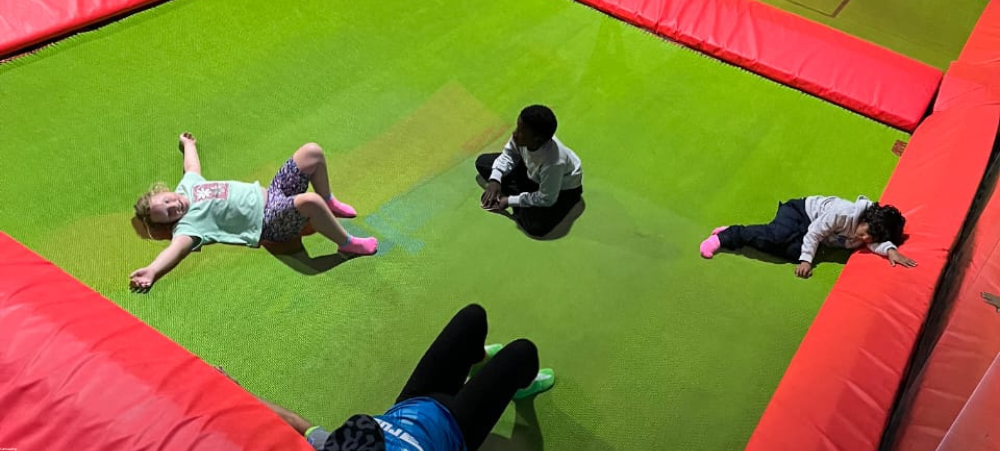
On our wall-to-wall trampolines, children can jump alongsidepeers without any demand for verbal exchange. They share the same space, the same rhythm, and the same physical joy — each within their own defined section of the mat. This builds a genuine sense of belonging and community without the social overwhelm that traditional environments impose.
This is what makes Rush the perfect place for trampoline therapy for autism.
Over repeated sessions, parallel play often evolves organically into interaction: a shared laugh, a friendly wave, an impromptu synchronised bounce. These micro-connections, built on shared physical experience rather than verbal performance, are developmentally significant and authentic.
- No turn-taking scripts required: Each child has their own space on the mat.
- No verbal performance pressure: Communication is optional, not expected.
- Shared rhythm creates connection: The bounce itself becomes a social bond.
- Low unpredictability: The environment is consistent, bounded, and familiar across visits.

Sensory-Friendly Session Planning
General Timing Guidance For Families:
- Weekday mornings (Mon–Fri) are consistently quieter than weekends — lower ambient noise and fewer unpredictable crowd movements.
- Avoid peak public holiday afternoons if your child is sensitive to crowds.
- Build in a café break mid-session. A snack and a few minutes of lower stimulation allows the nervous system to reset before returning to the trampolines.
- Bring noise-cancelling headphones for the arrival transition — the entry area can be louder than the main floor.
Booking to Visit to Rush
To check session times and pricing, visit the Rush holiday pricing and bookings page. Easter and Family Day slots — particularly sensory-friendly sessions — fill well in advance.
Frequently Asked Questions About Trampoline Therapy For Autism
Is trampoline therapy evidence-based?
Yes. Research published in peer-reviewed journals, including a a study by Malque Publishing, has demonstrated measurable reductions in anxiety and improvements in motor proficiency in children with ASD following trampoline-based interventions.
While Rush is not a clinical therapy provider, the sensory input provided by trampolining closely mirrors the mechanisms used in occupational therapy settings.
What age is trampoline play suitable for children with autism?
Rush caters for a wide age range, though suitability depends on the individual child rather than age alone. Toddlers and younger children benefit from smaller jump zones with lower trampoline tension, while older children and teens often respond well to the full park experience. We recommend contacting your nearest Rush park to discuss your child’s specific needs before a first visit.
How is Rush different from a regular playground for autistic children?
Rush indoor trampoline park offers several structural advantages over conventional playgrounds:
- predictable, bounded spaces; consistent sensory input (the bounce) rather than chaotic unpredictability
- parallel play opportunities without forced social interaction
- soft, padded surfaces that reduce injury anxiety
- at participating locations — dedicated sensory-friendly sessions with reduced capacity and sound levels.
Are there any organisations you are involved with?
Absolutely. We work closely with Western Cape Autism where we have hosted special play days for kids on the spectrum. Which we will be hosting again this year! See our socials for more information!
Our staff is also fully trained to support children with autism, making sure they feel safe, secure, and ready to have a blast at our park.
Give Your Child the Gift of Flight This Autumn
Trampoline therapy for autism does not require a clinical referral or a therapy room. It requires a trampoline, a safe space, and the freedom to move. At Rush, all three are waiting.
This April, trade the stress of the holiday schedule for the rhythmic, grounding calm of a trampoline mat. Let your child stim freely, move fully, and connect in a way that feels natural to them — not performed for the benefit of a neurotypical world.
Spaces for school holidays — especially sensory-friendly sessions — fill well in advance. Do not leave it until the holiday rush.

They cater to all ages, from toddlers to seniors, providing a tech-free environment packed with opportunities for active play. The park is thoughtfully designed to promote development through multisensory experiences, enhancing agility, balance, hand-eye coordination, strength, and cognitive skills while delivering endless fun.
At Rush, it’s all about People, Safety, and Fun—a place where everyone can have a blast!
- Rainy-Day Birthday Party Rescue: How Rush Extreme Saves the Day - September 10, 2026
- Trampoline Therapy for Autism: Why Bouncing Builds Balance at Rush - May 27, 2026
- Redefining play: Creating inclusive spaces for children on the autism spectrum - May 1, 2026


3 thoughts on “Trampoline Therapy for Autism: Why Bouncing Builds Balance at Rush”
Being an expectant mom, I do wonder if my little one will be on the spectrum. It’s so comforting to know Rush promotes inclusivity.
This was such a great read! It is absolutely refreshing to see that there is a space for all children. Jumping on the trampoline allows autistic kids to help regulate their emotions – and what a fun way of doing so. This entire article was really insightful.
This is such an important conversation 👏🏽. Creating spaces where neurodivergent children can just be themselves matters so much!!!