There are moments in almost every family when a screen feels like a small miracle.
A long car journey. Dinner needs to be cooked. A parent needs twenty quiet minutes. Everyone is tired.
So this is not an article about making parents feel guilty about screen time. Screens are part of modern childhood, and they can entertain, connect and even teach. The more useful question is not, “How do we get rid of screens?” but rather:
“What experiences does my child still need away from a screen?”
Because however colourful, clever or interactive an app may be, there are some things a child’s developing body and brain can only really learn by moving through the real world.
Some things have to be felt, not watched
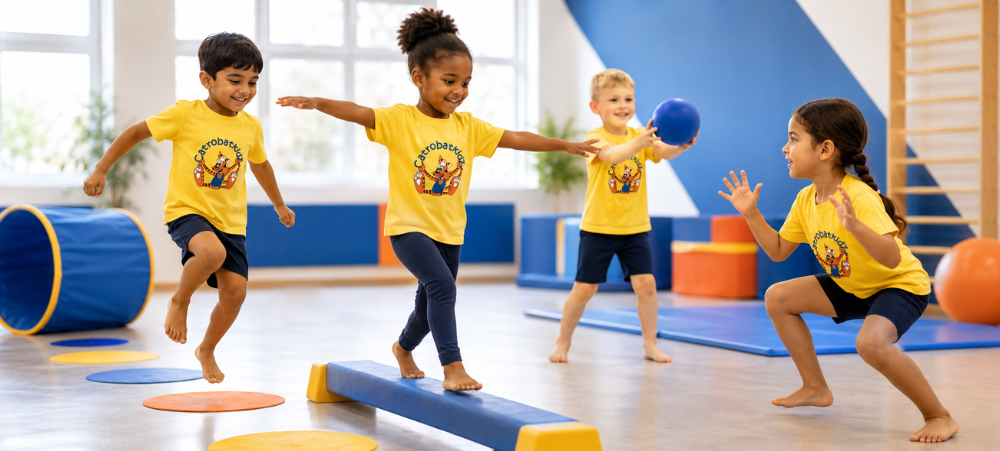
A child can watch someone balance on a beam, jump over an obstacle or catch a ball, but watching is not the same as doing.
When children balance, their bodies are constantly making tiny adjustments. Their feet feel the surface beneath them, their muscles respond and their eyes help them judge where they are in space. They wobble, correct themselves and try again.
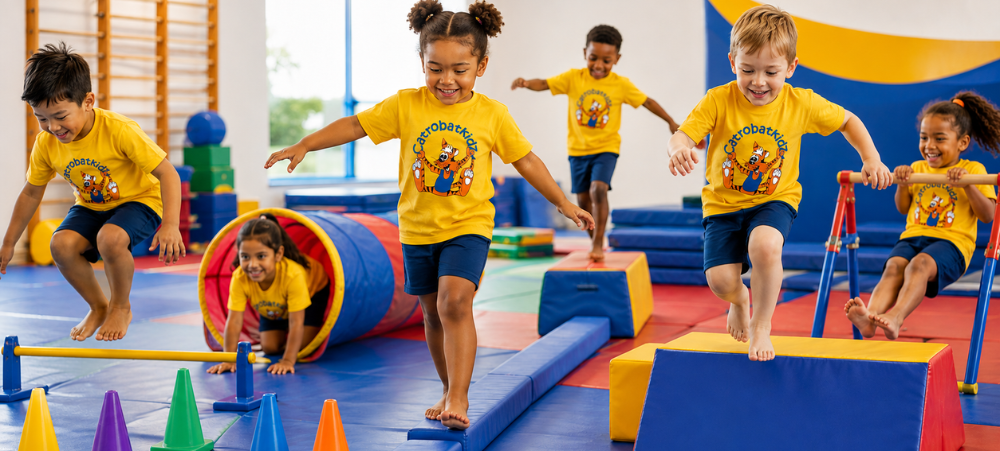
The same is true of climbing, jumping, rolling and landing. These experiences teach children about gravity, distance, speed, effort and control in a way that simply cannot be recreated on a screen.
Movement gives the body information that the brain uses to learn.
Real objects build real coordination
Tapping an object on a screen may require quick reactions, but catching a real ball asks much more of a child.
They have to watch where the ball is going, judge its speed, move their hands into position and decide when to reach for it. Sometimes they catch it. Sometimes they miss completely.
And that missed catch matters too.
Each attempt gives the brain new information. It learns, adjusts and prepares for the next try.
Throwing, catching, bouncing, kicking, building, threading and handling different objects all help children develop eye-hand coordination, timing and control. These are skills that grow through repeated physical experience.
Children need to learn where their bodies fit in the world
Spatial awareness develops when children move through their environment.
They crawl under the table, step over a cushion, squeeze through a gap, run around a chair, jump between markers or crawl through a tunnel.
Through play, children begin to understand ideas such as under, over, around, through, near, far, high and low.
A screen keeps everything neatly inside a rectangle. Real life is wonderfully less tidy.
A child has to work out whether they can fit through a space, how far they need to jump, how high to lift a foot or how quickly to slow down before bumping into something.
That is how children learn to understand and control their bodies in relation to the world around them.
Real-world play includes real people
Physical play also gives children something screens cannot fully reproduce: the unpredictable give-and-take of playing with other people.
Someone runs in front of them. A friend wants the same ball. Another child changes the game. Someone has to wait for a turn.
These moments help children practice sharing, listening, negotiating, reading facial expressions and coping when things do not go exactly as planned.
It can be noisy, messy and occasionally frustrating, but that is part of the learning too.
Children are not only developing physical skills. They are learning how to be with other people.
Movement gives imagination room to grow
Real-world play also leaves space for imagination.
Give a child a cardboard box and it may become a racing car, a pirate ship, a house or a rocket to the moon. A hoop becomes an island. Cushions become stepping stones over crocodile-infested water. A towel becomes a superhero cape.
The important part is that the child creates the story.
During open-ended play, children decide what things mean, what happens next and how the game changes. They are not simply following a world that has already been designed for them.
They are building one of their own.
It is about balance across the whole day
South Africa’s 24-hour movement guidelines for young children look at the full picture of a child’s day. They recognise that healthy development depends on a good balance between active play, quiet sitting time, screen time and enough sleep.
For children aged three to five, the guidance recommends plenty of movement spread throughout the day, including energetic play, while keeping recreational screen time limited.
The important message is not simply, “Use screens less.”
It is also:
“What can we add instead?”
That is where the idea of a screen-time swap becomes useful.
Think “swap”, not “stop”
Parents do not need to overhaul family life overnight.
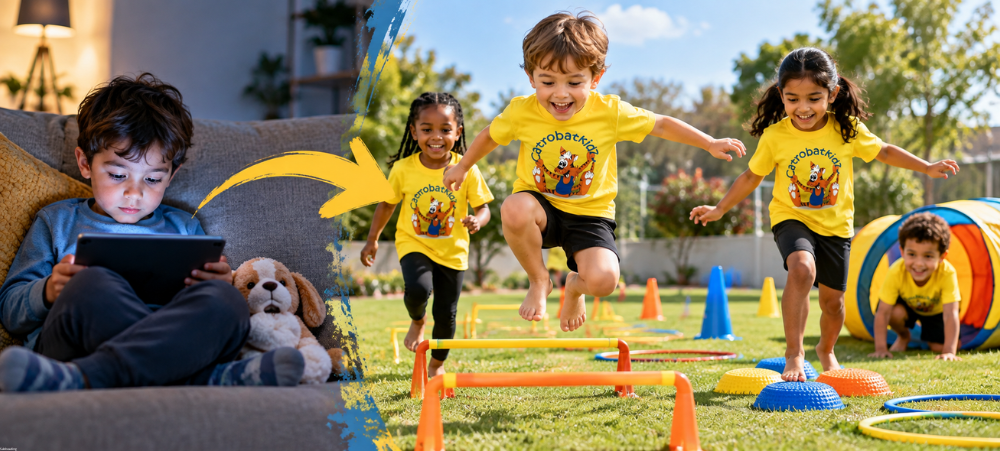
Swap ten minutes of screen time for throwing a ball outside. Put on some music and dance through one song. Build a cushion obstacle course. Walk along a chalk line. Play follow-the-leader. Take a ball to the park.
Small swaps add up.
And perhaps that is the kindest way to think about screen time – not as a battle between “good parents” and screens, but as a reminder that childhood still needs real things.
Real balls to catch.
Real spaces to explore.
Real friends to play with.
And real bodies that need to discover just how much they can do.
At Catrobatkidz, we believe children learn through movement because movement gives the brain experiences that cannot simply be watched or swiped.
Sometimes the best thing we can give a child is not another thing at all.
It is space to move, freedom to play and time to discover the real world.

- The Screen-Time Swap: What Real-World Movement Gives Children That Screens Cannot - October 13, 2026
- Confidence Starts in the Body: How Physical Skills Help Children Believe “I Can” - September 7, 2026
- The Brain–Body Connection: Why Movement Helps Children Focus, Remember and Learn - August 11, 2026