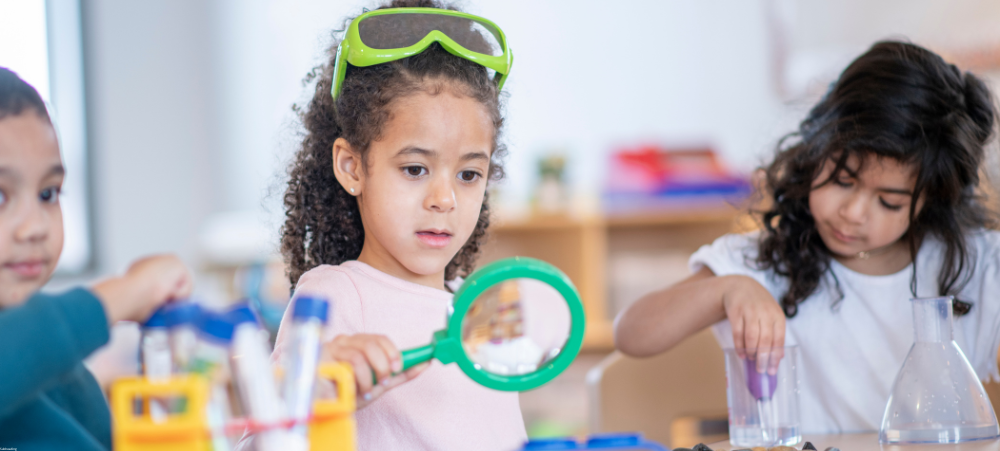
A bowl of water, a few raisins, an old torch and the contents of a kitchen cupboard may not look much like a science lesson. To a preschooler, though, they can provide plenty to investigate.
Young children spend a great deal of time testing the world around them. They pour water from one container to another, build things to see how high they can go and repeat an action to find out whether the same thing will happen again.
That instinct gives parents an easy entry point into early science.
“Science with young children does not need to begin with explanations or terminology,” says Ursula Assis, Managing Director of Dibber International Preschools South Africa. “It can begin with a question. What do you think will happen? Why do you think that happened? Giving children time to make a prediction and then see the result for themselves makes the experience far more interesting.”
And it does not require specialist equipment.
Here are six experiments families can try with ordinary household items.
1. Will It Sink or Float?
Fill a basin with water and collect a few objects such as a plastic block, wooden spoon, cork or large stone.
Before putting each object into the water, ask the child what they think will happen. Then test it.
The experiment introduces children to the idea that different objects behave differently in water. For older preschoolers, parents can begin using simple words such as floating, sinking and buoyancy without expecting them to master the science behind them.
The prediction is just as valuable as the result. Being wrong is part of the experiment.
2. Make Water “Walk”
Place several clear cups in a row and partly fill every second cup with water. Add different food colouring to the filled cups, then connect each cup to the next with folded pieces of paper towel.
Over time, the coloured water begins travelling through the paper towel into the empty cups.
Children are watching capillary action: the movement of water through small spaces in the paper fibres. They may be more interested in the colours meeting in the middle, which creates another useful conversation: what happens when two colours mix?
3. Try Magic Milk
Pour a little milk into a shallow dish and add several drops of food colouring.
Dip a cotton bud into dishwashing liquid and touch it gently to the surface of the milk. The colours quickly move and swirl.
The reaction happens because soap affects the liquid’s surface tension and interacts with the fat in the milk.
A preschooler does not need that full explanation. “What changed when we added the soap?” may be enough.
4. Watch Raisins Dance
Drop a few raisins into a glass of sparkling water and wait.
Bubbles of carbon dioxide attach to the raisins’ wrinkled surfaces and can lift them toward the top. When the bubbles burst, the raisins may fall again.
For a child, watching the same raisin repeatedly rise and fall is often enough to prompt the inevitable question: why?
5. Investigate Shadows
Science can also begin outside.
On a sunny day, ask a child to look at their shadow and notice where it falls. Try again later. Has it moved? Is it longer or shorter?
Indoors, a torch and a wall can produce the same kind of experimentation. Move the light closer to an object, then further away, and watch what happens to the shadow.
Children begin to see that changing the light’s position changes what they see.
6. Make Static Electricity Visible
Inflate a balloon and rub it against a woollen jersey or hair. Bring it close to small pieces of paper and watch them move towards it.
Rubbing the materials together can build up an electrical charge, producing the attraction the child can see.
Again, the terminology can wait. At preschool age, surprise is a perfectly good place to begin the conversation.
The Questions Matter as Much as the Experiment
There is a temptation for adults to explain everything immediately. Assis suggests resisting it occasionally.
“If the adult gives the answer before the child has had time to wonder, part of the opportunity disappears,” she says. “Ask what they noticed. Let them have an idea, even if that idea turns out to be wrong. Then try it again.”
Repeating an experiment can be useful too. A child who wants to sink the same objects for the fifth time may be checking whether the outcome remains the same, changing something or simply enjoying the satisfaction of knowing what is about to happen.
There is no need to turn that into a formal lesson.
Adult supervision matters throughout, particularly when activities involve small objects, balloons, glassware or substances such as dishwashing liquid. Items used in the experiments should not be eaten or left with young children unattended.
At Dibber, hands-on investigation is part of how children are encouraged to explore ideas in the early years. The purpose is less about producing a correct scientific answer and more about giving children opportunities to notice, predict, test and reconsider.
“Curiosity is already there,” says Assis. “Adults do not have to manufacture it. Sometimes all we need to do is put something interesting in front of a child and give them enough time to see where the question takes them.”
The raisins will eventually stop dancing, and the coloured water will be poured away.
The question that started it all, though, may lead somewhere else entirely: What happens if we try this?

- Six Simple Science Experiments That Get Preschoolers Asking Questions - October 5, 2026
- Why the Best Early Years Educators Do More Than Teach - September 25, 2026
- How to Help Toddlers Learn the Language of Emotion - September 18, 2026