
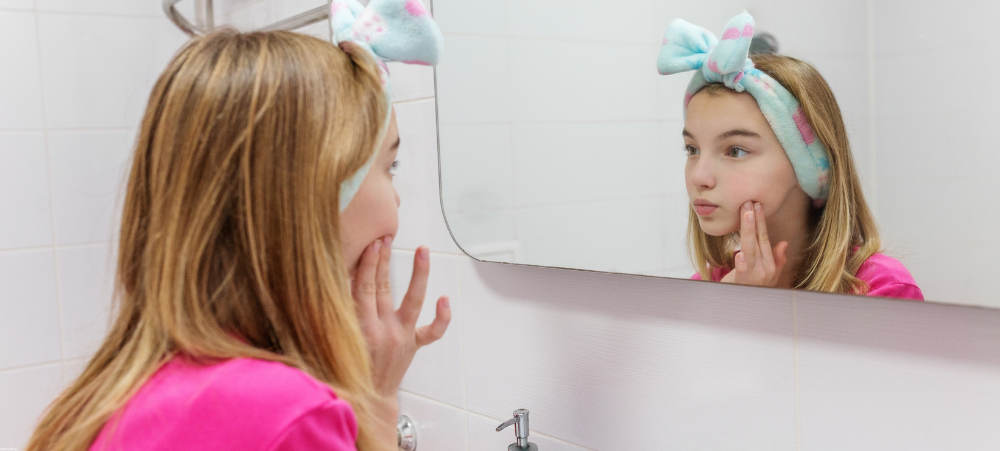
From seven-year-old skincare creators to R2,800 routines and powerful active ingredients, new research reveals what young people are really seeing on their feeds.
Your 13-year-old asks for a serum. Then an exfoliating toner. Then another product promising “glass skin”.
It seems harmless enough. At least they’re interested in looking after their skin.
But what happens when skincare advice from an algorithm becomes more influential than advice from a parent, pharmacist or dermatologist?
Researchers recently decided to find out.
They created TikTok accounts pretending to be 13-year-olds and watched what the algorithm showed them.
What appeared on their feeds was eye-opening.
Seven-Year-Olds, Six-Step Routines and Thousands of Rands
In a 2025 study published in the medical journal Pediatrics, researchers analysed 100 skincare videos recommended to their supposedly 13-year-old TikTok accounts.
The creators ranged from seven to 18 years old.
The average video had 1.1 million views.
The average skincare routine contained six products and cost about R2,800. Some routines contained as many as 14 products, with the most expensive costing the equivalent of roughly R10,000.
But the price wasn’t the most worrying part.
Among the 25 most-viewed routines, researchers found an average of 11 potentially irritating active ingredients.
One contained 21.
Suddenly, the colourful bottles lined up on a bathroom shelf look a little less innocent.
The Problem Isn’t One “Bad” Ingredient
Many active skincare ingredients have perfectly legitimate uses.
The problem comes when young people use ingredients they don’t need, combine several products doing similar things, or copy routines designed for completely different skin.
A teenager may not realise that their cleanser, toner and serum contain overlapping exfoliating ingredients.
To them, they’re three products recommended by three different people.
To their skin, it can mean repeated exposure to ingredients capable of causing irritation, redness, burning, dryness and increased sensitivity.
And when irritated skin starts looking worse?
TikTok is ready with another product to fix it.
How an Algorithm Makes Six Products Feel Normal
This may be the most important part for parents to understand.
TikTok doesn’t need to tell your child: “Buy this.”
Instead, they watch another young person doing a “Get Ready With Me” before school. A cleanser goes on. Then toner. Serum. Another serum. Treatment. Moisturiser.
Nobody is obviously selling anything.
It simply looks like normal life.
The researchers found that once their 13-year-old profiles watched, liked or saved a few skincare videos, their feeds quickly became saturated with more of the same.
That repetition matters.
What initially looks excessive can soon begin to look ordinary.
Everyone seems to be doing it. Maybe I should too.
And because TikTok personalises each feed, parents opening the app themselves may not even see what their children are seeing.
When Did Children Start Worrying About Ageing?
There is another question hiding beneath all those bottles.
Why are children being introduced to products designed to address ageing, wrinkles, pigmentation and other adult skin concerns?
The American Academy of Dermatology advises that young people generally do not need anti-ageing actives such as retinol or exfoliating acids simply because they are trending. Young skin has different needs, and unnecessary actives can cause irritation.
There is a difference between teaching children to care for their skin and teaching them to constantly examine it for imperfections.
That distinction matters.
Skincare can be fun and confidence-building. But when a 12-year-old begins worrying about pores, texture or ageing because an algorithm has taught them these are problems, something has shifted.
The Sunscreen Contradiction
And then comes perhaps the most surprising finding of all.
Despite the elaborate routines, only about one in four daytime videos included sunscreen.
Think about that.
Young people were layering multiple products and potentially irritating active ingredients onto their skin — while one of the simplest, most established ways of protecting it was often missing.
It’s a useful reminder that viral and sensible are not necessarily the same thing.
What Should Parents Do?
Probably not ban TikTok skincare.
And definitely not ridicule it.
For many teenagers, skincare is enjoyable. It can be part beauty, part identity, part social life and simply a few quiet minutes of self-care.
Instead, get curious.
The next time another bottle appears on the wish list, ask:
- What is it supposed to do?
- Which ingredient does that?
- Are you already using something that does the same thing?
And perhaps the most useful question of all:
What problem with your skin are we actually trying to solve?
Sometimes there is a genuine problem. Teenage skin changes, oil production can increase and breakouts can become very real.
That is when skincare should become more targeted, not more complicated.
And persistent, painful or scarring acne deserves proper professional advice — not another evening scrolling through TikTok.
Why This Matters to Us at Zanna Skin
This increasingly confusing skincare world is one of the reasons we created Zanna Skin.
We saw young people caught between harsh acne products on one side and complicated adult beauty routines on the other — while social media constantly suggested something else they should add.
We wanted to take a simpler approach: understand young and changing skin, choose ingredients for a reason and make a routine manageable enough to actually follow.
Teenagers don’t need a bathroom shelf filled with products to learn how to care for their skin.
Perhaps the most valuable skincare lesson we can give them in the TikTok era is also the simplest:
Viral doesn’t mean necessary.
References
- Hales M, Rigali S, Paller A, Liszewski W, Lagu T. Pediatric Skin Care Regimens on TikTok. Pediatrics. 2025;156(1):e2024070309.
- American Academy of Dermatology. A Dermatologist’s Guide to Skincare from Growing Up to Glowing Up. 2025.

- Who’s Teaching Your Teenager About Skincare? Chances Are, It’s TikTok. - November 9, 2026

3 thoughts on “Who’s Teaching Your Teenager About Skincare? Chances Are, It’s TikTok.”
And unfortunately some realise after the damage has been done to their skins in their early 20’s. There’s really too much influence in social media and TikTok is not the only issue, there’s also bullying and self esteem issues that make them try things that will “help them” improve their appearances and likability. I do wish they didn’t feel the need to try so hard.
As a mom to a 9-year-old daughter who is such a girly girl, this was interesting to read because it reflects what our children are doing these days and how much times have changed. Sometimes, instead of fighting certain things, we should try to listen, understand and learn from their perspective.
I will definitely buy Zanna Skin for 14 year old daughter, the pimples during menstruations stress her. Thank you for talking about skin problems for teenagers and advising them not to use ageing products, as a Mom of teenage girl it’s frustrating sometimes you don’t know which products are suitable for teenagers.