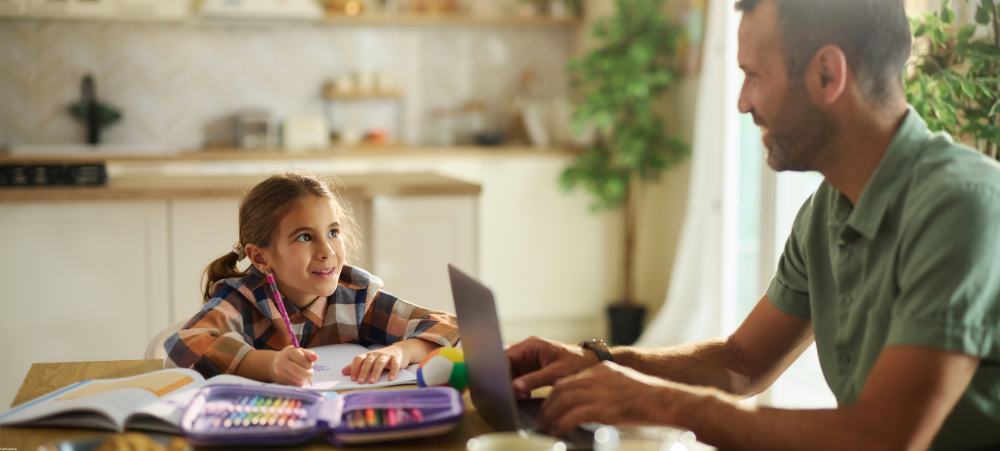
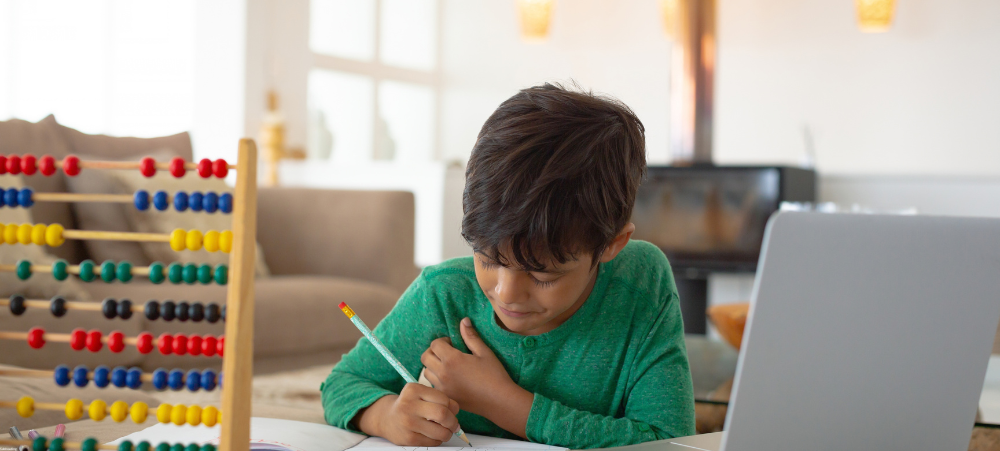
An online primary-school day should include far more than a child watching lessons on a laptop. For younger learners, reading, writing, practical activities, movement and adult interaction remain central to the learning process.
In a well-structured online primary school, the screen is one part of the learning day.
Children still need to read aloud, write by hand, count physical objects, draw, build, move, practise and talk about what they are learning.
That is especially important in the early primary years, when much of learning is still physical and social.
So when parents ask, “How many hours will my child spend on a screen?”, it is worth asking a second question:
What will they be doing when the screen is off?
Screen Time Does Not Describe the Lesson
Twenty minutes spent talking to a teacher, sounding out words or solving a Mathematics problem is different from twenty minutes watching entertainment.
The device can be a route to the teacher, instructions or learning material. It should not have to carry the entire educational experience.
For younger children, strong online programmes deliberately move the learner between digital and physical activity.
That may mean watching a short explanation, closing the laptop, completing work on paper, reading with an adult or using objects to practise a Mathematics concept.
The screen can start the learning activity without containing every part of it.
What This Looks Like in CambriLearn’s Foundation Phase
CambriLearn’s current primary-school programme gives a useful example.
For Grade R to Grade 3 learners, the school says children typically spend around two to three hours a day in active screen-based learning.
The rest of the programme includes printed workbooks, hands-on activities, art, reading and physical play.
Lessons in this phase are structured in shorter blocks, with breaks and activity changes built into the day.
That is a very different picture from a child sitting in front of a laptop from morning until afternoon.
Learning to Read Still Requires Reading
Early literacy is a good test of whether an online primary programme understands young children.
A video can introduce a sound.
Interactive material can help a learner practise it.
A teacher can demonstrate how letters and sounds work together.
The child still needs to read.
At CambriLearn, Foundation Phase reading includes phonics work, printable readers and practice material, with guidance for the adult supporting the learner at home.
A parent or learning coach plays an important role at this stage, including listening while the child reads and helping them practise.
There is no technological shortcut around hearing a young child stumble over a word, try again and finally get it.
Mathematics Should Leave the Laptop Too
The same principle applies to early Mathematics.
Young learners often understand concepts more easily when they can handle something.
Counters, blocks, coins, measuring cups, paper shapes and household objects can turn an abstract explanation into a physical idea.
A child learning fractions can divide real objects.
A child learning measurement can use a ruler.
A child working on number bonds can move counters before writing the calculation.
The sophistication is in the teaching sequence, not in making every activity digital.
Writing by Hand Still Matters
Online school does not mean typing everything.
Primary-age children need opportunities to form letters, write sentences, complete calculations, draw diagrams and organise work on paper.
Printed workbooks and offline assignments are useful for precisely this reason.
Parents comparing online primary schools should ask whether the programme includes meaningful written work or whether most activity happens through clicking, dragging and multiple-choice exercises.
A child can become very good at using an interface without becoming equally good at explaining an answer on paper.
Those are different skills.
Parent Involvement Changes as Children Get Older
One of the biggest differences between online primary and online high school is the adult role at home.
A six-year-old needs far more practical support than a twelve-year-old.
In the early years, a parent or another adult may help the child organise materials, follow the routine, read aloud and complete practical activities.
As the learner grows, the adult role should begin changing.
The child should gradually become more capable of moving between activities, managing simple tasks and asking for help independently.
That transition matters.
Independence is something children practise. It should not be confused with leaving them to figure everything out alone.
The Balance Changes in Grades 4 to 7
As children grow, the school day can include longer periods of independent work.
CambriLearn says its Grade 4 to Grade 7 learners typically spend around three to four hours a day on screen, balanced with offline assignments and projects.
The adult role should begin reducing too.
A parent may still check that the day has started, help with organisation and review progress, but the learner should carry more of the routine themselves.
This is one of the reasons parents should ask about screen time by age rather than looking for a single number covering the whole school.
What a Learning Sequence Can Look Like
Imagine a primary learner working on a new Mathematics concept.
The child begins with a teacher explanation or assigned lesson.
The laptop closes.
The learner uses physical objects or paper to practise the idea.
They complete a short piece of written work.
The work is checked or submitted according to the programme.
The learner receives feedback and either moves forward or revisits the part that was misunderstood.
That is an illustrative example rather than a fixed CambriLearn timetable, but it captures an important principle.
Digital delivery and physical learning can sit in the same lesson.
Parents do not need to choose between technology and real learning. They need to check whether the programme uses each tool for the job it does well.
What Parents Should Ask Any Online Primary School
Parents should ask how much active screen time is expected at their child’s age.
They should ask how long learning blocks usually last and how often the child changes activity.
They should ask how reading is taught, how much work is completed on paper and what physical or creative activities are built into the programme.
They should know what the parent must do each day.
They should know who teaches, who marks the work and how feedback reaches the child.
They should also know how progress is monitored and what happens when a learner is struggling.
A school should be able to answer those questions clearly.
If every answer is about an app, dashboard or video library, keep asking.
The Screen Is the Classroom Door, Not the Whole Classroom
Online primary school works best when technology connects the child to teachers, instructions and resources, while learning continues away from the device.
At CambriLearn, that means live and interactive learning sits alongside workbooks, reading, hands-on activities, assessments and teacher feedback, with the balance changing as the learner grows.
Parents considering online primary school should see that balance before they enrol.
Ask to see the school day.
Ask what happens after the laptop closes.
For a young child, that second answer may tell you more about the quality of the programme than the first.

- Online Primary School: What Happens Away From the Screen? - October 28, 2026
- Can Online School Work When Both Parents Work Full-Time? - October 21, 2026
- Switching from CAPS to an International British Curriculum: Will Your Child Lose a Year? - October 14, 2026