
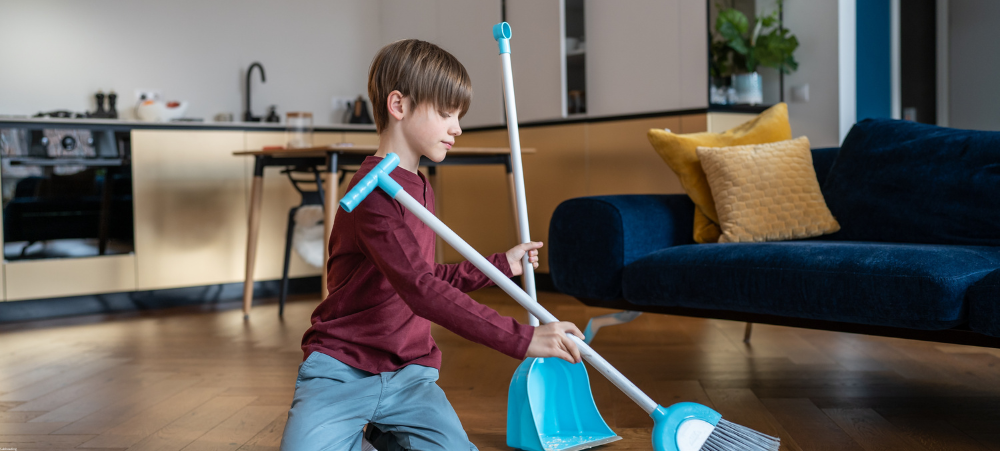
Getting kids to help around the house can feel like more effort than doing it yourself — the reminders, the half-finished jobs, the negotiations. But chores aren’t really about the tasks themselves. They’re one of the most effective, research-backed ways to build responsibility, confidence, and a sense of contribution in children. The key is matching expectations to what’s actually developmentally realistic at each age.
Why Chores Matter More Than They Seem To
Long-term studies on child development have repeatedly pointed to one surprising finding: children who do regular chores from a young age tend to show greater independence, stronger work ethic, and better relationship skills as adults, compared to children who didn’t. The mechanism isn’t the chore itself — it’s the repeated experience of contributing to something bigger than yourself and being trusted with responsibility.
Chores by Age Group
Ages 2-3: Simple, supervised tasks
- Putting toys in a bin
- Placing dirty clothes in a hamper
- Wiping up small spills with help
- Putting books back on a shelf
At this age, the goal isn’t efficiency — it’s building the association between “I help” and family life. Expect messy execution and celebrate the effort, not the result.
Ages 4-5: Short, concrete tasks
- Setting the table (with unbreakable items)
- Feeding a pet
- Watering plants
- Sorting laundry by color
- Making their bed (loosely)
Children at this age respond well to visual chore charts and can follow two-to-three step instructions independently.
Ages 6-8: Growing independence
- Fully making their bed
- Packing their school bag
- Clearing their own plate
- Simple food prep (spreading, mixing)
- Sweeping small areas
- Basic pet care beyond feeding
This is a good age to introduce the idea that some chores are about self-care (own belongings) while others are about contributing to the household as a whole.
Ages 9-12: Real responsibility
- Doing their own laundry (with initial guidance)
- Vacuuming
- Preparing simple meals or snacks independently
- Taking out the trash
- Basic yard work
- Helping with younger siblings under supervision
At this stage, chores can start connecting to broader life skills — time management, basic cooking, and organization.
Teenagers: Full participation
- Cooking full meals
- Managing their own laundry entirely
- Deep cleaning tasks
- Budgeting for personal expenses
- Contributing to family logistics (grocery lists, scheduling)
Teens benefit from chores framed around real-world skill-building for the independence they’ll need soon — not just household maintenance.
Making It Stick Without the Battle
Keep expectations age-realistic. A three-year-old cannot make a bed with hospital corners. Match the standard to the age, not to how you’d do it.
Avoid tying chores to payment for everything. Research suggests chores framed as a contribution to the family (rather than a transaction) build a stronger sense of responsibility than a strict pay-per-task system, though an allowance system can still work well alongside baseline expected contributions.
Expect to reteach, not just assign. Most chores need to be modeled and practiced together several times before a child can do them independently.
Let natural consequences play a role. If a chore isn’t done, a natural consequence (no clean favorite shirt because laundry wasn’t started) often teaches more effectively than repeated reminders or punishment.
Praise effort and follow-through, not perfection. “You remembered to feed the dog without me reminding you” reinforces the habit far more than criticizing how the bed was made.
The Real Goal
Chores aren’t really about a tidy house — though that’s a welcome side effect. They’re about teaching children, one small task at a time, that they are capable, trusted, and needed. That message, repeated consistently through the years, builds the foundation for the independence they’ll need long after they’ve left your home.

We understand that there are many aspects that encompass a Mother, Father or Child and strive toward providing resources and services that accommodates this.
Our content is aimed to inform and educate families on issues starting from pregnancy through to the challenges of the teen-age years.
- Chores by Age: Building Responsibility Without a Battle - October 22, 2026
- Parenting Burnout: Recognising It and Recovering From It - October 21, 2026
- The Power of Routine: Why Kids Thrive on Predictability - October 20, 2026