Impaq

How healthy homeschooling habits matter to future success

For many parents, homeschooling is not only about where a child learns. It is also about how that child builds curiosity, keeps going when work feels difficult, and stays interested in learning. These are habits that can support later success, but they need to start somewhere. Learning at home gives parents more direct influence over the pace and rhythm of their child’s education. That can be a real advantage, and it makes the home a place where children begin to build habits that shape how they learn as they grow. Those patterns can continue to matter long after the early years, through later schooling and eventually in the workplace. The World Bank’s Building Human Capital Where It Matters report highlights the home as one of the key places where children’s development takes shape. It shows that children need more than resources alone to grow and learn well. They also need care, encouragement, reading, routine, and regular opportunities to learn. The report also points to the need to enable parents to create homes that are both nurturing and stimulating. For homeschooling families, good intentions and content matter, but children also need a clear sense of direction in their work. A steady path through the week Without a clear way forward, home education can start to feel uneven. Children may stay busy without making steady progress or building strong work habits. In the early grades, parents need to know what comes next, how learning should build over time, and how to tell whether their child is keeping up. That kind of clarity makes daily lessons easier to manage and gives children a steadier sense of progress. This is where Impaq’s homeschooling options for Grades R to 3 can make things easier for families. The packages include workbooks, readers, learner aids, and portfolio-based assessments for daily lessons at home – useful tools parents can use as learners build early reading, numeracy, and life skills. Impaq also offers a clear, CAPS-aligned way to organise learning at home. This gives parents a proven framework for parent-led homeschooling, including regular listening, speaking, reading, writing, and ways to track progress. With CAPS-aligned learning materials, facilitator guides, assessment tools, and access to the Optimi Learning Portal (OLP), parents have what they need to lead teaching at home with more confidence. For children, this creates a regular rhythm that supports steady learning. They are not only working through content. They are also building consistency, follow-through, and confidence – habits that matter later in life. The value of these habits over time The habits formed in Grades R to 3 continue to matter beyond the early years. Over time, they shape how children approach challenges, respond to feedback, and take responsibility for their learning. Homeschooling is not the right choice for every family, but for those who do choose this learning path, the quality of the materials and guidance they use can make a real difference in helping their child grow – both in learning and in the habits they carry into later life. As Louise Schoonwinkel, Managing Director at Optimi Schooling, of which Impaq is a registered trademark, says, “When families read, talk, and build routines early, children arrive at formal learning with confidence, and that confidence compounds later in their lives.”

Impaq

Your child’s first classroom is home: building strong learning foundations in your own space

If you’re considering homeschooling for your child, the early years can feel like a big step. Grade R to 3 is when children start building the foundations they will keep using as they grow. These include literacy, numeracy, and life skills.  The early years shape what comes next As the World Bank notes in its Building Human Capital Where It Matters report, the home plays an important role in how children learn and grow. In these years, children rely on the adults around them not only for care and safety. They also depend on them for stimulation, reading, routines, and opportunities to learn that shape later progress.  The report also makes an important point. Gaps in early learning can be hard to close later on. That is why support at home matters so much. The national CAPS curriculum for Grades R to 3 gives a clear structure to these early years. It includes regular listening, speaking, reading, writing, and ways to track progress. But turning that framework into a daily routine at home can be a challenge. That is where the right guidance can make a clear difference. Why clear direction matters early on Worksheets and videos online can be helpful for extra practice, but without a clear CAPS-aligned plan, children can do activity after activity without building skills in the right order. That’s where a clearly defined homeschooling approach makes a difference. If you’re considering home education, you need more than curriculum-aligned content. You need a proven plan, useful tools, and guidance you can trust. Impaq’s Grade R to 3 homeschooling options speak to the kind of learning the World Bank highlights in its report, for example:  In short, Impaq helps you create the kind of home learning environment that gives your child a strong start. Guidance for you, steady growth for your child “Strong foundations aren’t about pushing children harder,” says Louise Schoonwinkel, MD at Optimi Schooling of which Impaq is a registered trademark. “They’re about building confidence through small, repeated wins, such as reading daily, practising basic numeracy, and keeping to routines to make learning easier.” “Our job is to help parents feel capable,” Schoonwinkel says. “When the plan is clear, and the support team is easy to reach, children settle faster, build confidence, and start to enjoy learning.” If you’re considering homeschooling for your child, this means you don’t have to do everything on your own. With the right guidance, your home can become a strong place for learning to begin.

Impaq

Why the Foundation Phase matters more than most parents realise, and how to support learning at home

Recent literacy findings have reignited a national concern: too many learners reach the Intermediate Phase without the reading skills they need to cope with the curriculum. The PIRLS 2021 results found that 81% of South African Grade 4 learners could not read for meaning in any language. The Department of Basic Education has echoed this urgency in its own reporting, noting that learners who cannot read with meaning “will struggle in every other subject” and referencing evidence that 8 in 10 children cannot read for meaning by Grade 4. For homeschooling parents and families, it helps to choose a provider like Impaq that supports you through the early grades with a clear CAPS-aligned plan, structured materials, regular assessments, and accessible guidance, so you’re not left to figure it out alone.  The Foundation Phase (Grade R – Gr 3) built at home, day by day, using the resources and routines you choose, is where the core building blocks are formed: listening and comprehension, vocabulary, phonics, handwriting, early numeracy, attention and learning habits. When these foundations are not secure, gaps tend to compound from Grade 4 onwards, because the learner must suddenly “read to learn” across every subject. “Foundation Phase is not a soft start, in fact, it’s the platform everything else stands on,” says Louise Schoonwinkel, Managing Director at Optimi Schooling of which Impaq is a registered trademark. “If reading and basic numeracy aren’t solid by the end of Grade 3, children often spend the rest of their schooling trying to catch up while the curriculum keeps moving.” Free resources help, but structure is what makes them work There is no shortage of material online. Parents can find worksheets, videos, printable readers, and even DBE resources such as CAPS documentation and Rainbow Workbooks, which provide weekly worksheets aligned to CAPS. These tools can be extremely valuable, especially for extra practice. However, the challenge is that “more” does not automatically mean “better.” Without a clear weekly plan, a progression of skills, and assessment checkpoints, families may end up with scattered activities that don’t build mastery. That matters most in the early grades, where learning depends on sequence: sounds before words, words before sentences, sentences before comprehension. “Parents need confidence that the material follows the right order, covers what it must, and gives them a clear way to track progress. In the early years, the sequence matters as much as the content,” Schoonwinkel says. A quick checklist: what your home materials should include Your programme should include these essentials, and by year-end your child should show these outcomes: When these elements are missing, families often only discover problems later, when the curriculum demands increase and the learner feels behind. “Children don’t fall behind in Grade 10, they usually fall behind in Grade 1 to Grade 3,” Schoonwinkel adds. “That’s why the Foundation Phase deserves the most deliberate attention from parents and providers.” What Impaq offers for Grades R–3 For families who want a structured home-learning option in the early grades, Impaq provides CAPS-aligned lesson material and assessments, clear weekly planning, and support that helps parents teach with confidence. In the Foundation Phase, families also have access to weekly live, interactive sessions and recorded support lessons (used as additional reinforcement for homeschool learners), as well as progress tracking and report information through the learning platform. Teacher guidance is available so parents don’t feel they are navigating the early years alone. “In the Foundation Phase, parents shouldn’t have to guess what comes next,” says Schoonwinkel. “The right support gives you a clear plan, quality resources, and the reassurance that your child is building the literacy and numeracy foundations needed for the years ahead.” Note for parents choosing home education: DBE (provincial) registration is required for homeschoolers in Grades R–9.

Impaq

SONA 2026 puts early learning, literacy and a “skills revolution” at the centre of education reform

Education was a major focus in the President’s State of the Nation Address (SONA) last week. The priority was clear: strengthen learning foundations early, help more learners stay in the system through the senior years, and rebuild post-school skills training to link education more directly to jobs and economic participation. In his address, the President pointed to strong matric results, emphasising both the overall pass rate and equity wins behind it. He noted that a significant share of bachelor’s passes came from schools in disadvantaged communities. He pointed to this as evidence of progress and as a reason to push further on quality and learner progression. The cohort numbers underline why progress matters. In the Department of Basic Education’s Select Committee briefing/report on the 2024 NSC outcomes, approximately six in ten learners who were registered in Grade 1 in 2013 were still registered for Grade 12 in 2024. Learner stage Number of learners Registered for Grade 1 (2013) 1,222,851 Registered for Grade 10 (2022) 1,148,437 Registered for Grade 12 (2024) 740,876 Wrote NSC exams (2024) 705,291 Passed 615,429 Bachelor’s passes 337,158 Source: DBE Select Committee briefing/report on the 2024 NSC outcomes (18 February 2025). A prominent feature of the speech was early learning, described as the point where long-term educational outcomes are won or lost. Government’s plan includes expanding access to early childhood development (ECD) through mass registration of facilities and increased subsidies. It includes a commitment to keep Grade R compulsory so that all children “get off to a good start.” The shift reinforces a focus on school readiness and the foundational years as a practical way to improve later academic performance. “Starting at Grade R is exactly where the focus should be,” said Louise Schoonwinkel, Managing Director at Optimi Schooling, of which Impaq is a registered trademark. “When children enter formal learning with the right foundations – language development, early numeracy, attention skills, and a love of learning – they cope better in the early grades and carry that confidence forward.” “Grade R isn’t about rushing children; it’s about giving them a structured, age-appropriate start so gaps don’t become barriers later. For some families, homeschooling in the early grades can be especially beneficial because it allows young children to build confidence at their own pace in a calmer environment, while still developing the core skills they need for the years ahead. If we get the foundation phase right, we reduce pressure in the later grades, improve progression, and ultimately give more young people a fair shot at success.” The President also highlighted a renewed drive to “fix” basic education with a more intensive focus on foundational skills, specifically literacy and numeracy. In this context, he referenced mother-tongue-based bilingual education, signalling a continued focus on language as a factor in reading comprehension and early learning progression. The message was not only about curriculum content. It was also about how teaching and learning are structured in the early grades to build competence that carries through to high school. While welcoming improved matric outcomes, the President cautioned that the system must address dropout rates, particularly in the final years of schooling. He argued that more learners should reach matric and take “gateway” subjects such as Mathematics and Science, which expand options into higher education and skills pathways. Schoonwinkel added that the focus on dropouts and gateway subjects should sharpen attention on what happens during the schooling years, not only matric. “It’s not enough to celebrate the pass rate. We need to reduce dropout in the senior grades and ensure learners are genuinely prepared for gateway subjects, because those choices determine the options available after school.” Even as the national system strengthens Grade R and the foundational years, it’s important to recognise that education is not one-size-fits-all. For many South African families, homeschooling and online schooling remain credible, structured options that can support strong outcomes. The need may be a calmer learning environment, a timetable that can accommodate travel or high-performance sport, or a learning pace that suits a child. What matters is that the pathway is aligned to the curriculum, that progress is tracked consistently, and families have access to guidance and support. When those elements are in place, alternative models form part of the practical solutions helping more learners thrive.

Impaq

Split Grade 10, 11, or 12 subjects over two years to ease pressure and protect learning standards

When more than 300,000 Grade 10 learners repeat a year, it’s not just a statistic — it points to how many young people are struggling to manage the workload. News24 recently reported that 303,236 public-school learners who were in Grade 10 in 2024, repeated the year in 2025, about 27% of the Grade 10 population across the country. Grade 10 has long been a pressure point, but repetition at this level highlights how quickly learning gaps can deepen in the Further Education and Training (FET) phase. By the time learners reach Grades 10–12, the pace is faster, the content load is heavier, and falling behind can feel difficult to recover from, especially when learners are also navigating adolescence, home pressures, transport time, and limited access to quiet study space. At the same time, South Africa continues to grapple with retention challenges in Grades 10–12, where dropout pressure is often highest. At Impaq, we see a growing number of families asking a different question: instead of “How do we survive Grade 10?”, they ask “How do we create a path where my child can actually master the work?” That shift matters because the goal in the FET phase isn’t speed. It’s completion with understanding. An option more families should know about One practical way to reduce pressure in Grades 10, 11, and 12 is to spread a grade over two years — not by “doing less”, but by pacing learning more intentionally. In a typical approach, a learner splits the subject load across two academic years: This approach gives learners time to build momentum and creates space for targeted support where they need it most (often maths, physical sciences, accounting, or language comprehension). It also reduces the constant “all subjects, all the time” pressure that can overwhelm learners who are already behind. This strategy isn’t only relevant for learners who are struggling academically or managing health-related challenges. It also makes practical sense for high-performing learners whose lives don’t fit the timetable of a conventional full-time school day — particularly those competing in sport at provincial, national, or international level. When training schedules, travel, tournaments, recovery time, and performance demands take priority, the issue is often not ability, but time and energy. A two-year-per-grade structure allows these learners to split subjects, protect focused study time, and keep their academic progress steady, without feeling forced to choose between sport and academics. “Grade 10 is the point where the academic workload and the emotional load collide. A two-year plan gives learners room to breathe while they rebuild the foundations they need for the final stretch,” said Louise Schoonwinkel, Managing Director at Optimi Schooling, of which Impaq is a registered trademark. Reducing pressure without lowering standards Extending a grade over two years changes the shape of the learning journey — not the destination. Learners still work toward the same curriculum outcomes, but with a structure that supports mastery. This is made possible through Impaq’s association with the South African Comprehensive Assessment Institute (SACAI), which administers National Senior Certificate (NSC) exams for homeschooling and distance-learning candidates and is accredited by Umalusi. In the online and homeschooling environment, pacing can also unlock a simple but powerful advantage: learners can study in their own space, with a daily rhythm that suits their household, with fewer classroom distractions and less social pressure. For many teenagers, that stability can help learning feel manageable again. “The message to families is simple: if your child needs more time, that doesn’t mean they’re failing — it means we need to match the plan to the learner. A two-year approach can be the difference between dropping out or finishing strong,” Schoonwinkel concluded. Next steps for your FET phase learner If a learner is struggling in Grade 10, 11 or 12, or feels anxious about what’s coming next, the first step is to shift the conversation from “Will they cope?” to “What pace will help them succeed?” In many cases, a structured two-year plan with subject splitting, consistent support, and a calmer study environment can help learners approach the FET phase with more confidence and a clearer plan. And importantly, it’s not about taking the easy road. It’s about taking the road that leads to completion.

Impaq

Homeschooling in SA: Keeping learning steady amid school placement delays

South Africa’s school placement scramble is influencing the choices families make about how their children learn. For many, the uncertainty runs deep into the first term – particularly in the early grades where classroom capacity is stretched and late placements can disrupt the steady routines young children need. As provincial education departments work to place learners, parents are left balancing practical realities with what matters most: keeping their children learning, settled, and confident. For some families, homeschooling is no longer a “last resort”. It has become a deliberate, parent-led option that offers continuity when mainstream placement is delayed, or when a child needs a calmer, more supported start to their school journey.  As South Africa’s largest homeschooling provider, Impaq supports parents with structured lesson plans, the Optimi Learning Portal (OLP), and a full ecosystem of resources designed to guide learning at home – without parents having to “figure it out” alone. “Parents are doing their best in an uncertain placement environment, and what children need in the early years is stability, encouragement and consistent learning routines,” says Louise Schoonwinkel, Managing Director at Optimi Schooling, of which Impaq is a registered trademark. “The Foundation Phase is where children build their relationship with learning. When that is nurtured in a supportive environment, it can have a lasting impact on confidence and readiness for the years ahead.” The early grades, from Grades R to 3, are widely recognised as the building blocks for literacy, numeracy, and emotional development. These are also the years when confidence can be shaped quickly. A learning environment that feels rushed or inconsistent may affect how a child sees themselves as a learner.  Homeschooling, when structured properly and supported with quality materials, can create space for children to learn at their own pace, ask questions freely, and strengthen the basics without the pressure of feeling “left behind.” Impaq’s lesson plans help parents follow a clear weekly rhythm, ensuring children cover what they need to while maintaining a steady routine at home. The Optimi Learning portal (OLP) provides guided learning resources and tools that support understanding and practice. For many parents, especially those juggling work and household responsibilities, the value is not just the content, but knowing what to do next: what to teach, when to teach it, and how to track progress. “Homeschooling doesn’t mean parents must become teachers overnight,” Schoonwinkel explains. “It means families need a trusted partner that provides a curriculum-aligned plan, resources that make learning practical, and support that helps parents stay consistent, because that is what builds confidence in young children.” That confidence shows up in everyday moments: a child reading aloud without fear of making mistakes, completing a task independently, or trying again when something feels difficult. In the Foundation Phase, those “small wins” matter. They shape resilience, curiosity, and willingness to participate – traits that carry into later learning, whether a learner continues homeschooling long-term or transitions back into a classroom setting once placements stabilise. Families considering homeschooling should ensure they choose a credible provider and understand the legal and administrative requirements for home education in South Africa. Parents should also be realistic about what they can commit to daily, and select a programme that offers guidance, structure, and accessible support. For younger learners, homeschooling works best when learning is consistent and age-appropriate – incorporating play-based activities, movement, reading practice, and short, focused lessons rather than long periods of screen time or a rigid “classroom at home” routine. As placement challenges continue to affect parts of the country, the conversation is shifting from “What do we do now?” to “What learning environment will help my child thrive?”  “Placement delays are a reality in many communities, but a child’s learning and confidence don’t have to be put on pause,” Schoonwinkel says. “The Foundation Phase is where children learn to trust themselves as learners – and with the right structure, support, and consistency at home, parents can protect that momentum and give their child a strong, steady start, regardless of what’s happening in the wider system.”

Impaq

Impaq learner named SACAI’s top NSC candidate for the Class of 2025

An Impaq learner has been named SACAI’s top National Senior Certificate (NSC) candidate for 2025, underscoring the strong outcomes possible through home and online schooling in South Africa. The accolade was announced at an awards ceremony at SACAI’s offices in Pretoria East, where top achievers from across the country were recognised. SACAI (the South African Comprehensive Assessment Institute) administers matric examinations for homeschoolers and distance learners, providing a quality-assured route to the NSC for families who choose alternative schooling options. For Impaq, South Africa’s largest provider of home and online schooling, the recognition comes in a year of strong overall performance across its matric results. The top national candidate, Georgia Anne Constanti, began her homeschooling journey in Grade 8, joining a cohort of learners whose high school years coincided with the disruption and uncertainty of the COVID-19 period. For many families, those years reshaped what learning could look like – with disrupted routines, shifting learning environments, and a growing need for structure that could hold steady even when circumstances did not. Against that backdrop, Georgia’s performance reflects a sustained commitment to consistency over multiple years, rather than last-minute pressure. Impaq reported that Georgia has led her grade since 2023 (Grade 10) and achieved an average of 92.29% across seven subjects. Her marks included Business Studies (98%), Mathematics (96%), Afrikaans First Additional Language (95%), Life Orientation (93%), Computer Applications Technology (91%), English Home Language (88%), and Life Sciences (85%). At the SACAI awards ceremony, Georgia received multiple top honours, including Best Overall Candidate Average, Best in English Home Language (88%), Best in Computer Applications Technology (91%), and Best in Business Studies (98%). Two other Impaq matriculants, Dylan Case and Yoosuf Ramith, were also acknowledged after achieving six distinctions each. Louise Schoonwinkel, Managing Director at Optimi Schooling, of which Impaq is a registered trademark, said the differentiator for top learners is typically steady routine rather than high-pressure cramming near the end. “The strongest performers make exam conditions feel familiar: they practise under time, review memos for how marks are earned, and escalate early when there are concepts they don’t understand. Those habits translate directly into final-year outcomes,” she said. Beyond the top individual achievement, Impaq said the 2025 matric results reflect broader momentum, reporting a total of 558 distinctions, 767 bachelor passes, and 1 430 total passes – up from the previous year.  As South Africa’s Class of 2025 steps into the next phase – whether at university, a college, in learnerships or in the workplace – Impaq congratulates every matric learner who completed the journey and wishes them well for their studies and training this year.

Impaq

Class of 2025: Impaq celebrates exceptional results, higher bachelor passes, and total of 558 distinctions 

 Impaq, a member of the Optimi Group and South Africa’s largest home and online school provider, congratulates its Class of 2025 on their National Senior Certificate results. Learners who completed their studies through Impaq’s distance and online learning models, have shown that alternative schooling pathways can meet family needs while preparing students for recognised academic outcomes.  Results show year-on-year gains in both bachelor passes and overall passes, alongside a rise in total distinctions.  Impaq Matric Results “To every matriculant, parent and teacher who put in the work this year – well done,” says Louise Schoonwinkel, MD of Optimi Schooling of which Impaq is a registered trademark. “These results show steady commitment, and the lift in bachelor and overall passes reflects that effort.”  Remarkably, the class of 2025 entered high school in the shadow of Covid-19. In 2020, while completing Grade 7 amid lockdowns and rotational timetables, their transition to Grade 8 was shaped by backlogs and hybrid learning in 2021. They advanced into the FET phase in 2023, sat SACAI’s compulsory common assessments in June 2025, and have now completed Grade 12—a full high-school journey navigated through disruption, consolidation, and steady progress.  Impaq Top 10 (NSC 2025) Impaq’s Top 10 matriculants set the pace for the Class of 2025, each completing seven subjects with averages between 81.14% and 92.29%.   Drawn from across South Africa, this group showcases standout strengths across languages, commerce and STEM – among them Mathematics (up to 96%), Business Studies (98%), Afrikaans FAL (95%), CAT (91%) and English HL (88%). Their performances underline what disciplined study, clear structure and steady teacher support can deliver in home and online schooling.  Congratulations to the following top students of Class of 2025: Overall, Impaq students achieved a total number of 558 distinctions cross 21 subjects. Chris Klopper, CEO at SACAI, explains, “The release of the results emanates from a comprehensive process of interaction with Umalusi, the quality assurer. The quality assurer’s process comprised the following to ensure that the quality of the results of the three examination bodies is on par with each other and that parents and candidates can be assured of the credibility and quality of the results, i.e.:   Home & Online Schooling Success Amidst Challenges The achievements of these learners come at a time when more families are exploring alternative education options. Homeschooling offers parents and students a way to overcome challenges such as school placement issues, language barriers, and overcrowded classrooms.  Impaq’s focus remains on equipping families with the resources and support they need to meet education requirements and deliver quality learning experiences in the home environment.  “Distance and online learning are no longer a “second-best” alternative for many families – it has become a practical and effective model that offers flexibility, accessibility, and, increasingly, proven academic success,” Klopper says.  “The quality of distance education providers that make use of the latest technology for teaching, continuous assessment and proctoring has improved with leaps and bounds over last few years. It is now clearly a viable alternative model for quality education. Based on the success of these institutions, SACAI has identified best practice principles that will form part of an advocacy programme to ensure that all institutions are drawn up to the highest common denominator,” Mr Klopper concluded. 

Impaq

Nearly 23 000 pupils still unplaced as term begins — families weigh interim options and longer-term alternatives

With public schools due to open on 14 January 2026, placement pressure remains acute in several provinces. News24 reports that almost 23 000 pupils in Gauteng, Western Cape, Limpopo and Mpumalanga were still awaiting places this week as departments work through appeals, late applications and capacity constraints.  Against this backdrop, education providers say parents are asking two sets of questions at once: “How do we secure a place now?” and “What is our Plan B if we don’t?”  Here are some practical steps for those caught in placement bottlenecks — from documenting applications and tracking provincial deadlines to understanding recognised alternatives that keep learning on track.  “Most families still want their first-choice school, and departments are working to place learners,” says Louise Schoonwinkel, MD at Optimi Schooling of which Impaq is a registered trademark. “But when the clock runs down, parents also need a credible pathway that protects the academic record and daily routine. We encourage families to plan in parallel: continue engaging with your district on placement while you map a structured learning option at home should you need it.” Gauteng officials say the province has narrowed its own backlog to about 4 858 Grade 1 and 8 learners, with late applications open through 30 January 2026 and offers being released on a rolling basis. Departments in the Western Cape, Limpopo and Mpumalanga have also acknowledged outstanding lists and ongoing appeals as schools prepare for the first day.  Schoonwinkel emphasises that “alternative” does not mean “informal”: home education in Grades R–9 requires provincial registration, while learners in Grades 10–12 who opt for distance education complete the NSC through an assessment body accredited by Umalusi. Families also retain social and co-curricular opportunities through sport, arts and more, which many use to maintain a balanced routine during placement uncertainty.  “Parents’ primary concern is credibility — is this route legal and recognised? And the answer is a resounding yes,” Schoonwinkel adds. “If an alternative route is necessary — even temporarily — the weekly plan, assessment calendar and reporting must be clear from day one. That’s what helps learners settle quickly while placement issues are resolved.” For families still waiting this week, Schoonwinkel suggests a simple checklist: confirm the status of all applications and appeals, keep copies of offers or correspondence and explore a weekly learning timetable at home that aligns with the national curriculum. “The aim is not to replace the school you wanted; it’s to prevent lost learning time while the system catches up,” she says. As the term starts, provincial departments will keep issuing offers and finalising appeals — but for several thousand families, decisions must be made now.  “Every learner deserves a stable start,” Schoonwinkel concludes. “Whether that stability comes via a late placement or a structured alternative at home, the focus should be the same: consistent teaching, credible assessment and a calm daily rhythm until a permanent solution is in place.” For families who prefer a teacher-led model, Impaq’s Online School offers a timetable of live classes with qualified subject teachers, structured assessments and clear reporting. The daily routine is managed by the school, so parents don’t have to oversee each lesson while still staying informed. It can serve as an interim bridge during placement delays, or as a longer-term solution where the fit proves right for the learner. For more information please visit https://impaq.co.za/ 

Impaq

A practical guide for parents on end-of-phase assessments at home

South Africa’s BELA Act requires end-of-phase assessments in Grades 3, 6 and 9. An “end-of-phase assessment” is a formal evaluation, set and marked by a qualified teacher or assessor under exam conditions, to confirm that a learner has mastered the required outcomes before progressing to the next phase. For families choosing home education, this is both a compliance step as well as an opportunity to confirm that their child’s learning is on track before moving into the next phase. The rule of thumb for parents is simple: treat these assessments with the same standards you would expect in any mainstream school: qualified people objective conditions, and clear academic records. The requirements for end-of-phase assessments ensures that homeschool learners can easily transfer back to a mainstream school should they wish to do so, or be ready to successfully complete Grade 10, by ensuring that learners are assessed in line with the standards expected in a traditional school environment,” says Louise Schoonwinkel, MD of Optimi Schooling of which Impaq is a registered trademark “We advise all families who partner with us to register with their province, use our credible assessments, and keep proper records; therefore, keeping a portfolio of evidence for a period of three years on all assessments completed by their learner. We guide our clients to follow the framework, to make sure their child’s progress through every grade is recognised and recorded, as that helps to transition smoothly to the next grade.” What the law expects What “good” looks like in home education Think of end-of-phase assessments as a package with four parts: design, conditions, marking, and moderation. Consistency beats cramming Although the legal requirement lands at the end of each phase, the best results come when families apply the same standards throughout the phase: Who signs off and what to file It is good practice for the competent assessor to sign off the learner’s marks at year-end. Most provincial report templates include a signature section for this purpose. Keep the following on record: “When families have these records, it demonstrates that they have taken all due diligence steps. There will be no questions as to their child’s progress, and will ensure there is a smooth transition to the next grade and the next phase. This will be more important when they choose, for example to re-enter mainstream schooling, or planning Grade 10 subject selections,” Schoonwinkel explains. “End-of-phase assessments should reassure both parents and learners: the work of the phase has been learned, demonstrated, and recorded fairly,” Schoonwinkel concludes. “Qualified people, objective conditions, and disciplined record-keeping – do those three things well to ensure your child moves to the next grade and the next phase.”

Impaq

Supporting families facing bullying with a viable alternative 

The recent Milnerton High School incident has pushed a hard truth into the spotlight: for many children, bullying is unfortunately not a once-off event, but a daily reality. Parliamentary oversight members who visited the Milnerton school recently spoke of a “culture of bullying” in many schools across the country, and highlighted the absence of comprehensive anti-bullying policies and adequate psychosocial support – all concerns that resonate with many parents.  At Impaq, we recognise that families should not have to choose between safety and learning. If a child’s wellbeing is at risk, home education provides a recognised pathway while keeping academic standards intact.   “Children deserve to feel protected and confident in their learning environment in order to learn, and not have to worry about bullying or other issues they may face to be able to thrive,” says Louise Schoonwinkel, MD at Optimi Schooling, of which Impaq is a registered trademark. “This is why families explore various options, including home education and online schooling, to provide an environment that is conducive to learning.”  What an alternative route changes practically  A move to home or distance education changes three things at once:  Social development still matters – here’s how it works  A common misconception is that leaving a school campus means losing social growth. In practice, families curate safe social touchpoints such as community sport and arts, structured study groups, volunteering, or faith-based youth programmes. Impaq also celebrate big milestone events, and recently hosted two matric farewells for more than 600 home and online learners.   Coping strategies  Bullying has severe implications for your child’s mental health. If your child is struggling with anxiety issues, due to bullying, some coping strategies can help ease your child’s fears, including:  “The aim isn’t to ‘opt out’ of education and take a child out of school immediately,” Schoonwinkel emphasises. “Rather, we advise families to choose a pathway that protects learning and dignity at the same time. When the environment improves, many families are so happy that they choose to stay and continue with homeschooling, while others choose to re-enter a mainstream school. Both are valid options – it just means that families at least feel they have options, they are not alone, and they don’t have to be stuck in a difficult situation.”  A reassurance to families  “If your child is in distress, you do not have to wait for an incident to occur before making the decision to home educate your child,” Schoonwinkel concludes. “Homeschooling is a credible, practical option, and for many families it has been the turning point. We see learners who chose an alternative mode of education regain stability, rebuild their confidence, and engage deeply with their work.”  Explore alternative options to create a thriving environment for your child. Impaq’s registrations for 2026 are open – reach out to the team for more information. 

Impaq

Education beyond the traditional classroom: The benefits of home and online schooling for South African learners

Change is the only constant. And while it may seem that nothing much has really changed about the traditional classroom model, it is important to recognise that it is not the only viable path.  This is according to Louise Schoonwinkel, Managing Director of Optimi Schooling, of which Impaq is a registered trademark, who explains that home and online schooling has emerged as compelling alternatives to the traditional system.  “When it comes to educating our children, a one-size-fits-all approach is becoming obsolete. There is a growing need for a more dynamic, learner-centric model that is fit-for-purpose and accessible,” she says.  One of the most significant advantages of home and online schooling is the ability to tailor the educational journey to the individual learner. The conventional school system operates on a set pace, with students moving through a curriculum in lockstep. This can be problematic, as some learners grasp concepts quickly and may become disengaged, while others require more time to master subjects and risk falling behind.  Learner-centric learning  Home and online schooling dismantles these rigid boundaries, allowing children to learn at their own pace. As Schoonwinkel points out, “Education today is about putting the needs of the learner first, which starts with the acknowledgement that the days of a one-size-fits-all approach are both outdated and simply no longer necessary.”  This approach allows a student to spend extra time on a challenging topic until they truly understand it, or to accelerate through a subject they find easy. It fosters a deeper understanding of the material and cultivates a genuine love for learning, moving beyond the pressure to simply pass exams. Personalised learning is the central premise of both home- and online schooling. It encourages learners to take responsibility for their own education, fostering self-discipline and independent thinking.   “I completed my high school career through Impaq, and it was one of the best decisions I could have made for my future,” says Tiwhan Botha – now 19 – who matriculated in 2024. “The homeschooling structure taught me how to work independently, manage my time effectively, and take responsibility for my own progress. I now apply these skills daily in my role as office manager at a company specialising in Body Corporate and HOA management. The self-discipline and independence I developed at Impaq help me handle large volumes of administration, client service, and management tasks with confidence and accuracy.” “Impaq’s flexibility gave me the opportunity to focus on academic content, but also to develop life skills that prepared me for the realities of the professional world. Since I became used to managing my own schedule, I am now able to balance both my work and my studies. I am currently completing my LLB degree through UNISA, and every day I see how Impaq’s system taught me to work consistently, with perseverance and a clear sense of purpose.”  Rather than being passive recipients of information, students become active participants in their learning process. Parents or caregivers assume a supporting role, guiding their child’s educational journey rather than acting as a traditional teacher. This self-directed approach helps to build confidence and prepares learners for a future that will demand self-management and continuous learning.  What’s more, an agile structure allows for a broader range of subject choices. Learners are not limited by the resources available in a single school; instead, they have the freedom to explore other subjects such as coding, creative arts, or entrepreneurship. Adding options like these makes learning more meaningful and directly aligns education with a child’s interests and future aspirations. Tech and tools  The accessibility and power of technology are central to the success of this educational shift. “The rise of online schooling platforms has made quality education available to learners regardless of their geographical location,” Schoonwinkel says. It leverages digital tools and resources to create a rich and interactive learning environment.  Beyond just accessibility, technology enriches the learning experience itself. Digital platforms can offer interactive lessons, educational videos and real-time assessments that provide immediate feedback. This level of engagement can make complex topics more understandable and engaging for learners. Myth busters  Contrary to common myths, home and online schooling are far from haphazard. Schoonwinkel confirms that these learners follow structured, reputable curricula like CAPS, which ensures they receive the same National Senior Certificate (NSC) as traditionally schooled learners. This fact is crucial, as it reassures parents that their child’s education is not compromised.  Further, one of the most persistent myths surrounding homeschooling is the idea that it leads to social isolation. However, this concern is largely unfounded. As Schoonwinkel advises, “The reality is that home and online schooled learners often have more flexibility to engage in activities outside of a school setting. Socialising does happen – it just looks different.” Joining homeschooling groups, sports clubs, or online communities can help learners build strong social connections. For families with children involved in demanding activities, home and online schooling provides the necessary flexibility to balance education with personal passions, creating a well-rounded individual. Ultimately, the decision to pursue home or online schooling is a personal one, but it is a choice that is increasingly being recognised as a legitimate and beneficial alternative.  It represents a paradigm shift from a one-size-fits-all approach to an educational model that is dynamic and truly puts the needs of the learner first. By leveraging technology and embracing alternative education methodologies, home and online schooling provide a powerful pathway for South African learners to achieve a quality, future-ready education that is tailored to their unique pace and passions.

Impaq

Making Sense of Infinite Content: Why Curation and Curriculum Matter in Online Learning

There has never been more free educational content. And it’s growing at astonishing rates daily. YouTube channels, open courses, shared notes, and videos. The challenge for families is not that they can’t find learning material and resources; in fact, there is so much of it available that making sense of it all and ensuring learners stay aligned to what they must master to progress successfully and stay on track with their peers, is the biggest challenge for many families. “Parents easily find multiple videos on a single topic in minutes,” says Louise Schoonwinkel, Managing Director at Optimi Schooling of which Impaq is a registered trademark. “But what they need is a high quality, reliable, age- and level appropriated content that aligns to the curriculum – not a bigger pile of unverified and unmoderated links.” Impaq’s onlinelearning platformis offers a unique learning ecosystem for both parents and learners: a place where content is mapped to CAPS, lessons are sequenced in teachable order, and assessments and feedback are embedded in the same environment. “Curation beats accumulation,” Schoonwinkel says. “A platform is doing its job when it guides learners week-by-week and surfaces gaps early enough to fix.” What a curriculum-aligned platform is designed to do “The point is coherence,” says Schoonwinkel. “When the curriculum, the teaching materials, and the assessments all line up in one place, learning can be manageable, engaging and exciting.” How Impaq’s Online Learning Platform Supports Parents Impaq’s platform, the Optimi Learning Portal (OLP) is designed to remove guesswork for parents by turning the yearly curriculum, aligned with the national CAPS curriculum, into a clear, week-by-week roadmaps. Lessons, activities, and assessments are sequenced in the right order, with a built-in planner that shows what to cover and when. This structure helps families keep pace with the syllabus without spending evenings stitching together resources from multiple sites. The platform also gives parents visibility without requiring them to micromanage. Because teaching materials, assessments, memos, videos, past papers and additional resources live in one place, alongside links to interactive and recorded classes, parents can track learner progress and intervene early, rather than discovering gaps at exam time. Finally, the OLP supports the realities of family life. Learners can revisit recorded explanations, submit work, and stay on track during travel or schedule changes. Free resources (like YouTube) can still be used, but the platform keeps everything aligned to CAPS and extra material enhances the lesson and understanding. Schoonwinkel stresses that free resources still have a place when used deliberately. “Open content is fantastic for reinforcement,” she says. “A platform simply ensures that enrichment supports the syllabus rather than pulling learners off course.” Finally, she frames the OLP as part of the education infrastructure rather than a silver bullet.“Remember – a good platform should empower the user,” Schoonwinkel concludes. “It doesn’t replace the parent’s role in homeschooling, but it helps learners thrive and enables parents on multiple level to teach, excel and safe valuable time and effort.”

Impaq

Home vs Online: Parents Weigh Quality, Structure, and Support in Alternative Schooling

As application windows open for the next academic year, more South African families are evaluating homeschooling and full-time online schooling alongside traditional classrooms. The core question is shifting from “Is it cheaper?” to “Is it credible, structured, and sustainable for my child?” “Parents aren’t looking for hype,” says Louise Schoonwinkel, Managing Director at Optimi Schooling of which Impaq is a registered trademark. “They want to know exactly how alternative models work, who assesses their child’s progress, and how the pathway to matric is secured.” Under South African regulations, parents choosing home and online schooling up to Grades 9 register with their provincial department as a legal alternative to traditional schooling. For Grades 10–12, learners outside a brick-and-mortar school complete their National Senior Certificate through a distance education provider registered with an Umalusi-accredited assessment body, such as SACAI. What quality looks like in alternative schooling Education experts point to four pillars that signal programme quality: a well-designed curriculum, trusted assessment, teaching support, and actionable progress data. “Families expect guidance when they choose alternative education,” says Schoonwinkel. “That means study plans, weekly pacing, proper memo’s, moderated assessments, and teachers who are reachable within agreed timeframes.” Parents also ask about re-entry to mainstream schooling. “Good documentation makes transitions possible,” she adds. “Reports, moderated marks, and clear records help schools place learners appropriately if families choose to move back.” Schoonwinkel emphasises that alternative education does not have to be all-consuming for parents. “The goal is not to turn parents into teachers,” she says. “The goal is to give parents a clear roadmap and reliable support so learning can happen consistently at home.” Finally, she encourages families to compare their options. “Quality alternative education doesn’t have to break the bank,” Schoonwinkel says. “But it does have to meet standards. Compare like-for-like: curriculum, assessment, support, and reporting.” Toolkit: What’s included – and what’s not To help families compare offerings, the summary below indicates what’s usually included in home and online schooling, versus what you may need to budget for separately.  Often included Commonly not included (or billed separately) “Do your research and get clarity from providers if you are unsure,” says Schoonwinkel. “Clarity upfront prevents any surprises later.” Due-diligence questions parents can use Our Two Learning Pathways Choose between a parent-led Homeschooling model and a teacher-led Online School – both CAPS-aligned and supported. Choose with peace of mind. Whether you opt for Homeschooling or our Online School, Impaq gives your child a CAPS-aligned path from Grade R–12, qualified teacher support, structured assessments, and transparent progress reporting.  If you’re ready to lock in a placement-proof plan for 2026, start the enrolment conversation now – registrations for 2026 are already open: https://shop.impaq.co.za/registration 

Impaq

School Placement Pressures Spark Growing Interest in Home and Online Education

With the 2026 school placement season now underway, many South African parents are once again faced with tough decisions about their child’s education journey. While traditional mainstream schools remain the preferred option for many families, the rising pressure around placement timelines has opened the door for serious consideration of alternative models – especially home and online education. Online applications for Grade 1 and Grade 8 placements opened on 24 July 2025 and will close on 29 August 2025. In areas with high population growth and limited school infrastructure, competition for space in public schools continues to intensify. At the same time, independent schools often operate at full capacity or come with higher costs, leading families to explore other accredited options. “Families want reassurance that their children will have access to quality education – whether that’s in a traditional classroom or at home,” says Louise Schoonwinkel, Managing Director at Optimi Schoolinge of which Impaq is a registered trademark. “We’ve seen a noticeable increase in early registrations and queries from parents who are planning ahead and considering distance education as a long-term solution.” Impaq is South Africa’s largest provider of structured home and online education, supporting over 30,000 learners each year. Learners who enrol with Impaq follow the national CAPS curriculum and complete assessments through SACAI, one of three Umalusi-accredited assessment bodies for the Further Education and Training (FET) phase, which covers Grades 10 to 12. “Distance education is fully recognised in South Africa. Learners who complete their National Senior Certificate (NSC) through Impaq do so under the same curriculum and quality standards as their peers in public and independent schools,” Schoonwinkel explains. A key benefit of the model is flexibility. Learners can study from home, on the road, or even while managing other responsibilities – something that is increasingly important for families navigating unique schedules or health needs. Impaq’s offering includes self-paced learning, live online classes, tutor support, and interactive learning materials across all grades. “We often hear from parents that they initially considered distance education as a short-term option,” Schoonwinkel says. “But once they experience the structure, support, and flexibility, many choose to remain with us right through to matric.” As more parents become aware of these pathways, Schoonwinkel encourages them to start exploring early. “The sooner you plan, the more options you’ll have. Don’t wait until placement lists are full. Whether you choose a public school, an independent school, or a distance education model, understanding the requirements and timelines helps you make an informed choice.” Impaq also offers guidance to families transitioning from traditional schooling to distance learning. From registration to resource delivery and ongoing support, the platform is designed to remove complexity for parents while keeping learners motivated and on track. “Education today is not about one-size-fits-all,” Schoonwinkel adds. “What matters is choosing a path that supports your child’s growth, goals, and wellbeing. For many families, that path is now home or online education.” Registrations for the 2026 academic year at Impaq open in September 2025. To learn more about the programmes and support services available, visit www.impaq.co.za. 

Impaq

Homeschooling as a Lifeline

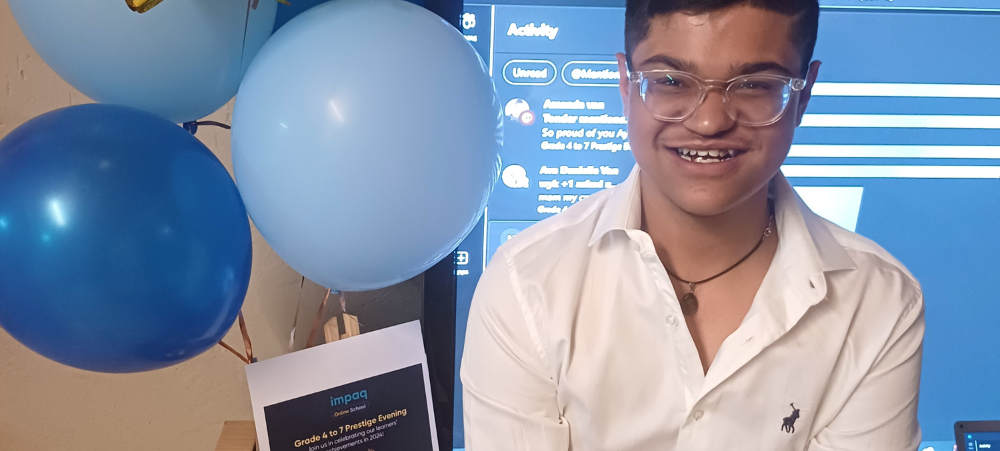
Education is fundamental to a child’s development, but for learners with medical challenges, traditional schooling can present significant barriers. The rigid structure of conventional schools often cannot accommodate the complex needs of children who require medical equipment, frequent treatments, or extended recovery periods. For Ayaan Bhoopal, a 15-year-old Grade 8 learner from Buccleuch with a compromised immune system and complex heart and lung conditions, traditional schooling simply could not accommodate his needs. Instead, homeschooling emerged as a practical solution. Ayaan is living with Tricuspid Atresia Type 2C and Pulmonary Vein Stenosis and has endured six open-heart surgeries, requiring 24-hour oxygen support and ongoing medical care. Since the global Covid-19 pandemic, and in response to escalating health challenges, Ayaan transitioned from traditional education to homeschooling, and later to a full online programme with Impaq Online School, learning from home in a structured, CAPS-aligned environment supported by a team of dedicated teachers. “Homeschooling gave Ayaan a sense of purpose and motivation,” his mother, Seshma, shares. “It allowed him to continue learning while managing his health safely and flexibly. His online classroom is a space where he feels seen, supported, and inspired.” A Learning Model That Adapts to Medical Realities For learners like Ayaan, flexibility in his daily or weekly routine is essential. Ayaan’s day-to-day life includes managing a home oxygen concentrator, saturation monitor, medication, and therapies. His learning environment must therefore adapt accordingly. The online format allows his family to structure lessons around medical appointments, rest, and therapy, without losing academic momentum. “The structure and support from Impaq have been phenomenal,” says Seshma. “Even when Ayaan was in ICU last year, he tried to log in for classes whenever possible. His teachers showed incredible empathy and adaptability, modifying content to help him stay on track without pressure.” Beyond academics, Ayaan’s learning experience has been holistic and joyful. Impaq Online School incorporates co-curricular activities such as Art Exhibitions, Talent Shows, Friday Dress-Up Days, Prestige Evenings, and E-sports Gaming, allowing learners like Ayaan to feel included, creative, and connected. He also benefits emotionally from having his support dog with him during lessons, helping him maintain calm, focus, and emotional well-being throughout the day. The Challenges and Commitments of Homeschooling Homeschooling has not come without its challenges. The model requires a high level of self-discipline, structure, and support at home. But Ayaan’s determination, combined with his family’s commitment and Impaq’s responsive academic team, makes this system work. “Ayaan is a self-disciplined learner,” his mother says. “He follows the CAPS curriculum closely, sets his own goals, and shows pride in his progress. Impaq has helped make this a lifestyle that suits him, removing unnecessary social pressures while keeping him academically engaged.” A System That Listens, Supports, and Encourages Impaq’s success lies not only in the digital infrastructure and curriculum but in the quality of its teacher and learner support systems. According to Seshma, communication with the teaching and support team is open and encouraging, and feedback is meaningful. “Every small achievement is acknowledged,” she explains. “Teachers know their learners, offer encouragement, and adapt where necessary. It’s not just about marks, it’s about perseverance, and Impaq understands that.” Even during one of Ayaan’s most medically difficult years, he remained connected to his schoolwork, driven by a strong desire to keep learning. His teachers provided flexibility without compromise, adjusting expectations while maintaining quality. This balance allowed Ayaan to feel part of something bigger, despite the isolation that can come with severe medical conditions. “Ayaan’s education is not just about academic progress,” says Seshma. “It’s about empowerment, identity, and being part of a community that values his contribution, no matter his limitations.”

Impaq

Why Homeschooling Could Be the Ultimate Family Bonding Experience

When parents think about home and online schooling, the first thing that often comes to mind is academics: lesson plans, assessments, and schedules. But what’s often overlooked is one of its most powerful and lasting outcomes: the opportunity to strengthen family bonds through shared learning experiences. In an age of increasingly busy routines, tight schedules, and time spent apart, home and online schooling offers families something invaluable – the chance to grow and learn together. At Impaq, we’ve seen firsthand how the homeschooling journey becomes a way for families to reconnect, collaborate, and support one another in meaningful ways. Learning Together, Growing Together Unlike traditional schooling, where parents and children spend most of the day apart, home and online schooling allows families to take a more active role in one another’s daily lives. Parents now also become facilitators, mentors, and motivators. This creates space for meaningful conversations, collaborative problem-solving, and mutual support. “Homeschooling isn’t just about working through a syllabus at home,” says Louise Schoonwinkel, Managing Director at Optimi Schooling, of which Impaq is a registered trademark. “It’s about learning as a unit – celebrating progress, overcoming challenges together, and creating a shared educational journey that brings families closer.” A great example of this is Inge Thompson, a mother of three who is currently completing her Visual Arts course through Impaq’s homeschooling programme. Having returned to formal education later in life, Inge’s story is a reminder that learning doesn’t end after school, and that the home schooling model allows individuals and families to embrace lifelong learning together. “For these three years, I’ve told myself I just want to learn as much as I can and get this input for myself. It’s an enriching experience, and I want to give it my best,” says Inge. A Flexible Model That Adapts to Your Life Every family is different. That’s why flexibility in learning is so important. With Impaq’s structured curriculum, families can maintain academic progress while still creating space for real-life learning and everyday experiences. Whether it’s exploring nature, working on a science experiment in the kitchen, or reading together as a group, families can turn ordinary moments into valuable educational opportunities. “Our curriculum is designed to provide structure and guidance while giving families the flexibility to make learning personal and relevant,” says Schoonwinkel.  Even for adults returning to learning, this structure provides focus and momentum. Inge shares how the Impaq curriculum has helped her stay on track, “Impaq’s curriculum is really well set up. Even as a mom of three and an entrepreneur, the structure and deadlines help me stay focused and finish what I start – something I’ve struggled with in the past.” Support Every Step of the Way We understand that starting a home or online schooling journey can feel overwhelming, especially for families new to the experience. That’s why Impaq provides ongoing support, from subject specialists and tutors to easy-to-use online platforms and tools. This allows parents to focus on what matters most – supporting their children and creating a positive learning environment at home. “What makes home and online schooling work is not just the curriculum, but the confidence parents feel when they know they’re not doing it alone,” adds Schoonwinkel. “We walk the path with families, providing the structure and the support they need to succeed.” For learners like Inge, this support has been crucial. “I’m not just learning how to create a pretty picture – I’m learning to make art with meaning. That’s the real value of this journey.”

Impaq

Autism Awareness Month: Autism Spectrum Disorder and the Need for Effective School Alternatives

Autism spectrum disorder. It’s a complex topic, to say the least, and one that presents countless challenges to the parents, caregivers and teachers of affected children. While designated days like World Autism Awareness Day in April is an important part of creating awareness about autism, the challenges remain plentiful. Not least among the challenges is finding a suitable school for the child on the spectrum. The reality for many hundreds of children on the spectrum is that they simply have to cope in a mainstream environment, due to the lack of options. One alternative in this regard is home and online learning as it provides structured, curriculum-aligned education that can simply and effectively be tailored to meet the individual needs of the learner in question.  Education today is about putting the needs of the learner first, which starts with the acknowledgement that the days of a one-size-fits-all approach are both outdated and simply no longer necessary. Alternative options, like homeschooling, bear exploring if we are serious about ensuring our children get a relevant education, while taking the needs of the learner and his/her family into consideration.  A common concern for parents considering homeschooling is whether their child will miss out on social experiences. The reality is that home and online schooled learners often have more flexibility to engage in activities outside of a school setting. Joining homeschooling groups, sports clubs, or online communities can help learners build strong social connections.  For families with children involved in sports, music, or other demanding activities, home and online schooling provides the flexibility to balance education with personal passions. It also allows for real-life learning experiences that bring lessons to life in ways that textbooks cannot. Importantly, homeschooling does not mean children need to be formally educated by their parents. Parents, or caregivers, play a supporting role in homeschooling, and do not need to take on the role of teacher.  One of the biggest challenges in traditional schooling is that every child is expected to learn at the same speed. Some children grasp concepts quickly and feel unchallenged, while others need more time and may fall behind. Homeschooling removes these pressures, allowing learners to master subjects at their own pace. This creates a deeper understanding of the material and fosters a love for learning, rather than just studying to pass exams. Unlike in a traditional school where subject choices can be limited by resources, home and online schooling offers learners more flexibility to explore their interests. Whether it’s advanced mathematics, coding, creative arts, or entrepreneurship, learners have the freedom to shape their education in a way that aligns with their future aspirations. This personalised approach makes learning more meaningful and engaging. Ultimately, parents know what’s best for their child. If homeschooling aligns with your family’s needs, trust your decision and embrace the flexibility, quality, and opportunity it offers. By Louise Schoonwinkel, MD at Optimi Schooling of which Impaq is a registered trademark

Impaq

Bela Bill: What it means for parents and how Impaq stays unshaken by the shift

The Basic Education Laws Amendment (BELA) Bill stays a hot topic for South African parents. But more so for those who homeschool their children. With its recent progress through Parliament, parents are asking: What does this mean for homeschooling? How will it affect my child’s education? Impaq stands firm in guiding parents and learners through this evolving landscape. So, let’s dive into what you need to know and how we’re staying ahead of the shift. Home education is here to stay Homeschooling is still a legal and valid alternative to traditional schooling. Despite concerns, the BELA Bill does not change this right. However, it does reinforce a few registration requirements for homeschooled learners. Parents of learners in Grades 1 to 9 must now register their children with their Provincial Department of Education. Although this rule has existed for years, the government now strongly emphasises it. While this may seem like an extra step, registration ensures: Curriculum and assessments: what stays the same? The biggest concern about the BELA Bill is the department’s oversight of home education curriculums. This regulation is not new. South Africa’s national curriculum (CAPS) has always provided a clear learning framework for schools and parents. Parents still have the freedom to structure their child’s education if their curriculum aligns with CAPs. Impaq ensures that all learning materials and assessments exceed these benchmarks, giving parents peace of mind. The BELA Bill also confirms that FET learners (Grades 10–12) must register with a credible assessment body to earn their National Senior Certificate (NSC). Impaq learners are registered with SACAI, a Umalusi-accredited body. This ensures their qualifications stay credible, both nationally and internationally. The role of tutors and support systems The BELA Bill also clarifies the role of tutors. While tutors stay an important support system for homeschooling families, they cannot function as independent schools. They must not present themselves as institutions or independently issue report cards. Impaq ensures tutors work with parents. The goal is to ease learning rather than replace the home-educating parent. The Optimi Learning Portal (OLP) stays the digital platform that helps parents in many ways. It allows parents to keep the learning journey structured and compliant by allowing them to: How Impaq stays unshaken While the BELA Bill introduces procedural changes, Impaq has been running within these guidelines for years. Our structured homeschooling approach ensures that learners: We empower parents and learners by removing obstacles rather than creating them. That’s why we continue to streamline the registration process, provide clear guidance, and ensure our resources meet all legal and quality assurance requirements. What should parents do now? If you are currently homeschooling—or considering it—here’s how you can stay ahead: The future of home education Change can be unsettling, but home education stays a thriving and credible choice with the right information and support. Impaq is still committed to walking this journey with parents, ensuring that learners receive a high-quality education that is recognized and respected. The BELA Bill is not the end of homeschooling—it’s another chapter in its evolution. With Impaq by your side, you can confidently move forward, knowing your child’s education is in good hands.

Impaq

Making the Switch: A Practical Guide to Home & Online Schooling An Alternative to Education

Every year, thousands of parents face uncertainty when it comes to school placements. With limited space in schools, many families find themselves in limbo, waiting for a placement that may not align with their child’s needs.  The good news is that parents don’t have to compromise on their child’s education. Home and online learning offer a structured, high-quality alternative that ensures continuity in learning without the stress of waiting lists, overcrowded classrooms, or placement delays.  If you are considering this route, here’s a practical guide to transitioning from traditional schooling to homeschooling. 1. Understand the Reasons and Benefits of Homeschooling Before making the transition, it’s essential to understand why homeschooling might be the right choice for your family. Some of the key benefits include: 2. Choose the Right Curriculum The first step in homeschooling is selecting the right curriculum. This decision should align with your child’s learning needs, future aspirations, and local education regulations. Impaq offers a CAPS-aligned curriculum, ensuring that homeschooled learners remain on par with their peers in mainstream schools. 3. Set Up a Learning-Friendly Space A dedicated, quiet, and well-equipped learning space at home can help learners focus and stay engaged. Ensure the area has all necessary learning materials, including a computer, internet access, and stationery. 4. Establish Clear Routines and Boundaries One of the biggest adjustments when moving from a traditional school setting to homeschooling is defining a clear structure. Create a daily schedule that includes learning time, breaks, and extracurricular activities to maintain balance. 5. Maintain Social Interaction A common concern for parents considering homeschooling is whether their child will miss out on social experiences. The reality is that home and online schooled learners often have more flexibility to engage in activities outside of a school setting. Joining homeschooling groups, sports clubs, or online communities can help learners build strong social connections. 6. Monitor Progress and Adapt as Needed Assessing your child’s progress regularly is key to ensuring they stay on track. Whether through formal tests, projects, or discussions, keep track of their learning and adjust teaching methods where necessary. 7. Understand the Legal Requirements Parents must ensure they comply with local homeschooling regulations, including registering their child as a homeschooler where required. 8. Prepare for Challenges Like any change, transitioning to homeschooling comes with its challenges. It may take time to find the right rhythm, and learners may initially resist the change. However, with patience, support, and access to experienced subject specialists, homeschooling can become an effective and rewarding education model. 9. Foster Independence in Learning Homeschooling encourages learners to take responsibility for their own education. Encourage self-directed projects and independent learning to help build confidence and a love for learning. 10. Trust the Process Ultimately, parents know what’s best for their child. If homeschooling aligns with your family’s needs, trust your decision and embrace the flexibility, quality, and opportunity it offers. Education Without Compromise With school placements remaining a challenge, home and online schooling presents a viable and structured alternative. No child should have to put their education on hold while waiting for a placement. By making the switch, parents can ensure that their child receives a consistent, high-quality education tailored to their needs. The choice is clear – education should work for the learner, not the other way around.  #EducationTheWayYouWantIt

Impaq

Start off strong with alternative education in 2025

As you look ahead to the new school year, you’re probably searching for learning options that not only reflect your family’s values but also nurture your child’s overall well-being. Alternative education – such as homeschooling and online schooling – can help you achieve just that. It offers the freedom to step away from the traditional system’s constraints and craft a learning environment that truly supports your child’s growth.  With more flexibility to plan your day and study from anywhere – and step-by-step guidance from specialist teachers – alternative education lays the foundation for your child’s success in 2025.  Why alternative education makes sense  Traditional schooling can come with hurdles like limited classroom capacity and a one-size-fits-all approach to education. These often add stress and take your focus away from what’s really important: helping your child thrive. By choosing alternative education, you can enjoy:  If your child is working toward their National Senior Certificate (NSC), or matric, alternative education can provide a well-structured environment that helps them succeed academically and personally – setting them up for a confident start to the new year.  Crucial resources for back-to-school success  To make the most of 2025, consider partnering with leading alternative education providers who can offer additional support. This can include:  These tools help you create a learning environment that maximises your child’s potential. That said, the benefits of home- and online schooling go well beyond your learner’s academic results.  Mental health advantages of alternative education  In many traditional school settings, issues like bullying and a lack of classroom capacity can add stress for both you and your child. By contrast, homeschooling and online schooling prioritise emotional well-being. Your child can feel safe, focused, and free to learn in a caring, personalised setting without unnecessary distractions or pressure.  https://www.facebook.com/ImpaqOnlineSchool/videos/1831605564255216 You’ll also find peace of mind by playing an active role in their education. This empowerment can bring a deep sense of fulfilment as you watch your child develop a strong sense of identity, values, and self-confidence – traits that traditional schooling might not always foster.  Ready to make 2025 extraordinary for your child?   At Impaq, we understand the importance of an education that nurtures the whole learner. Let’s work together to make this a year of excellence. Register your child for our homeschooling or online school program today! 

Impaq

Preparing for the future: fostering an entrepreneurial mindset

In today’s fast-paced world, parenting means more than just meeting our children’s basic needs. As parents and educators, we are responsible for equipping them with the skills, knowledge, and mindset to help them thrive in a rapidly changing global economy. The rise of automation, AI, and globalisation has transformed the job market, making traditional career paths more uncertain. Fostering an entrepreneurial mindset in our children is more important than ever to ensure they can navigate the unpredictable landscape at the end of their schooling journey. Mindset matters Raising the entrepreneurs of tomorrow doesn’t necessarily mean you need to turn your child into the next Steve Jobs. Instead, it’s about nurturing the attributes they need to succeed in their chosen path. An entrepreneurial mindset includes: Resilience and optimism: The ability to overcome challenges and setbacks and maintain a positive outlook. Creativity and innovation: Thinking outside the box and developing original ideas. Self-reliance and accountability: Taking ownership of decisions, actions, and their consequences. Financial literacy: Understanding how to work with money and make smart financial choices. Effective communication and teamwork: Being able to express ideas clearly and work effectively with others to achieve common goals. Curiosity: Maintaining a passion for learning and exploring new ideas. Young Entrepreneurs: helping your child discover their inner CEO The good news is that you don’t have to be an entrepreneur to encourage these qualities in your children. With our range of Young Entrepreneurs courses for learners aged 7 to 16, you can future-proof your child’s success! Visit Optimi Plus today to explore the Young Entrepreneurs product range, which includes: Business Savvy Minipreneurs (ages 7 to 8) Business Savvy Kidpreneurs (ages 9 to 12) Business Savvy Bizteens (ages 13 to 15) The Business Savvy range of courses will equip your child with essential 21st-century skills. Over 15 weeks of engaging, one-hour-long sessions, you will embark on a journey to foster an entrepreneurial mindset and develop key business and financial literacy skills. Each course has multiple levels to help facilitate lifelong learning, but you are not required to complete a specific level before moving on to the next one. Licence to Lead (ages 16+) The Licence to Lead course for learners aged 16 and above is more than just another online programme – it’s an investment in your teen’s future. In this self-paced course, learners get access to 80 video lessons to help them develop 13 essential attributes for the world of work and business, including self-assessments and worksheets, key insights into informed decision-making for life after school, workplace readiness and essential EQ skills. Practical tips and tricks for fostering an entrepreneurial mindset in children Here are some simple and practical ways to cultivate an entrepreneurial mindset: Encourage problem-solving Expose your children to real-world challenges and ask them to brainstorm solutions. This helps develop critical thinking and creativity. Promote independence Give your children opportunities to take responsibility for specific tasks and make decisions independently. Allow them to manage their time, set personal goals, and track their progress. Foster creativity Offer outlets for creative expression, through art, writing, or music. Encourage your children to think of new ways to use ordinary objects or solve everyday problems. Teach financial literacy Start teaching the basics of budgeting, saving, and managing money. Discuss household finances, helping them learn the value of financial planning. Build communication skills Encourage open dialogue within the family. Provide opportunities for public speaking, whether presenting a project at home or speaking in a group setting. Cultivate curiosity Homeschooling offers a unique opportunity for your children to explore their interests. Encourage them to ask questions and seek answers through books, documentaries, or online courses. Model resilience Share your own experiences with failure and how you bounced back from setbacks. Celebrate effort and persistence as much as success, showing your children that resilience is a vital part of life’s journey. Encourage teamwork Involve your children in group projects or collaborative activities. Teach them the importance of cooperation, listening, and contributing to a team effort. Read more: How to foster resilience in children The future of work is unpredictable, but one thing is clear: our children will need to adapt to a rapidly changing world. By nurturing an entrepreneurial mindset, we can help our children build the skills and resilience they need to succeed in any environment. In doing this, you can empower your child to become adaptable, resourceful, and self-sufficient in an evolving job market.

Impaq

Impaq: We provide education the way you want it

At Impaq, we believe that your child’s education should be as unique as they are.  Whether it’s the flexibility of Impaq Homeschooling that appeals to you, or if you prefer the structured virtual classroom of the Impaq Online School, your child’s learning journey should match their talents and passions. Let’s look at how Impaq can help you choose a learning experience that inspires a lifelong love of learning. Learn at your own pace with Impaq Homeschooling At Impaq Homeschooling, we empower you to take control of your child’s education. With engaging textbooks, step-by-step support, and thousands of additional resources, we provide all the tools you need to create a personalised homeschooling journey for your learner in Grade R to 12! Key benefits of Impaq Homeschooling: Flexibility: Learn at your own pace and create a schedule that suits your family. We provide suggested timetables, but you stay in control of your schedule.*  Customisation: Choose the subjects and learning materials that align with your child’s needs and interests. For learners in Grades 10 to 12, we offer elective subjects that are not always offered at traditional schools, including Agricultural Sciences, Dramatic Arts, Engineering Graphics and Design, and more! Support: Benefit from the step-by-step guidance in our facilitator’s guides or ask our qualified subject specialists for additional academic support. Real-time progress tracking: Our user-friendly online platform, the Optimi Learning Portal, helps you to easily navigate your child’s learning journey. Monitor their progress, submit their marks and generate report cards, all in one place. *SACAI rules and regulations apply for distance education learners in the FET Phase (Grades 10 to 12). Set timetables for tests and exams must be followed strictly. How it works: As an Impaq Homeschooling parent, you become your child’s main teacher. We provide the resources and support to help you navigate the learning process. With access to live and recorded online lessons and additional materials, you can tailor the learning experience to your child’s unique needs. Plus, our expert team is always available to offer further guidance. You can also enlist the services of an independent tutor for subject-specific support and additional services. Get full-time, structured schooling at the Impaq Online School For parents seeking a more structured classroom environment, the Impaq Online School offers a dynamic and engaging learning experience for learners in Grades 4 to 12. With live online classes taught by qualified teachers, your child will receive a comprehensive education while interacting with classmates across the country. Key benefits of the Impaq Online School: Live interaction: Engage in real-time learning with qualified teachers and connect and collaborate with classmates during group activities, fun virtual clubs, or online events. Structure: Benefit from a full-time school schedule with a set assessment plan. Online invigilation: Our qualified teachers oversee and mark all tests, exams, practical assessment tasks (PATs), and orals.  Holistic development: Enjoy wellness programs, fitness classes, and counselling support.   Digital literacy: Develop essential digital skills for success in the 21st century with our Information and Communications Technology classes. How it works: The Impaq Online School operates much like a conventional school, except that our classes take place online. Our qualified teachers present live classes daily, mark all our learners’ assessments, and give parents regular feedback on academic progress and performance.   Get matric with us Did you know that our books are CAPS-aligned? All Impaq’s lesson material and assessments for both Impaq Homeschooling and the Impaq Online School are aligned with the Curriculum and Assessment Policy Statement. This means that at the end of Grade 12, your child will receive the same National Senior Certificate as matriculants in traditional schools. Impaq registers all Grade 10 to 12 learners with the South African examination board, SACAI. A new way of learning Whether you prefer the flexibility of homeschooling or the structure of online learning, we are committed to providing your child with a high-quality education that fits their unique needs. Join our thriving community of learners and experience the difference. Register here for 2025 and get your education the way you want it. 

Impaq

From classroom to clicks: how to make the switch to online learning

The educational landscape is evolving, with more and more South African families embracing online schooling as an alternative to traditional schools. Getting quality education from the comfort of your home has never been easier, but is online schooling the right choice for your family, and how do you make the switch to online learning? With the right approach, swapping the brick-and-mortar classroom for a virtual one can be a smooth and rewarding journey. Structuring success: Maintaining a structured routine Maintaining a structured routine is one of the biggest adjustments when moving to online schooling. At the Impaq Online School, we offer full-time, structured schooling with a fixed timetable for learners from Grades 4 to 12. This structure creates a stable learning environment while fostering self-discipline, which allows learners to develop strong organisational skills. Tip: Create a dedicated learning space at home. Having a specific space for schoolwork can help learners distinguish between when it’s time to learn and when they can use their time for leisure.   Read more: Studying from home: Impaq learners and parents share their tips Live and interactive: Make online learning click Unlike some online programmes, the Impaq Online School offers live, interactive classes led by qualified teachers. This allows learners to engage in real-time discussions, ask questions, and receive immediate feedback. Tip: Encourage your child to prepare for and actively participate in their online classes. Interacting with teachers and classmates can enhance their understanding and retention of the material being covered. Guided growth: Personalised feedback and support Consistent feedback is essential for academic growth. At the Impaq Online School, we are dedicated to each child’s development. We ensure that learners receive regular feedback on their performance and provide personalised support to help them reach their full potential. Tip: Review your learner’s progress reports to understand their strengths and areas for improvement. You can also contact the relevant teacher for additional resources and support to help your child stay on track. Connect and collaborate: The social side of online learning A common misconception about online schooling is that it’s an isolating experience. However, at the Impaq Online School, we value social interaction and collaboration – from group activities to virtual clubs and online events, learners have numerous opportunities to connect and collaborate with their peers. Tip: The Impaq Online School is a bully-free space. Encourage your child to join in on group projects or participate in any of our exciting virtual events to help develop social skills and make their online schooling experience more fulfilling. Read more: Inspiring journeys: success stories from the Impaq Online School Beyond academics: Building healthy habits At the Impaq Online School, we know that physical health and emotional wellbeing are key contributors to your child’s overall development. That’s why we incorporate fitness and wellness sessions into the timetable and use the It’sOK app to ensure that learners stay active and well-balanced.   Tip: Remind your learner to take regular breaks and to make time for leisure activities. A balanced routine can improve concentration and reduce stress. The Impaq Online School counsellor is also available to all registered learners for additional support and advice. Read more: Beating burnout: mental wellness for online learners Tech titans: empowering learners for a digital future Digital literacy is the cornerstone of online learning. Our focus on Information and Communications Technology (ICT) helps learners succeed in their day-to-day online learning activities and prepares them for their future careers in a technology-driven world. Tip: The Impaq Online School provides a comprehensive induction course. Review the course with your learner to ensure that they are ready to hit the ground running! You can also find an overview of the systems we use here. Read more: Tech troubles: overcoming common challenges in the digital classroom A new way of learning: investing in your child’s future   Transitioning from traditional school to online learning can open up a world of opportunities for your child. By choosing the Impaq Online School, you’re not just embracing a new way of learning; you’re investing in your child’s future. Make the switch today! Register online or call us on 087 405 2233.

Impaq

Inspiring journeys: Success stories from the Impaq Online School

Meet three students who have found themselves thriving at the Impaq Online School. With diverse backgrounds, each student brings a unique perspective to the digital classroom. We learn more about how they have adapted to this new way of learning and how they have transformed along the way. Choosing the Impaq Online School Grade 11 Impaq Online School learner Matthew J Dunn switched from homeschooling to online schooling in 2023. Grade 9 learners Kalyn Payne and Carla Roets switched from classroom walls to digital calls at the start of 2024.   For Matthew, switching to online learning gave him the freedom of flexibility: “The Impaq Online School is more travel-friendly than traditional schooling because I can learn from anywhere”. But besides being a school you can pack in a bag, online schooling has proved to be an effective strategy to beat the bullies. Kalyn’s mom, Ronel Payne, says that Kalyn was being bullied at her previous school. “Not only did this impact her emotionally, but it also affected her schoolwork,” Ronel explains. They decided to switch to online learning to see if it would make things easier for Kalyn, and it did: “I now have a changed child at home,” Ronel says. “I have a happy child for the first time in a long time,” she adds. Many parents feel that their kids get lost in traditional brick-and-mortar schools. This was the case for Carla, who says she made the switch because she wasn’t doing as well as she wanted to. “The Impaq Online School offered me a fresh start,” she explains. The best of IOS Not only did Carla get a fresh start at her new school, but she could now also enjoy the daily interactive classes. Carla says she loves connecting with her peers: “I love to participate in class conversation with the teachers and my classmates”. However, these connections are not limited to school hours, as Carla made three new best friends. “I can be myself with them,” she adds. Ronel says that what she and Kalyn enjoy the most about the Impaq Online School is that there is no pressure around sports and extramural activities. At the Impaq Online School, learners receive a holistic education with mental wellness and physical activities included in the school timetable. Read more: Winter warriors: How to stay active in the cold On the other hand, Matthew says he enjoys the special events the most. The Impaq Online School hosts fun events throughout the year to encourage student participation. Matthew’s favourite is the virtual bake-off.   Learners can also join mentored social clubs, including the Impaq Online School leadership team and journalism club. Experiencing the difference Matthew, Kalyn and Carla say that they love learning online! When we asked what they liked most about the Impaq Online School (as opposed to a traditional school environment), they had a whole list of benefits: More freedom and flexibility to embrace hobbies. Great peer engagement. Fun virtual events. Never worry about transport. No concerns about fitting in at school. No more school uniforms. More options when it comes to subject choices. Also read: Do’s and don’ts of online learning A 5-star learning experience At the Impaq Online School, our SACE-registered teachers are passionate about making a difference. Ronel says that Kalyn loves her teachers. “Kalyn is no longer afraid to send an email or speak to any of the teachers. This was a concern in normal school as Kalyn never asked questions,” Ronel explains. Matthew also says that a helping hand is always close by. “All my teachers are always ready to assist with any of my questions”, he adds. “If I could give Impaq a rating, it would have to be 5/5 stars!”. Carla agrees and says that her teachers are kind and helpful.   Strategies for online learning success Matthews says that when he is faced with a challenge, the Impaq Online School provides him with many solutions. Here’s how he goes about it: He watches educational videos on the Optimi Learning Portal (OLP). He reaches out to the specific subject teacher for extra classes. He asks his homeroom teacher for clarification on the issue. Carla says it was challenging to start again with different learning methods, but she was willing to work hard and focus on understanding all her subjects. Ronel says that so far, it has been smooth sailing for Kalyn. “I love what I have seen,” Ronel says. She explains that Kalyn now understands the work and no longer complains that it is too difficult. At the Impaq Online School, learners get additional academic support through extra classes, intervention classes, master classes, and the Grade 12 Winter School.   Thriving in the virtual classroom Switching to the Impaq Online School has been transformative for Kalyn. Ronel notes a positive change in her personality: “She is friendlier and more excited about projects”. Achieving 80% on a task for the first time reflects her newfound dedication to academics. “Now she cares, and she puts the effort in,” Ronel adds. Carla agrees: “I have more confidence in myself now that I am able to achieve what I set my mind to”. Also read: Beating burnout: mental wellness for online learners Matthew, already a top achiever, credits Impaq for further academic advancement. He cheekily adds that his favourite experience at the Impaq Online School is the award ceremony. The transformative power of online learning Kalyn, Carla, and Matthew’s success stories show the profound impact online learning has had on not only their academic journeys but also their personal wellbeing. From newfound enthusiasm and dedication to enhanced confidence and continued academic excellence, their experiences underscore the transformative potential of online learning.   Are you ready to make the change? Click here to learn more about the Impaq Online School or contact us at [email protected].

Impaq

Nurture a love for learning: five strategies for homeschooling success

One of the greatest gifts we can give our children is a genuine love for learning. As a homeschooling parent, you have the unique opportunity to nurture a love for learning at home. Embrace the freedom, tailor the journey, and witness the wonder of a child who loves to learn, not because they have to, but because they can’t wait to see what’s next.  Here are our top tips for nurturing a love for learning at home: #1 Pursue their passions Learning is more exciting when you are learning about something you love. Encourage your learner to explore topics that spark their interest and curiosity – whether it’s learning about dinosaurs, outer space, fashion, or art.  The 10 Habits of Successful Learners course can help you enhance this approach by providing tailored strategies to deepen understanding and retain knowledge. By aligning learning with their interests, you can fuel your child’s intrinsic motivation and inspire a lifelong love for learning. #2 Make learning engaging Learning doesn’t have to be confined to textbooks and worksheets. Why not look for creative ways to make learning fun and interactive? Consider integrating educational games, hands-on experiments, or outdoor exploration into your lesson plans. By making learning fun and interactive, you spark curiosity and creativity in your child’s education.  Read more: Boost learning by going outside #3 Foster a growth mindset Encourage your child to embrace challenges and consider mistakes as opportunities for growth instead of catastrophic setbacks. It’s not about how many times they fall, but about how many times they get back up again! Skill and ability can be developed through dedication and effort.  Read more: If at first you don’t succeed, try, try again The 10 Habits of Successful Learners: Parent Pack includes a step-by-step guide for parents and valuable tips on how to support your child’s learning journey and get them back on track with a more positive mindset. #4 Celebrate progress and achievements Remember to acknowledge and celebrate your child’s accomplishments, no matter how small! Whether it’s mastering a new concept or completing a challenging task, recognition boosts confidence and motivation. Facilitating this by setting achievable goals, tracking your learner’s progress, and celebrating milestones along their learning journey is essential. Also read: How to reward your kids the right way #5 Lead by example Show your child that learning is a lifelong adventure by modelling a love for learning yourself. This can also be an excellent opportunity to bond by sharing your interests and hobbies, reading books together, exploring new ideas and engaging in thoughtful discussions. With the 10 Habits of Successful Learners course, aimed at learners in Grades 4 to 12, you can nurture a lifelong love for learning and truly set the stage for success in all areas of life.  Kyra Roodt

Impaq

The power of play-based learning for homeschoolers

Building elaborate forts out of blankets or transforming cardboard boxes into spaceships is not just child’s play; it’s play-based learning in action. Between the giggles and make-believe, your child is developing their critical thinking and problem-solving skills. Play-based learning can be transformative, especially for homeschooling learners.  Beyond fun and games: The science of play  Children are naturally curious and imaginative beings. Play-based learning taps into these innate qualities, making education an exciting adventure. But play-based learning is not just a welcome break from textbooks – it’s essential for development. Playing with your learner has many benefits, including: Boosted creativity and imagination: Open-ended play allows children to experiment, take risks, and build new worlds – the foundation of innovative thinking. Sharpened critical thinking and problem-solving: From navigating pretend traffic jams to figuring out how to build the tallest tower, play presents endless challenges that develop mental agility and resourcefulness. Fostering social and emotional intelligence: Through collaborative play, children learn to communicate, negotiate, and empathise, building their capacity for healthy relationships. Boosted confidence and self-esteem: Mastering challenges in a playful environment fosters a sense of competence and a love for learning that fuels perseverance and achievement. Here’s how to integrate this learning tool with plenty of playful possibilities from Optimi Plus. Create a playful environment Set the stage for creativity by establishing a dedicated play space. A conducive environment is vital – dedicate a corner in your house or a specific time to play during the day. Prepare the space by including role-playing toys and activities. Whether it’s pretending to be astronauts exploring space or chefs in a bustling kitchen, imaginative play will help your little one think outside the box. Embrace open-ended toys Blocks, paints, playdough, and natural materials like leaves and sticks encourage open-ended exploration and imaginative storytelling. These activities stimulate cognitive development and enhance problem-solving skills.  Encourage your child to express themselves freely through drawings, stories, and even doodles – you’ll be amazed at the creativity that unfolds. If you still need stationery for the year, unleash your child’s creativity and develop their gross and fine motor skills with the Stationery Packs available on Optimi Plus.   Craft your own adventures  One of the key elements in play-based learning is the emphasis on early literacy. And what better way to foster a love for reading than with the Foundation Phase Readers from Optimi Plus? These captivating stories, brimming with colourful illustrations and imaginative characters, not only improve reading skills but also open the door to a world of imagination.  Encourage your child to craft their own adventures, re-interpreting storylines or creating new ones. Let them act out scenes, invent dialogue, and build worlds beyond the printed page. Integrate technology mindfully Leverage the power of technology and include educational games and interactive learning experiences. Apps such as Cami can provide a fun and engaging way to reinforce concepts learned in more traditional lessons. Nurture a genuine passion for reading with Cami Literacy or foster a mathematical mindset and problem-solving abilities with Cami Maths. You can even take your child on a virtual safari through the African bush! Safari Academy 101 is a new and exciting e-learning course that empowers learners with first-hand knowledge of wildlife and nature. Encourage your child to create nature journals, write stories about their favourite animals, or even design their own conservation projects inspired by their virtual adventures. Explore hands-on STEM STEM is an acronym that stands for science, technology, engineering, and mathematics. These subjects often intimidate young learners, but infusing play can help your child develop a positive attitude towards these subjects from the start. The Foundation Phase Maths Kit includes hands-on activities to help your little one explore concepts like addition, subtraction, and shapes in a hands-on, interactive way. The kit is ideal for fostering mathematical fluency, reasoning, and problem-solving skills in young learners.   Older learners can also explore STEM concepts through play with Resolute Robotics. The hands-on robotics kit allows learners to build, program, and play with their very own robots. Through experimentation and discovery, your child can develop the following skills: problem-solving,  critical thinking skills, and  creativity. The Optimi Plus advantage At Optimi Plus, we understand the importance of play-based learning in nurturing young minds. From captivating storybooks to interactive learning platforms, we have everything you need to make learning child’s play. Visit www.optimiplus.co.za to unlock the endless possibilities of play-based learning! Sources: https://www.britishcouncil.org/programmes/creative-play/creativity-pretend-play  https://www.nidirect.gov.uk/articles/how-play-helps-childrens-development

Impaq

How Impaq helps you work through the CAPS curriculum

Whether you are a homeschooling veteran or a nervous newcomer, looking at all the content you need to cover can be overwhelming. Luckily, Impaq makes working through the CAPS curriculum easy! All you have to do is pick a grade, complete your registration, and you’ll be provided with everything you need to complete the year at home (and have some fun along the way). Here’s how we help you make learning at home a breeze. Read more here: From CAPS to Cambridge and everything in between Planning for the year ahead   Dale Carnegie knew a thing or two about planning for success as he famously said: “An hour of planning can save you 10 hours of doing”. And by now, you might be wondering how many hours you need to spend planning for the year ahead to save time down the road. The answer? Almost none. With Impaq Homeschooling, the planning is already done for you. We provide carefully crafted lesson plans that tell you exactly how much time you need to spend on each subject, and how to integrate the lesson plans with the learner material. The curriculum is broken down into bite-sized bits to help you and your child know exactly what to focus on during each term. Lesson plans, along with weekly calendars and additional resources are available on the Optimi Learning Portal (OLP). CAPS made easy As a homeschool parent, the CAPS curriculum can seem content-heavy, and you might be wondering what to focus on. As of 2024, Impaq will be providing our learners with a framework of what to concentrate on for each subject. We have organised the content to make it easier for homeschool parents to work through the curriculum challenges and ensure that their child masters the basic concepts. All these resources can be found on OLP. All the support you need   As a homeschooling parent, you will receive your very own facilitator’s guides to help you teach your child at home. These detailed guides accompany the lesson material your child receives and give you step-by-step guidance to set your child up for success. Prepping for tests and examinations is also made easy as you can find suggested timetables for Grades 4 to 9 on OLP. You can then decide whether to stick to these timetables or to create your own. Grade 10 to 12 learners write tests and exams according to a strict timetable If you find yourself needing some additional support, especially in certain subject areas such as Mathematics and Physical Sciences, you can reach out to our team of education specialists. They are always happy to assist and support parents with any academic queries. You can also find the answers to most of your homeschooling questions on our client helpdesk. Enjoy online resources The Optimi Learning Portal (OLP) serves as our learning hub and contains a treasure trove of digital resources. Along with the lesson material your child receives, they can find additional resources per subject on OLP, including educational videos, quizzes, previous examination papers, helpful notes and much more. Learners can also easily access both live and pre-recorded subject guidance sessions on OLP. These sessions focus on providing guidance on how to complete specific assessments, revision for more difficult concepts, as well as enrichment lessons. Track your child’s progress   Tracking your child’s progress is as easy as logging in to OLP. With the click of a button, you will be able to see which lessons your child has completed (marked in green) and which lessons they still need to complete (marked in red). You will also be able to capture the marks for their tasks, tests, and examinations (depending on their grade) and generate report cards. The advantage of keeping track of your child’s progress is that you can easily see which subjects or topics they need a bit more help with. This individualised attention ensures that your child fully grasps the concepts before moving on to more advanced topics. A fun adventure Now that the planning is done, the content is sorted, and you have access to additional support, you can spend your time on making learning fun. With everything laid out for you, you’ll have more time to focus on your child and plan exciting excursions and activities. If you find you have some extra time or your child is especially interested in a certain subject or topic, why not incorporate it into your daily lessons? Learn a new language like isiZulu, take up a new hobby such as robotics, learn how to develop successful study habits or take your learner on a virtual adventure through the African bush.   Also read: Say yebo to isiZulu! The benefits of multilingualism Register today With Impaq as your guide, homeschooling has never been easier. Ready to get started? Register online or send an email to [email protected] 

Impaq

There’s no place like (Optimi) Home

Home is more than just a physical space. It is a sense of belonging, comfort, and security. At Optimi Home, we create an environment where Grade R to 12 learners can feel right at home.  Make yourself at home Optimi Home offers two distinct offerings: Impaq Homeschooling and the Impaq Online School. This allows learners to pick a learning pace that works for them. Impaq Homeschooling offers learners a flexible schedule, while the Impaq Online School offers a more structured approach, where qualified teachers present daily online classes according to a fixed schedule. Read more: Take schooling to the next level with the Impaq Online School Find peace of mind  Both Impaq Homeschooling and the Impaq Online School provide learners with quality CAPS-aligned lesson material and resources. Our lesson material has been developed by experts in their relevant fields. With more than 20 years of experience, you can rest assured that our content meets the standards as set out by the Department of Basic Education.  Get all the support you need If you opt for Impaq Homeschooling, we provide detailed facilitator’s guides to help you facilitate the learning process at home. Our education specialists are always on hand to help with academic queries. Read more: How does Impaq help me homeschool my child in 2023? At the Impaq Online School, our qualified teachers guide learners through the content during live online classes and answer learners’ academic questions in real-time. Take the stress out of assessments Homeschool parents will receive all the CAPS-aligned assessment components, such as tasks, tests and examinations, that your child needs to write to complete the grade. At the Impaq Online School, our teachers ensure learners complete the necessary assessments.  All Grade 10 to 12 Impaq learners are registered with the examination board, SACAI, accredited by Umalusi. This means that learners who complete their matric through Optimi Home will receive the National Senior Certificate (NSC), just like they would have if they had attended a public school. Get on like a house on fire When you register with Impaq Homeschooling, you not only join the largest homeschooling curriculum provider in South Africa, but you join a family of over 30 000 learners. We have several Facebook groups that learners and parents can join to connect with other homeschoolers.  At the Impaq Online School, learners are sorted into homerooms and enjoy a year-long journey with their teachers and classmates. Learners also have many opportunities to collaborate while working through their daily lessons.  Be your true self  We encourage our learners to explore the vast array of options available to them. That’s why we offer various elective subjects in Grades 10–12. We also offer isiZulu as a First Additional Language for all grades.  At the Impaq Online School, we are committed to preparing learners for the ever-evolving world of tomorrow. Our classes focus on Computer Literacy and effective communication skills. Read more: Homeschooling with Impaq allows me to conquer the waters of Europe Nurture your body and mind Discover the freedom of learning at your own pace with Impaq Homeschooling! Your learner can organise their schedule to suit their needs*. At the Impaq Online School, we prioritise learners’ overall wellbeing. Fitness classes are incorporated into the timetable, learners can access the It’sOK wellness app, and our experienced counsellor is always available for additional support. Join the Optimi Home family and feel at home. Registrations open on 1 September 2023. Visit our website or email [email protected] to pick your pace for 2024. *Grade 10 – 12 learners must follow a strict test and examination timetable.

Impaq

How to handle angry feelings

Once there was a red balloon that lived in a house with a family. Every day the red balloon got bigger and bigger without anyone noticing. One day the balloon popped with a loud bang and everyone in the house got a nasty fright.  Anger is often like the red balloon in that it builds up slowly over time until it explodes over a seemingly small incident/event. Aggressive behaviour is learned through the modelling of significant others. If you handle your anger like the red balloon, your children might learn that aggression is the best way to deal with uncomfortable emotions. Eventually these emotions could cause school difficulties, anxiety and relationship problems.  Emotional control, however, creates a feeling of security and peace within a family. It is thus important for us as parents to ensure that our emotions and our reactions in response to our emotions are equal. For example, when you are angry, you do not have to express that anger by yelling or throwing things. Feeling angry is not wrong, but the way you express it might be wrong.  As parents we have the responsibility to teach our children how to deal with their emotions in effective and appropriate ways. The following tools can help you manage your emotions more effectively: If you realise that there are often outbursts among family members, write down your emotions and thoughts. Keeping a journal will help you gain perspective. Humour can help you feel more in control over stressful circumstances. Take deep breaths. This will help to not only relieve some of the tension but will also give you a few moments to think more clearly. Focus all your attention on something in your environment or something on yourself, like the garden outside your window or the pattern on your dress or shirt. This technique can help you gain control over your emotions. Research has shown that there is a close link between a healthy marriage and successful parenting. It is therefore a good idea to invest in building a healthy relationship with your wife/husband. A good way to do this is by going away for a weekend or having planned date nights, to help you reconnect with your partner. Build your self-knowledge. Who am I? What is my personality like? Self-knowledge can help you gain insight into your own behaviour and emotions. Be mindful of external factors that could contribute to your emotions. For example, are you eating healthy foods, exercising, getting enough sleep? Are you stressed and worried? 

Scroll to Top