
How to cope with school closures amidst the third wave

As the number of COVID-19 cases continues its upward trend, more stringent lockdown regulations could follow, including the closure of schools and a return to more regular remote learning. 

Several schools have already taken the step to start closing partially or fully amid community or localised outbreaks. In addition, many parents may be taking their children out of school in a bid to protect themselves.

For many parents, especially homeschoolers, this is familiar territory by now, but for others, they may need some extra advice on how to cope with learning at home. We look at five tips on how to cope with school closures.

 

Talk about the current situation

Firstly, have a conversation with your children to make sure that they are calm and understand what is going on regarding the current situation. By now, many children may have a better grip of this situation. However, it’s still important to try to reduce any possible anxiety while also communicating that learning will now occur at home for the next few weeks.

Also read: How to help a child struggling with (coronavirus) anxiety 

Supplement learning with e-learning 

If your child’s school has handed out learning packs, make sure you have them on hand. If possible, look through the lesson material and search the internet to see if there are ways to supplement the learning topics with e-learning. 

There are many providers out there who offer free e-books. One local South African example is this e-book library from Optimi Classroom, which consists of 45 000 free e-books

Stay organised

Being organised is critical. Make a schedule that you and your children agree to and stick to it. You don’t have to follow a strict timetable to complete academic work throughout this period, but having a plan does help. 

If you need assistance with setting up a timetable, we have put together this simple daily schedule to guide you and your children with staying on track during school closures. 
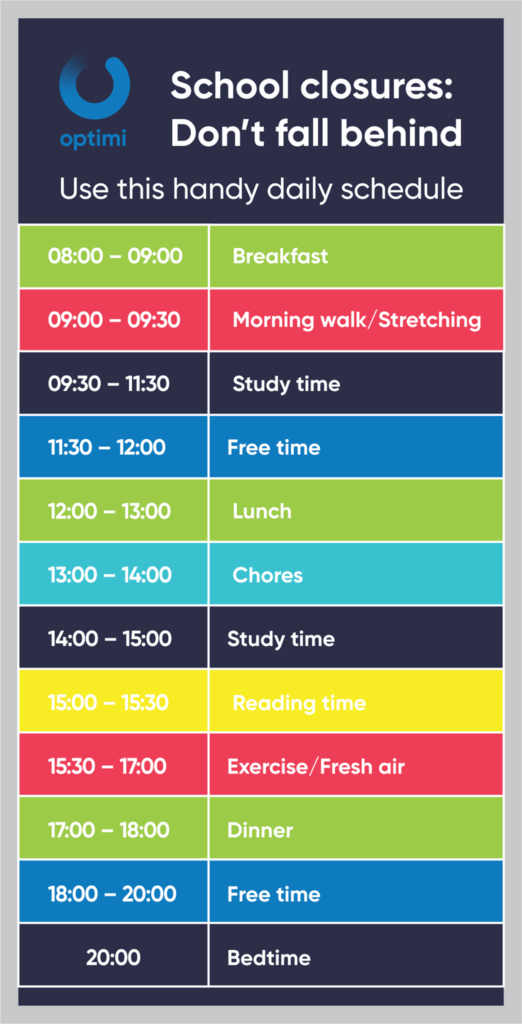
Bear in mind that you might not be able to stick to a timetable if someone in your household is sick, needs to return to work, or do other activities. Your child will then have to adapt the schedule and complete the academic work at another time. However, even loosely sticking to a timetable will help everyone know what is expected while ensuring that learning takes place.

Also read: Ten tips to help you cope with school closures

Exercise

It’s also critical to ensure your children engage in physical activities such as playing in the garden or even going for walks. You can add playtime into your timetable as a reward for completing academic work. 

Apart from this, you can also encourage your children to participate in hobbies or even certain extracurricular activities, where it is deemed safe from a social distancing perspective.

Also read: Why exercise is important for good academic results

Hire a tutor

Finally, if you feel you need extra help and resources, look to credible homeschooling providers out there that follow the CAPS curriculum. Homeschooling providers, such as Impaq, can offer a structured approach to learning and guidance on what to teach and when. Learners can also continue their learning journey at home amidst school closures when registering with a home education provider.

Plus, you do not have to do it alone. There are independent tutors across the country who can meet virtually to help guide you and your children during this time. Calling in a tutor is also a great option when you have children in multiple grades or at different levels; the tutor can work with one child while you help another. In addition, tutors are also a valuable resource for more challenging subjects, especially in the higher grades.

by Louise Schoonwinkel, MD of Optimi Home

Parenting Hub

Leave a Comment

Your email address will not be published. Required fields are marked *

Bullying: What parents and schools can do

ARTICLE BY PROF RITA NIEMANN, NALIZE MARAIS, ZENDRÉ SWANEPOEL AND MONIERA MOOSA

Bullying is a great concern for both parents and schools. Here we outline a number of measures that can help them both parties deal with bullying.

Parents

When parents notice that their child is behaving differently – not wanting to go to school, using illness as an excuse, suddenly performing poorly at school or enuresis – and suspect bullying, they need to act immediately.

Firstly, they must determine where this is happing (at school, at a sports club, on social media, etc.) and who the perpetrator(s) are.

Secondly, if the bullying is taking place in an organised environment such as at school or sports club, the authorities need to be informed and requested to step in. They are legally bound to protect the rights of the child.

Thirdly, parents have the responsibility to equip their children to cope by:

  • Instilling the knowledge that children must take a stand and that they have a choice in allowing someone else to victimise them.
  • Assisting children to terminate relationships that are potentially harmful, such as blocking a person on social media.
  • Helping them to identify bullies and the different forms of bullying.
  • Creating a safe space for children to speak about what is happening to them.
  • Emphasising assertive verbal communication if threatened.
  • Building children’s self-concept.
  • Getting the help of a psychologist, if necessary, to counsel the victim.
  • Emphasising that respectful behaviour is always the best option and thus preventing retaliation.
  • Fostering problem-solving and conflict resolution skills with the focus on restoring damaged relationships.
  • Working collaboratively to solve the problem with their children so that they can feel reassured.

Schools

As bullying is a deliberate act to hurt someone, there must be consequences for the bully. Once teachers are aware that a bullying incident has taken place at school, the matter must be dealt with by:

  • Asking the victim to provide the names of the perpetrator(s), as well as the names of friends of the victim, as soon as he/she has calmed down.
  • Counselling the victim and finding out whether he/she has been injured and what effect the bullying or harassment has had on him or her.
  • Cultivating a “no blame” approach towards bullying or harassment.
  • Establishing punitive sanctions for both the bully and for any bystanders.
  • Developing a bullying code of conduct/bullying policy and informing learners of this.
  • Having designated teachers to deal with incidents of bullying.
  • Facilitating mediation and discussions with the victim and the bully, depending on the severity of the bullying.
  • Passing the responsibility to the bully or group of bullies to make sure that the problem is solved.
  • Ensuring that potential bystanders understand that they have a vital role to play during bullying incidents.
  • Letting the victims feel protected after they have reported the incident.
  • Encouraging learners to make suggestions on how they can contribute to alleviating the negative experiences of the victim.
  • Scheduling follow-up meetings to monitor the situation where each party has to share how things are going.
  • Informing the parents of both the bully and the victim about the incident/s.

The principal and teachers have a crucial role to play in directing learners towards becoming responsible citizens. They should create a safe and secure environment, establish a non-violent culture, and be good role models for all learners.

Reference

Niemann, R., Marais, N., Swanepoel, Z. & Moosa, M. 2016. Problem areas in schools In: Jacobs, M. Teaching-learning Dynamics, Johannesburg: Pearsons

Parenting Hub
The benefits of art therapy for children

“Art is a place for children to learn to trust their ideas, themselves, and to learn what is possible.”– MaryAnn F. Kohl

Art has been a source of communication and recreation for centuries. Art therapy, which emerged as a distinct health discipline in the 1940s, is a form of therapy where creative materials and methods are used to help children explore their thoughts and feelings. 

Performed by art therapists and related professionals, it is particularly effective in helping children suffering from anxiety, depression, trauma, and grief. It has also been shown to help children who struggle with learning disabilities, behavioural issues, or developmental delays. 

Also read: ADHD: Setting the record straight

The benefits of art therapy include:

  • Helping children express their thoughts and feelings.
  • Enhancing executive functions such as attention, memory, and spatial orientation.
  • Improving language and communication.
  • Encouraging exploration.
  • Enhancing creativity.
  • Promoting self-awareness and boosting self-esteem.
  • Improving motor skills.
  • Encouraging creative and constructive problem-solving.

Art therapy encompasses visual arts, such as painting, drawing, sculpting, and music and movement, with each component offering specific benefits.

Music, for example, can connect us to our deepest emotions, making it a wonderful therapy tool. Not only does it enhance attention and memory, but it also strengthens creativity, encourages socialisation, and helps children structure language. 

Through movement, which includes theatre and dancing, children can integrate the emotional, cognitive, and physical, which helps with spatial orientation and strengthens creativity. Being physically active also does wonders for their mood! 

Also read: Why exercise is important for good academic results

Ten things to try at home

Although art therapy is only considered actual therapy when directed by an art therapist, doing art projects at home can still be beneficial. Here are a few guidelines for practising ‘art therapy’ at home:

  1. Clay: Make or buy clay and let your children make a ‘monster’ to express their feelings or simply let them pound and mould the clay.
  2. Collage: The physical sensation of handling different materials and textures is very comforting. In addition, the creative process of putting things together in a new and different way helps organise and calm the brain. 
  3. Dancing: Dancing has incredible therapeutic powers because it helps children channel their emotions. Through dance, body awareness is created, which allows children to connect to themselves.
  4. Drawing: Allow your children to draw what they are feeling, even if those feelings are negative. This allows free expression, especially for children who cannot verbalise their feelings.

Also read: Can homeschoolers take part in extracurricular activities?

  1. Mandalas: Drawing figures with repeated patterns, such as mandalas, is good for regulating emotions and the nervous system. It can also help children focus their attention and calm down.
  2. Masks: Creating or decorating a mask can lead to discovering different aspects of our personality. Give children preformed masks or make some out of paper and let them decorate it however they like. When they are finished, let them tell you the story of the mask. 
  3. Nature: Working with natural materials is soothing, and there are myriad items you can make. An added bonus is that children have to walk around outside to find useful materials, which is a natural mood booster.
  4. Painting: Children’s paintings offer a window into their world without them realising it. Finger painting, especially, is a great way to stimulate different parts of the brain at the same time.
  5. Puppets: Make puppets from old socks or paper bags, and let children use the puppets to tell you about their feelings and fears.
  6. Singing: Through song, children can express what they are feeling in a fun and creative way. 

Keep in mind that the goal is not necessarily to make something that is pretty because our feelings and emotions aren’t always pretty. Instead, try to focus on the benefits of being creative.

*Please contact a professional art or related therapist if your child is unable to share his or her feelings or becomes behaviourally out of control.

by Danielle Barfoot

Parenting Hub
Music all year round: Why School of Rock Parktown North Is the Gift That Keeps Giving

At School of Rock Parktown North, we don’t just teach kids how to play instruments, we help them build confidence, creativity, community, and lifelong skills. As the year winds down and festive energy sets in, many of you are probably looking for enriching activities that give you and the kids more than just a hobby. Here’s why the School of Rock experience is a perfect fit for the season!

Beyond Notes: The Many Benefits of Music Education

Music isn’t just fun; it’s transformative. Learning an instrument or singing can improve language development, memory, concentration, and even academic performance.

  • Improves cognitive and academic skills: Understanding rhythm, structure and patterns in music helps develop spatial and mathematical thinking; which can translate into better performance in school subjects like maths.
  • Develops discipline, patience and focus: Learning music requires regular practice, persistence, and the ability to work through challenges, which are all skills that carry over into homework, school projects, and everyday life.
  • Boosts self‑esteem, emotional expression and confidence: Performing music, whether in a band or on stage, gives children the chance to express themselves, overcome nerves, and feel proud of their progress.
  • Strengthens social skills and teamwork: Playing in a band or group helps children learn to listen, collaborate, and support each other while building friendships and a sense of belonging.

Why School of Rock Parktown North Does It Differently

At School of Rock Parktown North, we believe that learning music should be fun, social, and purposeful. Our model combines individual lessons with band rehearsals and live-performance opportunities, giving kids a real chance to experience what it’s like to be in a rock band.

  • Performance-based learning: Students stay motivated, focused, and excited to practice because they’re working toward real shows.
  • Real-world experience: Our instructors are working musicians who teach both the mechanics of music and what it means to perform, collaborate, and connect.
  • Songs kids love: Rather than starting with strict theory, students learn using the music they enjoy, making the experience personal and meaningful.
  • Inclusive and supportive community: Beginners and experienced players alike are welcomed. We value progress, effort, and self-expression over perfection.
Photo Credit: mediaproductions_

Holiday Workshops for Kids: December & January

This festive season, our Holiday Workshops give children a fun, structured way to explore music while school is out. Open to both new and current students during December and January, these workshops offer:

  • Hands-on experience with instruments, vocals, and group jams
  • Confidence-boosting exercises and creative challenges
  • Social connection and teamwork with new friends
  • Mini performances to end the holidays on a high note

Whether a child is picking up an instrument for the first time or expanding existing skills, our workshops provide inspiration, fun, and confidence through music. Please pop us an email at [email protected] or Whatsapp us on 074 322 2000 for more info and to book a slot! 

Photo Credit: mediaproductions_


Corporate Year-End Workshops & Team- building events

School of Rock Parktown North also offers corporate and adult-focused workshops that are perfect for companies looking for a creative way to celebrate the end of the year. These sessions are designed to be fun, team-oriented, and stress-relieving:

  • Try instruments, vocals, and rhythm exercises in a relaxed, fun setting
  • Strengthen teamwork, communication, and collaboration
  • Take a creative break from work and enjoy a stress-free musical experience

These workshops offer a unique, memorable way to close out the year; combining music, collaboration, and a little bit of festive cheer. Reach out at [email protected] or Whatsapp us on 074 322 2000 for more details. 

A Great Time to Start (or Re-Start)

With the new year around the corner, there’s no better time to explore what music can offer. Whether you or your child has never touched an instrument, are looking to deepen skills, or want a creative team-building experience, School of Rock Parktown North is ready to welcome you all with open arms.

Let music be more than a gift this holiday!

Parenting Hub
Scroll to Top