Online schooling – how to set your child up for success

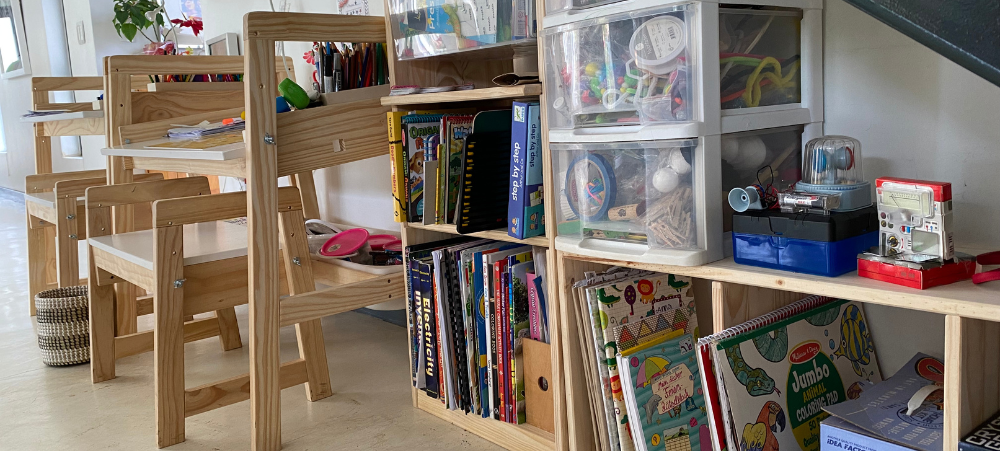
Online schooling is on the rise in South Africa, and more families are opting for the flexibility and other benefits of at-home learning.  However, it’s important for parents to be mindful of providing a child-friendly workspace that is conducive to learning.  A safe, comfortable and well-organised environment is essential for your child to thrive at their online school.

When lockdowns in 2020 shut schools down, architect, Henriette Frohlich opted for online school for her son, and saw how fellow parents were struggling to set up suitable workspaces for their children at home.  She realised that there was a great need for affordable child-friendly workspace furniture that was locally made.  Alongside her husband Markus, an engineer, they started work on designing and producing smart and adjustable furniture and launched HF Design.  Henriette says, “Most parents embrace the need to invest in a good curriculum, but few pay attention to their child’s learning environment.  We encourage parents to create workspaces for their children that are accessible. That way your child can control his/her own learning experience and journey, without having to be directed/guided by parents. Also think about improving lighting, reducing noise and ensuring your child is sitting comfortable on workspace furniture that is made for his/her bodysize. That way your child will be set up for a lifetime of learning.”

Henriette and Markus will be joining Koa Academy Principal, Mark Anderson as well as Occupational Therapist, Nasreen Cariem for a free parent’s webinar ‘Setting Up for Home Learning Success’ on Tuesday, 14 June from 7:30pm to 8:30pm.  Nasreen says that parents of at-home learners need to be on the lookout for the tell-tale signs that the child’s workspace is not working well for them.  “Be aware if your child is regularly distracted and inattentive, or not completing tasks,” she says.  “It’s also important to hear them if they are complaining about their learning set-up.  It can be easy to assume that children may be acting out or presenting excuses, when in fact their struggles with their learning environment are real and need to be addressed so that they enjoy being in their workspace.”

Mark highlights a fundamental for at-home learners – “Emotional safety is key,” he says. “This is the parent’s number one job for a child learning at home and will be the greatest indicator of the child’s academic success. We all learn best when we feel secure and in control. When you are setting up your child’s learning space, consult them! They need to be personally invested in their own workspace. Set your child up in a space that is calm, clean and has good lighting. It doesn’t have to be dead quiet, but it does need to be controlled.  Give them a dedicated space for their learning where they can store everything they need, such as their computer and stationery. It doesn’t have to be big, but it does need to be theirs. This is particularly important for younger learners who are still mastering the practicalities of executive functions like following a schedule and meeting deadlines.”

Henriette highlights 3 basics for an at-home learner’s workspace:

The most important thing is lighting – “If your child is struggling to absorb the content, they will lose interest quickly. Bad lighting may also contribute towards poor eyesight later in life. Many parents place their child’s desk near the window, which can lead to blinding natural light or overheating of the work area. Best is to position your child’s desk perpendicular to the window, allowing natural light to fall on the desk. Natural light is the best, followed by indirect light.

The second most important thing is comfort – “Your child must sit comfortably at their desk. The desk and bench or chair should be set at the right height, so as to strengthen core muscles and prevent slouching and discomfort. If a child is not sitting comfortably, they won’t sit for long.”

The third most important thing is noise management – Is your child’s workspace in an area that is shielded from disruptive noises? You can use room dividers such as plants, bookshelves, screens or curtains to create a private space for your child and make quality headphones available for online sessions if they are sharing space with other members of the family. Ensure that your child can control the noise in their area, so that they can focus and concentrate when necessary.”

There is no one size-fits-all when it comes to creating an optimal at-home learner workspace, and solutions are going to differ from home to home, and learner to learner.

Nasreen agrees with Henriette’s top priorities.  She says, “For both older and younger learners, a well-organised space with adequate lighting is of utmost importance. An environment which is relatively free of distractions helps to enable concentration, and a comfortable chair and desk with the right ergonomics will allow for prolonged sitting as well as writing comfortably.  The child’s work area doesn’t have to be expansive but there should be adequate space for school materials, stationery and online devices.  In making set-up choices, parents need to consider their children’s particular needs and learning styles.  Some siblings work well sharing the at-home learning space, others may be territorial and do better on their own.  For some children, having the family around in the background promotes accountability and ensures they don’t feel lonely, while other focus better if they are on their own.  Obviously, the family’s resources in terms of space available, furnishings and storage systems also need to be taken into consideration.”

Parents of at-home learners have a host of questions when it comes to setting up and organising a workspace for their child.  Should siblings share an at-home learning space?  Is it okay for my child to do their schoolwork on their bed?  Is an entry-level laptop adequate for online school?  What are the best storage hacks for school materials?  I’m working from home, should my children share my workspace so that I can keep an eye on them?

Mark, Henriette, Markus and Nasreen will be unpacking the answers at the ‘Setting Up For Home Learning Success’ webinar for parents on Tuesday, 14 June from 7:30pm to 8:30pm.  Join the conversation which includes a Q&A session with the experts.  Register here

Koa Academy

Leave a Comment

Your email address will not be published. Required fields are marked *

Homeschooling in SA: Keeping learning steady amid school placement delays

South Africa’s school placement scramble is influencing the choices families make about how their children learn. For many, the uncertainty runs deep into the first term – particularly in the early grades where classroom capacity is stretched and late placements can disrupt the steady routines young children need. As provincial education departments work to place learners, parents are left balancing practical realities with what matters most: keeping their children learning, settled, and confident.

For some families, homeschooling is no longer a “last resort”. It has become a deliberate, parent-led option that offers continuity when mainstream placement is delayed, or when a child needs a calmer, more supported start to their school journey. 

As South Africa’s largest homeschooling provider, Impaq supports parents with structured lesson plans, the Optimi Learning Portal (OLP), and a full ecosystem of resources designed to guide learning at home – without parents having to “figure it out” alone.

“Parents are doing their best in an uncertain placement environment, and what children need in the early years is stability, encouragement and consistent learning routines,” says Louise Schoonwinkel, Managing Director at Optimi Schooling, of which Impaq is a registered trademark. “The Foundation Phase is where children build their relationship with learning. When that is nurtured in a supportive environment, it can have a lasting impact on confidence and readiness for the years ahead.”

The early grades, from Grades R to 3, are widely recognised as the building blocks for literacy, numeracy, and emotional development. These are also the years when confidence can be shaped quickly. A learning environment that feels rushed or inconsistent may affect how a child sees themselves as a learner. 

Homeschooling, when structured properly and supported with quality materials, can create space for children to learn at their own pace, ask questions freely, and strengthen the basics without the pressure of feeling “left behind.”

Impaq’s lesson plans help parents follow a clear weekly rhythm, ensuring children cover what they need to while maintaining a steady routine at home. The Optimi Learning portal (OLP) provides guided learning resources and tools that support understanding and practice. For many parents, especially those juggling work and household responsibilities, the value is not just the content, but knowing what to do next: what to teach, when to teach it, and how to track progress.

“Homeschooling doesn’t mean parents must become teachers overnight,” Schoonwinkel explains. “It means families need a trusted partner that provides a curriculum-aligned plan, resources that make learning practical, and support that helps parents stay consistent, because that is what builds confidence in young children.”

That confidence shows up in everyday moments: a child reading aloud without fear of making mistakes, completing a task independently, or trying again when something feels difficult. In the Foundation Phase, those “small wins” matter. They shape resilience, curiosity, and willingness to participate – traits that carry into later learning, whether a learner continues homeschooling long-term or transitions back into a classroom setting once placements stabilise.

Families considering homeschooling should ensure they choose a credible provider and understand the legal and administrative requirements for home education in South Africa. Parents should also be realistic about what they can commit to daily, and select a programme that offers guidance, structure, and accessible support. For younger learners, homeschooling works best when learning is consistent and age-appropriate – incorporating play-based activities, movement, reading practice, and short, focused lessons rather than long periods of screen time or a rigid “classroom at home” routine.

As placement challenges continue to affect parts of the country, the conversation is shifting from “What do we do now?” to “What learning environment will help my child thrive?” 

“Placement delays are a reality in many communities, but a child’s learning and confidence don’t have to be put on pause,” Schoonwinkel says. “The Foundation Phase is where children learn to trust themselves as learners – and with the right structure, support, and consistency at home, parents can protect that momentum and give their child a strong, steady start, regardless of what’s happening in the wider system.”

Koa Academy
The power of play-based learning for homeschoolers

Building elaborate forts out of blankets or transforming cardboard boxes into spaceships is not just child’s play; it’s play-based learning in action. Between the giggles and make-believe, your child is developing their critical thinking and problem-solving skills. Play-based learning can be transformative, especially for homeschooling learners. 

Beyond fun and games: The science of play 

Children are naturally curious and imaginative beings. Play-based learning taps into these innate qualities, making education an exciting adventure. But play-based learning is not just a welcome break from textbooks – it’s essential for development. Playing with your learner has many benefits, including:

  • Boosted creativity and imagination: Open-ended play allows children to experiment, take risks, and build new worlds – the foundation of innovative thinking.
  • Sharpened critical thinking and problem-solving: From navigating pretend traffic jams to figuring out how to build the tallest tower, play presents endless challenges that develop mental agility and resourcefulness.
  • Fostering social and emotional intelligence: Through collaborative play, children learn to communicate, negotiate, and empathise, building their capacity for healthy relationships.
  • Boosted confidence and self-esteem: Mastering challenges in a playful environment fosters a sense of competence and a love for learning that fuels perseverance and achievement.

Here’s how to integrate this learning tool with plenty of playful possibilities from Optimi Plus.

Create a playful environment

Set the stage for creativity by establishing a dedicated play space. A conducive environment is vital – dedicate a corner in your house or a specific time to play during the day.

Prepare the space by including role-playing toys and activities. Whether it’s pretending to be astronauts exploring space or chefs in a bustling kitchen, imaginative play will help your little one think outside the box.

Embrace open-ended toys

Blocks, paints, playdough, and natural materials like leaves and sticks encourage open-ended exploration and imaginative storytelling. These activities stimulate cognitive development and enhance problem-solving skills. 

Encourage your child to express themselves freely through drawings, stories, and even doodles – you’ll be amazed at the creativity that unfolds. If you still need stationery for the year, unleash your child’s creativity and develop their gross and fine motor skills with the Stationery Packs available on Optimi Plus.  

Craft your own adventures 

One of the key elements in play-based learning is the emphasis on early literacy. And what better way to foster a love for reading than with the Foundation Phase Readers from Optimi Plus? These captivating stories, brimming with colourful illustrations and imaginative characters, not only improve reading skills but also open the door to a world of imagination. 

Encourage your child to craft their own adventures, re-interpreting storylines or creating new ones. Let them act out scenes, invent dialogue, and build worlds beyond the printed page.

Integrate technology mindfully

Leverage the power of technology and include educational games and interactive learning experiences. Apps such as Cami can provide a fun and engaging way to reinforce concepts learned in more traditional lessons. Nurture a genuine passion for reading with Cami Literacy or foster a mathematical mindset and problem-solving abilities with Cami Maths.

You can even take your child on a virtual safari through the African bush! Safari Academy 101 is a new and exciting e-learning course that empowers learners with first-hand knowledge of wildlife and nature. Encourage your child to create nature journals, write stories about their favourite animals, or even design their own conservation projects inspired by their virtual adventures.

Explore hands-on STEM

STEM is an acronym that stands for science, technology, engineering, and mathematics. These subjects often intimidate young learners, but infusing play can help your child develop a positive attitude towards these subjects from the start. The Foundation Phase Maths Kit includes hands-on activities to help your little one explore concepts like addition, subtraction, and shapes in a hands-on, interactive way. The kit is ideal for fostering mathematical fluency, reasoning, and problem-solving skills in young learners.  

Older learners can also explore STEM concepts through play with Resolute Robotics. The hands-on robotics kit allows learners to build, program, and play with their very own robots. Through experimentation and discovery, your child can develop the following skills:

  • problem-solving, 
  • critical thinking skills, and 
  • creativity.

The Optimi Plus advantage

At Optimi Plus, we understand the importance of play-based learning in nurturing young minds. From captivating storybooks to interactive learning platforms, we have everything you need to make learning child’s play. Visit www.optimiplus.co.za to unlock the endless possibilities of play-based learning!


Sources:

https://www.britishcouncil.org/programmes/creative-play/creativity-pretend-play 

https://www.nidirect.gov.uk/articles/how-play-helps-childrens-development

Koa Academy
How Impaq helps you work through the CAPS curriculum

Whether you are a homeschooling veteran or a nervous newcomer, looking at all the content you need to cover can be overwhelming. Luckily, Impaq makes working through the CAPS curriculum easy! All you have to do is pick a grade, complete your registration, and you’ll be provided with everything you need to complete the year at home (and have some fun along the way). Here’s how we help you make learning at home a breeze.

Read more here: From CAPS to Cambridge and everything in between

Planning for the year ahead


Dale Carnegie knew a thing or two about planning for success as he famously said: “An hour of planning can save you 10 hours of doing”. And by now, you might be wondering how many hours you need to spend planning for the year ahead to save time down the road. The answer? Almost none.

With Impaq Homeschooling, the planning is already done for you. We provide carefully crafted lesson plans that tell you exactly how much time you need to spend on each subject, and how to integrate the lesson plans with the learner material. The curriculum is broken down into bite-sized bits to help you and your child know exactly what to focus on during each term. Lesson plans, along with weekly calendars and additional resources are available on the Optimi Learning Portal (OLP).

CAPS made easy

As a homeschool parent, the CAPS curriculum can seem content-heavy, and you might be wondering what to focus on. As of 2024, Impaq will be providing our learners with a framework of what to concentrate on for each subject. We have organised the content to make it easier for homeschool parents to work through the curriculum challenges and ensure that their child masters the basic concepts. All these resources can be found on OLP.

All the support you need


As a homeschooling parent, you will receive your very own facilitator’s guides to help you teach your child at home. These detailed guides accompany the lesson material your child receives and give you step-by-step guidance to set your child up for success. Prepping for tests and examinations is also made easy as you can find suggested timetables for Grades 4 to 9 on OLP. You can then decide whether to stick to these timetables or to create your own. Grade 10 to 12 learners write tests and exams according to a strict timetable

If you find yourself needing some additional support, especially in certain subject areas such as Mathematics and Physical Sciences, you can reach out to our team of education specialists. They are always happy to assist and support parents with any academic queries. You can also find the answers to most of your homeschooling questions on our client helpdesk.

Enjoy online resources

The Optimi Learning Portal (OLP) serves as our learning hub and contains a treasure trove of digital resources. Along with the lesson material your child receives, they can find additional resources per subject on OLP, including educational videos, quizzes, previous examination papers, helpful notes and much more.

Learners can also easily access both live and pre-recorded subject guidance sessions on OLP. These sessions focus on providing guidance on how to complete specific assessments, revision for more difficult concepts, as well as enrichment lessons.

Track your child’s progress


Tracking your child’s progress is as easy as logging in to OLP. With the click of a button, you will be able to see which lessons your child has completed (marked in green) and which lessons they still need to complete (marked in red). You will also be able to capture the marks for their tasks, tests, and examinations (depending on their grade) and generate report cards.

The advantage of keeping track of your child’s progress is that you can easily see which subjects or topics they need a bit more help with. This individualised attention ensures that your child fully grasps the concepts before moving on to more advanced topics.

A fun adventure

Now that the planning is done, the content is sorted, and you have access to additional support, you can spend your time on making learning fun. With everything laid out for you, you’ll have more time to focus on your child and plan exciting excursions and activities.

If you find you have some extra time or your child is especially interested in a certain subject or topic, why not incorporate it into your daily lessons? Learn a new language like isiZulu, take up a new hobby such as robotics, learn how to develop successful study habits or take your learner on a virtual adventure through the African bush.


Also read: Say yebo to isiZulu! The benefits of multilingualism

Register today

With Impaq as your guide, homeschooling has never been easier. Ready to get started? Register online or send an email to [email protected] 

Koa Academy
Scroll to Top