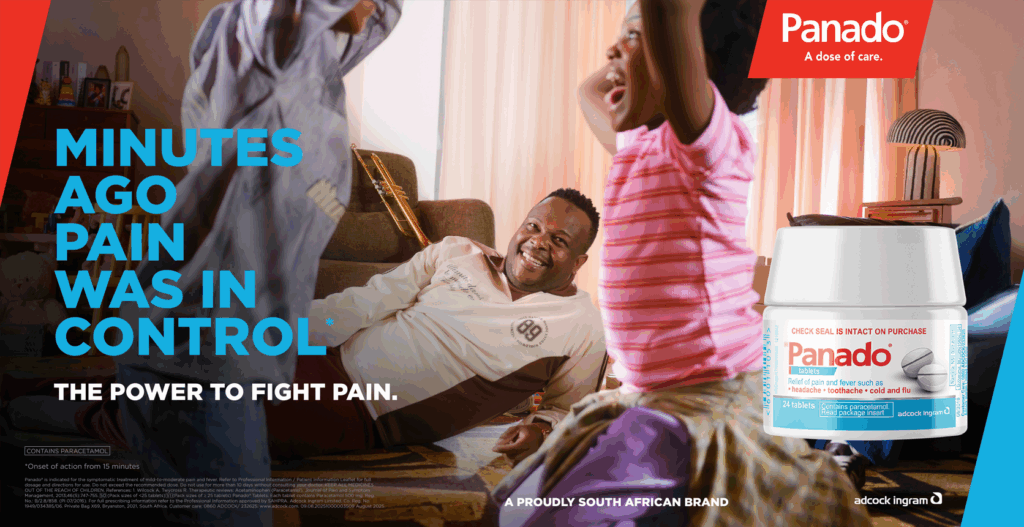
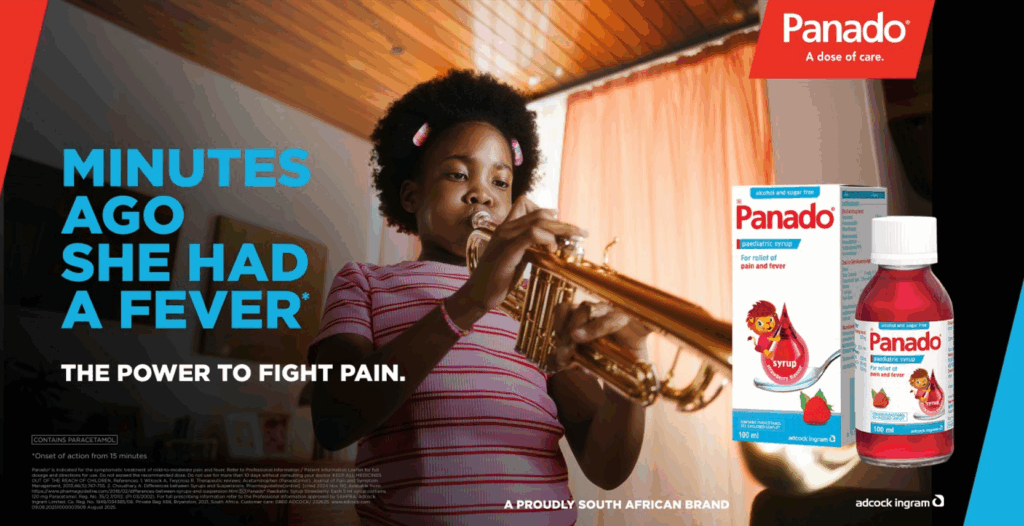
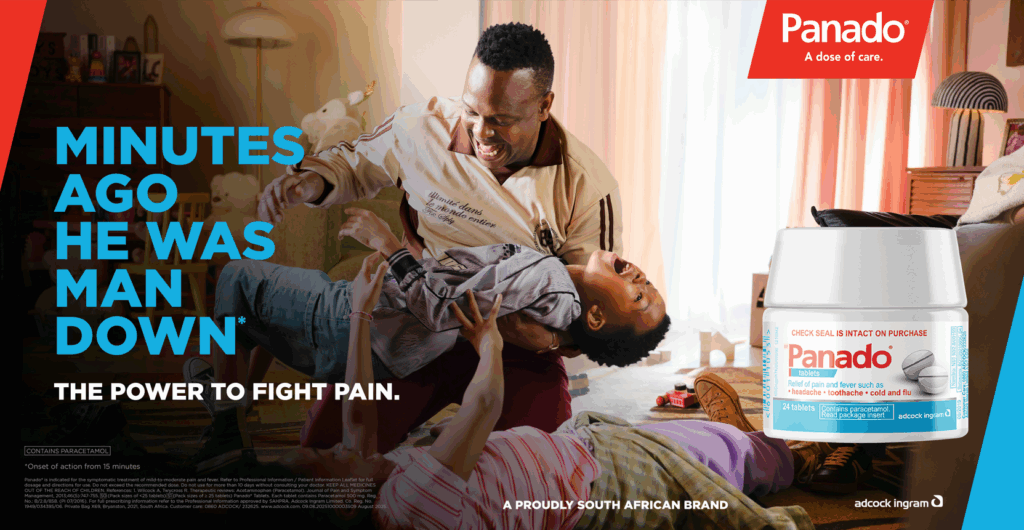
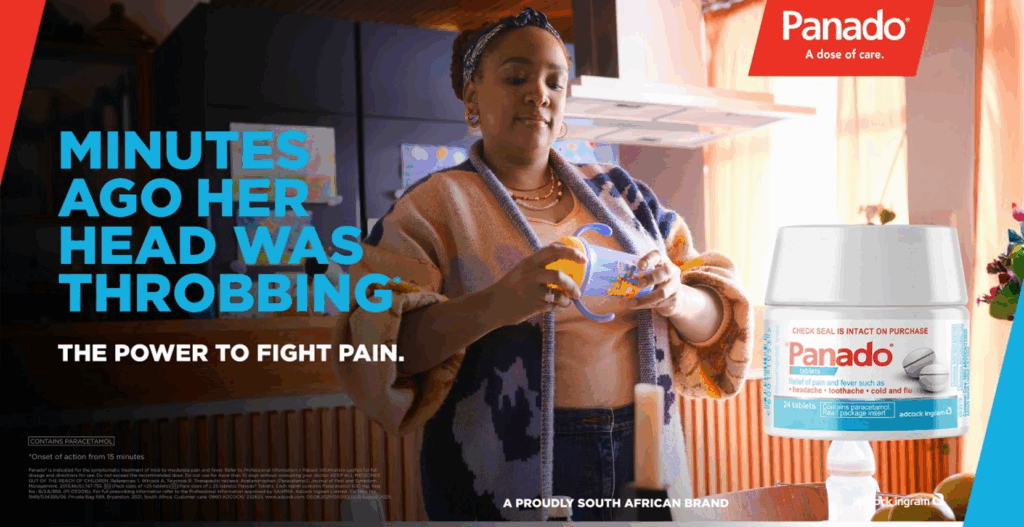
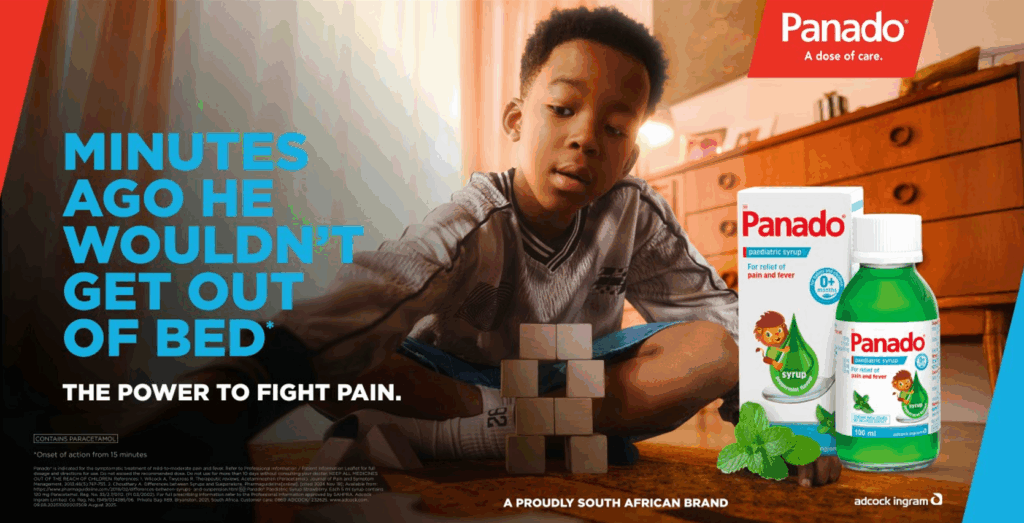
The Panado® Master Brand Campaign is modern, relevant and proudly South African. Anchored by the lines “The Power to Fight Pain”, it moves beyond the usual pain-and-recovery formula and underscores the pivotal “Minutes Ago…” moments, showing how quickly life can turn around once the pain subsides. The campaign focuses on ordinary, everyday experiences because pain isn’t abstract – it’s lived. By showing how quickly relief can change the course of a day, it feels authentic and relatable.
“When shaping the campaign creative, we asked ourselves how pain impacts our lives – and what life looks like once it’s gone. Pain may be personal, yet its impact is shared by families and communities,” says Taryn Correia, Adcock Ingram, Brand Manager Analgesics.
“The campaign brings to life Panado®’s power to fight pain. It works fast, helping the people of Mzansi move from pain back to laughing, being present, and living fully again. Panado® is not just about relief – it’s about a dose of care. It’s a trusted companion in the hands who hold families, build communities, and carry the everyday load.”
The campaign will run across multiple platforms, but television is at the heart of it. TV was chosen as it shows emotion and everyday life, letting people see themselves in the story, feel the move from pain to relief, and connect with Panado®.
An example of the TV execution shows a Mzansi dad on the couch, weighed down on the couch by a pounding headache. Just minutes2 after taking Panado®, his shoulders ease, his expression softens, and before long he’s on the floor, laughing and play-wrestling with his two kids. A moment ago, he was fighting pain; now he’s fighting to be the loudest in the room. The message is simple – Panado® has the power to fight pain when you need it .2
Catch the new TVC by scanning the QR code.
Catch the new TVC by scanning the QR code.
Pain may be part of life, but suffering doesn’t have to be and with Panado®, neither does sitting out on the moments that make it worth living.
As a proudly South African staple, Panado® has been trusted1 for generations and has a place in homes across the country. Its formulation of paracetamol is backed by more than 150 years of clinical experience3.
Panado® offers a range of products suitable for the whole family. Panado® Tablets4 provide fast pain and fever relief,4 Panado® Capsules5 are easy to swallow,6 while Panado® Effervescent Tablets7 dissolve in water, are ready to work immediately8 and were voted Product of the Year in the Adult Pain Relief category.9 For children, the Panado® paediatric syrups, available in Strawberry,10 and Peppermint11 with an improved taste,12 are ready to work immediately13. For babies, Panado® Infant Drops14 with a precision dropper ensure accurate dosing and have been recognised as Product of the Year in the Child Health category.15
Panado® products are available from Baby City, Pick n Pay, Checkers including Hypers, Shoprite, Clicks, Dis-Chem and independent pharmacies. For more information, visit: https://panado.co.za/and join the conversations on Facebook. For references and legal disclaimers, visit https://panado.co.za/references.
Parenting Hub is one of South Africa’s largest online lifestyle magazines, targeted toward Parents.
We understand that there are many aspects that encompass a Mother, Father or Child and strive toward providing resources and services that accommodates this.
Our content is aimed to inform and educate families on issues starting from pregnancy through to the challenges of the teen-age years.
Dr Jean de Villiers, a radiologist and director of SCP Radiology, answers some of the most frequently asked questions, specifically around the process from referral to reporting in radiology imaging.
The usual process when it comes to going to a radiology practice for imaging is that a medical professional (a doctor or clinician) will refer you for imaging. Radiographers take the images and then radiologists, doctors who have specialised in radiology, analyse and interpret the images and provide a detailed report.
The report is highly technical, which is why it is sent to your medical practitioner for explanation.
Why do I need a referral for imaging?
There are several reasons for this referral system, one of which is your safety: To ensure you are not being exposed to more imaging than is necessary. The other is so that your referring doctor – who is trained to know when and what imaging is essential or required – will receive the results, explain them to you and plan appropriate medical care.
The only exception is for a mammogram or bone density scan (DEXA scan).
Will the radiographer give me my results after the imaging?
A radiographer is a trained healthcare professional who operates the equipment that produces these images. They are responsible for taking the images but not interpreting them.
Who interprets the images and writes the report?
A radiologist is a medical doctor who has specialised in interpreting medical images such as X-rays, CT scans, MRIs and ultrasounds to diagnose and treat diseases. Reports cannot be generated immediately, it takes the radiologist time to study the images and often includes comparing previous images. This means they will not be able provide a report instantly and, any such report will need to be interpreted with full knowledge of your medical history and clinical findings.
So, I won’t receive the results from the radiologist?
No. The radiologist analyses your images and then prepares a detailed report, which is sent to your doctor. The protocols and systems around the reporting means that your doctor will discuss and explain the findings with you and then recommend treatment and co-ordinate follow up care.
In the case of a mammogram, the radiographer may sometimes let you know if the mammogram is clear or suggest an ultrasound for confirmation. However, the mammogram images are still sent to a radiologist who will prepare a report and may suggest further screening, if necessary.
How long does it take to get the results?
This depends on the type of imaging (scan) and the urgency of the case; generally, the results are available within 24 hours. Urgent cases are prioritised. Your doctor will contact you once the results have been received and reviewed. This may mean a follow-up appointment, or it can be discussed over the phone.
What does the radiologist’s report reveal?
The actual radiology report provides information about the type of imaging test that was done, how it was done, it includes the brief medical history and any information provided by the referring doctor. The report outlines what structures and processes are normal and any abnormalities in the images.
A radiologist does not diagnose but they can identify abnormalities or suspicious features in images that might indicate the presence of a tumour. They cannot definitively diagnose cancer from images alone, only a biopsy or tissue sampling can do that definitively.
They will use words and phrases in their report, such as:
‘Most likely’, which means a very high probability
‘Likely’, which means high probability
‘May’ means an intermediate probability
‘No visible sign of’ means it cannot be seen on the image
The radiologist may also suggest further investigations or additional images.
Am I allowed to view my results or get a copy of the X-rays?
Absolutely. Some radiology practices have a patient portal that allows you access to your images and results. It is routine for these results and images to be released once your referring doctor has had a chance to view them.(Remember it can take a few days).
Alternatively, you are able to request a copy of the imaging and reports from the radiology practice or your doctor.
Dr Villiers says, ‘if there are additional questions you want to ask don’t hesitate to ask at the radiology practice where you are having the imaging done.’
Parenting Hub is one of South Africa’s largest online lifestyle magazines, targeted toward Parents.
We understand that there are many aspects that encompass a Mother, Father or Child and strive toward providing resources and services that accommodates this.
Our content is aimed to inform and educate families on issues starting from pregnancy through to the challenges of the teen-age years.
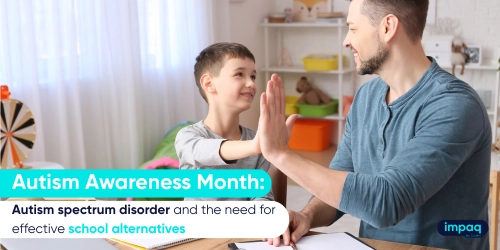
Autism spectrum disorder. It’s a complex topic, to say the least, and one that presents countless challenges to the parents, caregivers and teachers of affected children.
While designated days like World Autism Awareness Day in April is an important part of creating awareness about autism, the challenges remain plentiful.
Not least among the challenges is finding a suitable school for the child on the spectrum. The reality for many hundreds of children on the spectrum is that they simply have to cope in a mainstream environment, due to the lack of options.
One alternative in this regard is home and online learning as it provides structured, curriculum-aligned education that can simply and effectively be tailored to meet the individual needs of the learner in question.
Education today is about putting the needs of the learner first, which starts with the acknowledgement that the days of a one-size-fits-all approach are both outdated and simply no longer necessary. Alternative options, like homeschooling, bear exploring if we are serious about ensuring our children get a relevant education, while taking the needs of the learner and his/her family into consideration.
A common concern for parents considering homeschooling is whether their child will miss out on social experiences. The reality is that home and online schooled learners often have more flexibility to engage in activities outside of a school setting. Joining homeschooling groups, sports clubs, or online communities can help learners build strong social connections.
For families with children involved in sports, music, or other demanding activities, home and online schooling provides the flexibility to balance education with personal passions. It also allows for real-life learning experiences that bring lessons to life in ways that textbooks cannot.
Importantly, homeschooling does not mean children need to be formally educated by their parents. Parents, or caregivers, play a supporting role in homeschooling, and do not need to take on the role of teacher.
One of the biggest challenges in traditional schooling is that every child is expected to learn at the same speed. Some children grasp concepts quickly and feel unchallenged, while others need more time and may fall behind. Homeschooling removes these pressures, allowing learners to master subjects at their own pace. This creates a deeper understanding of the material and fosters a love for learning, rather than just studying to pass exams.
Unlike in a traditional school where subject choices can be limited by resources, home and online schooling offers learners more flexibility to explore their interests. Whether it’s advanced mathematics, coding, creative arts, or entrepreneurship, learners have the freedom to shape their education in a way that aligns with their future aspirations. This personalised approach makes learning more meaningful and engaging.
Ultimately, parents know what’s best for their child. If homeschooling aligns with your family’s needs, trust your decision and embrace the flexibility, quality, and opportunity it offers.
By Louise Schoonwinkel, MD at Optimi Schooling of which Impaq is a registered trademark
Parenting Hub is one of South Africa’s largest online lifestyle magazines, targeted toward Parents.
We understand that there are many aspects that encompass a Mother, Father or Child and strive toward providing resources and services that accommodates this.
Our content is aimed to inform and educate families on issues starting from pregnancy through to the challenges of the teen-age years.
From tracking steps and calories to getting the gains at the gym and taking care of mental and emotional wellness, South Africans have never been more health conscious. At the same time, there is a growing disconnect in how we perceive the systems that protect that health.
As we step further into 2026, it’s important to debunk the myths around medical aid that often cloud our judgement when it comes to looking after our own health and that of our families. Cover without interruption should be high up on our list of resolutions this year, and to achieve this, it’s important that South Africans get the facts straight.
Myth 1: Medical aid is a luxury
The most pervasive myth is that medical aid is a luxury. The data, in fact, suggests otherwise. According to the Council for Medical Schemes (CMS) 2024 Industry Report, hospital expenditure remains the dominant cost driver in South Africa, accounting for nearly 36% of total benefits paid.
‘Medical aid acts as a bridge to immediate, specialised intervention,’ says Lee Callakoppen, Principal Officer of Bonitas Medical Fund. ‘For a scheme like Bonitas, being a member is a guarantee of access to a network of private facilities when time is the most critical variable.’
Myth 2: Plan adjustments mean lower quality
There is a common fear that moving to a different plan within a scheme is a step backwards. In reality, the healthcare market is defined by customisation, allowing you to choose a plan that fits your specific lifestyle and healthcare needs without paying for bells and whistles you don’t use.
A dangerous trend has seen some people viewing gap cover or health insurance as a replacement for full medical aid membership. While these tools have their place, they are designed as supplements and not replacements.
Gap cover, for instance, is a vital tool for managing specialist shortfalls, but it relies on the foundation of a medical aid to function. Without that foundation, the protection is incomplete. Real security comes from a holistic ecosystem, with Prescribed Minimum Benefits (PMBs) ensuring that a pre-determined list of chronic conditions and emergency procedures are covered by law, regardless of the plan you choose.
Myth 4: Public-private hybrids are a universal quick fix
While the integration of public and private care is a key pillar of national health policy, the immediate reality for many in 2026 comes down to capacity. Public facilities are under significant strain, and while insurance products linked to public care provide a basic entry point, they often lack the elective agility that private medical aid provides.
In simple terms, this means that while you might be covered for a life-threatening emergency, you could face a very long wait for elective procedures like hip replacements, cataract surgery or specialised scans.
Securing private care through a scheme with a broad national footprint allows for proactive health management and the ability to treat a condition before it becomes a surgical emergency.
Myth 5: Medical schemes prioritise the young and healthy
South African medical schemes operate on a principle of social solidarity. This means that all contributions go into a collective pool of funds to be used by all members, as and when needed.
As per the Medical Scheme’s Act 131 of 1998, open schemes are legally required to accept all applicants. In fact, Bonitas’ 2026 strategy emphasises preventative care for all life stages, which includes a series of health screenings, vaccinations and wellness assessments. This ensures that the Scheme’s R9 billion in reserves is used to keep all members healthy for longer, regardless of age.
‘Ultimately, being a member of a medical aid is about having a partner that bridges the gap between health consciousness and health security. We must move beyond viewing healthcare as a grudge purchase to seeing it as a vital tool for long-term resilience,’ concludes Callakoppen.
Parenting Hub is one of South Africa’s largest online lifestyle magazines, targeted toward Parents.
We understand that there are many aspects that encompass a Mother, Father or Child and strive toward providing resources and services that accommodates this.
Our content is aimed to inform and educate families on issues starting from pregnancy through to the challenges of the teen-age years.
We use cookies on our website to give you the most relevant experience by remembering your preferences and repeat visits. By clicking “Accept All”, you consent to the use of ALL the cookies. However, you may visit "Cookie Settings" to provide a controlled consent.Accept All
Manage consent
Privacy Overview
This website uses cookies to improve your experience while you navigate through the website. Out of these, the cookies that are categorized as necessary are stored on your browser as they are essential for the working of basic functionalities of the website. We also use third-party cookies that help us analyze and understand how you use this website. These cookies will be stored in your browser only with your consent. You also have the option to opt-out of these cookies. But opting out of some of these cookies may affect your browsing experience.
Necessary cookies are absolutely essential for the website to function properly. These cookies ensure basic functionalities and security features of the website, anonymously.
Cookie
Duration
Description
cookielawinfo-checkbox-advertisement
1 year
The cookie is set by GDPR cookie consent to record the user consent for the cookies in the category "Advertisement".
cookielawinfo-checkbox-analytics
11 months
This cookie is set by GDPR Cookie Consent plugin. The cookie is used to store the user consent for the cookies in the category "Analytics".
cookielawinfo-checkbox-functional
11 months
The cookie is set by GDPR cookie consent to record the user consent for the cookies in the category "Functional".
cookielawinfo-checkbox-necessary
11 months
This cookie is set by GDPR Cookie Consent plugin. The cookies is used to store the user consent for the cookies in the category "Necessary".
cookielawinfo-checkbox-others
11 months
This cookie is set by GDPR Cookie Consent plugin. The cookie is used to store the user consent for the cookies in the category "Other.
cookielawinfo-checkbox-performance
11 months
This cookie is set by GDPR Cookie Consent plugin. The cookie is used to store the user consent for the cookies in the category "Performance".
viewed_cookie_policy
11 months
The cookie is set by the GDPR Cookie Consent plugin and is used to store whether or not user has consented to the use of cookies. It does not store any personal data.
Analytical cookies are used to understand how visitors interact with the website. These cookies help provide information on metrics the number of visitors, bounce rate, traffic source, etc.
Cookie
Duration
Description
_ga
2 years
This cookie is installed by Google Analytics. The cookie is used to calculate visitor, session, campaign data and keep track of site usage for the site's analytics report. The cookies store information anonymously and assign a randomly generated number to identify unique visitors.
_gid
1 day
This cookie is installed by Google Analytics. The cookie is used to store information of how visitors use a website and helps in creating an analytics report of how the website is doing. The data collected including the number visitors, the source where they have come from, and the pages visted in an anonymous form.
Other uncategorized cookies are those that are being analyzed and have not been classified into a category as yet.
Cookie
Duration
Description
_gat_gtag_UA_18530557_4
1 minute
No description
pron_ip
session
No description
pvc_visits[0]
1 day
This cookie is created by post-views-counter. This cookie is used to count the number of visits to a post. It also helps in preventing repeat views of a post by a visitor.
tk_ai
session
Gathers information for WordPress by themselves, first party analytics tool about how WP services are used. A collection of internal metrics for user activity, used to improve user experience.